The knee has a reputation for being simple. It bends. It straightens. When it hurts, people foam roll around it, stretch the quad, stretch the hamstring, and wonder why nothing improves. The reason is usually that nobody has addressed what the knee actually does beyond flexion and extension.
The tibia rotates. That’s not a minor technical detail. It’s a fundamental part of how the knee functions, and it’s also one of the first things to go when the knee gets injured and one of the last things to come back in rehab. Most training programs never touch it at all.
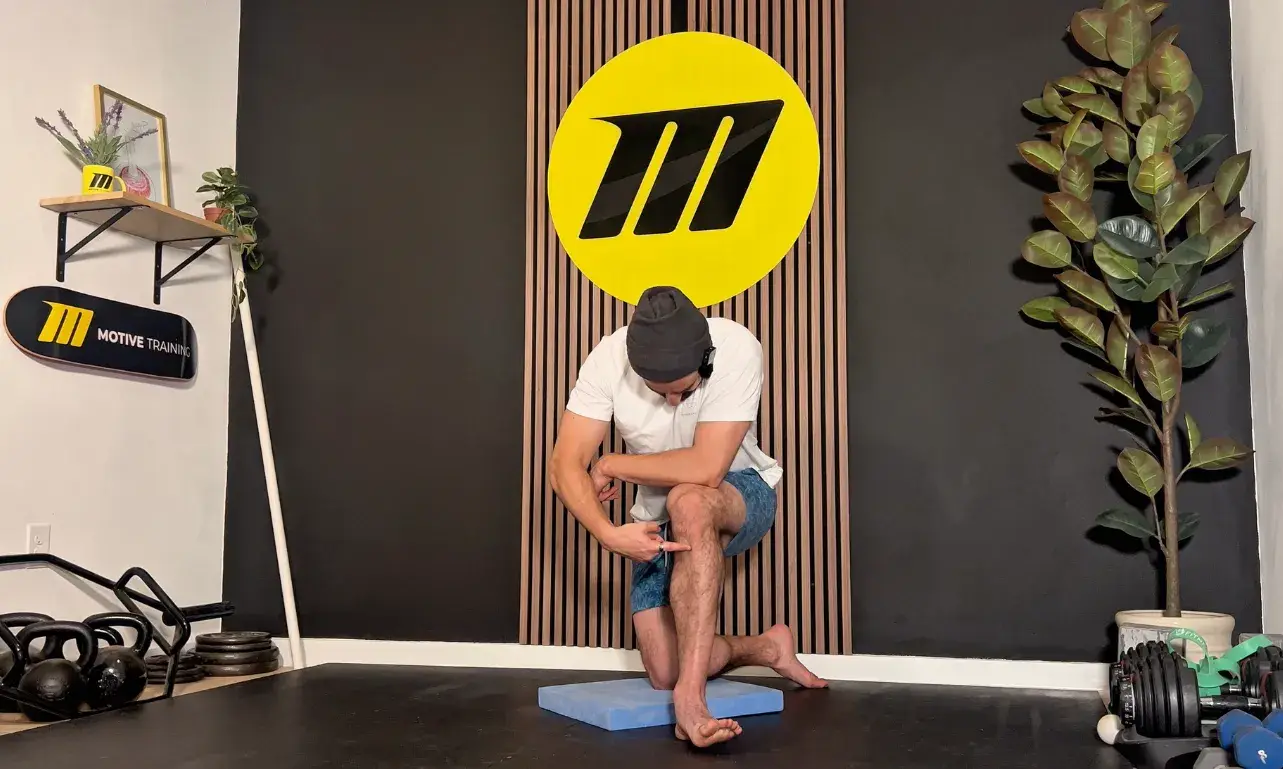
Inside KINSTRETCH Online, Andres built a class specifically around this. The focus is the anterior chain and knee health, and the through-line is tibial rotation: building the capacity and control to rotate the shin, then loading that capacity until it fatigues, then training the hip to support the whole system.
You can see some snippets from the class, here:
Why tibial rotation matters
The knee sits between two highly mobile joints. The hip above it can move in every plane. The ankle below it has significant dorsiflexion, plantarflexion, inversion, and eversion available. The knee itself is not just a hinge; it has a small but meaningful amount of axial rotation available, and that rotation becomes critically important when the joints above and below it are under load.
When you land from a jump, change direction, or take an awkward step on uneven ground, the tibia rotates relative to the femur. If there is no trained capacity for that rotation, no strength or control at those end ranges, the connective tissue in the knee absorbs the force instead. That is the mechanism behind a lot of non-contact knee injuries. Not bad luck. A lack of trained range.
The same logic applies to chronic knee pain that shows up without a specific injury. Restricted tibial rotation changes load distribution through the joint. Over time, the tissues that are absorbing the extra stress start to communicate that loudly.
How the class builds this
The sequence starts with axial rotation of the shin in a seated position: heel on the floor, ankle deliberately kept out of the movement, focus entirely on rotating the shin side to side with the hip trapped. This sounds simple. It is not, for most people. Getting the brain to isolate tibial rotation without the ankle compensating requires real concentration, and the fatigue that accumulates in sixty seconds of controlled rotation tells you something about how much neurological attention that tissue has been getting.
From there it moves into full knee CARs: the shin traces the available range of the joint through controlled rotation while lifting off the floor. The rule Andres holds throughout is that you never lock the knee at full extension, because you lose access to rotation there. The goal is to stay in the range where the joint can express what it actually has. If you want to understand the broader rationale for why CARs function the way they do, the controlled articular rotations guide covers it. The short version: you are training the nervous system to trust and access a range it otherwise treats as unfamiliar territory.
The knee PAILs and RAILs are where it gets specific. In half-kneeling, the shin gets loaded into external rotation, held there, and then progressively loaded isometrically. The cue is to pull the heel back and try to rotate the shin back toward neutral; the floor prevents the movement from happening, which means the force goes into the tissue rather than through it. Two rounds, because with end-range knee work the time and attention need to accumulate. One set is not enough to produce the kind of tissue communication that actually changes something. The PAILs and RAILs programming guide explains how this kind of work fits into a broader training week without turning into a separate project.
The hip piece
The class also works hip CARs in both standing and half-kneeling positions, and this is not a detour from knee training. It is directly related to it.
The hip governs a significant amount of the stress that arrives at the knee. A hip that cannot extend well forces the lumbar spine or the knee to compensate. A hip that lacks internal rotation during the swing phase of walking or running changes how the tibia tracks at contact. Building hip rotation capacity and control is not adjacent to knee health; it is part of the same system. The half-kneeling hip CAR variation in particular demands that the pelvis stay level throughout the movement, which changes how much honest range you actually have versus how much you were borrowing from a compensated position.
What loaded fatigue accomplishes
Late in the class, a heavy band gets added to the shin during seated knee CARs. Ninety seconds of rotating the shin under load, finding end range in both directions, fighting through the quad fatigue. Then a long-hold split squat isometric to load the entire anterior chain in a position that demands hip and knee stability simultaneously.
The reasoning behind this is worth understanding. When tissue gets injured and the brain routes around it, building compensatory patterns to protect the area, those patterns do not automatically reverse when the pain resolves. The tissue can be healed and still offline from a neurological standpoint. Long isometrics under load are one of the more reliable ways to re-recruit those lines of tissue, to get the nervous system to stop working around them and start working through them again.
This is why the class pushes into real fatigue rather than stopping when it gets uncomfortable. Not pain; fatigue. There is a meaningful difference, and Andres is consistent about it throughout. If it pinches, back out. If it burns and shakes and your body is telling you to quit, that is the point.
Who this class is for
Anyone who has had a knee injury and feels like something never quite came back online. Runners dealing with IT band or patellofemoral issues that stretching hasn’t resolved. People who have been told their knee pain is structural and have accepted that it’s just how things are now. Athletes in any rotational sport who have never specifically trained what happens to the knee when the foot is planted and the body rotates over it.
Also anyone who just wants to know what their knee actually does. Most people have never thought about tibial rotation until something goes wrong. Training it before something goes wrong is the less interesting story, but it is the more useful one.
The class lives inside KINSTRETCH Online. If you are dealing with knee issues and want a sense of where to start before jumping into the programming, a movement and mobility assessment will tell you what the knee is actually missing and what the hip and ankle are doing around it.
Written by

Brian Murray, FRA, FRSC
Founder of Motive Training
Motive Training is a coaching studio in South Austin built around assessment, joint health, and strength you can use. Train with us in the studio, come to a KINSTRETCH class, or work through the progressions in KINSTRETCH Online.