Mobility Training Is Popular. Lasting Relief Is Not.
Mobility training is everywhere.
Scroll social media and you will see routines promising to fix your hips, unlock your back, or eliminate neck pain in five minutes. In Austin, where people train hard and work long hours at desks, mobility has become part of the culture.
And yet, the same people are still stiff. Still irritated. Still cycling through the next drill.
Mobility training works. But only when it solves the right problem.
If it does not address the joint limitation actually driving your pain, it becomes another routine you outgrow.
Pain Is Usually a Capacity Problem
When someone comes into Motive Training dealing with recurring discomfort, the issue is rarely random.
Lower back irritation often tracks back to limited hip rotation. Chronic neck tension frequently reflects poor thoracic movement or shoulder control. Shoulder pain often reveals a lack of strength in specific joint positions.
Pain shows up where capacity is lowest.
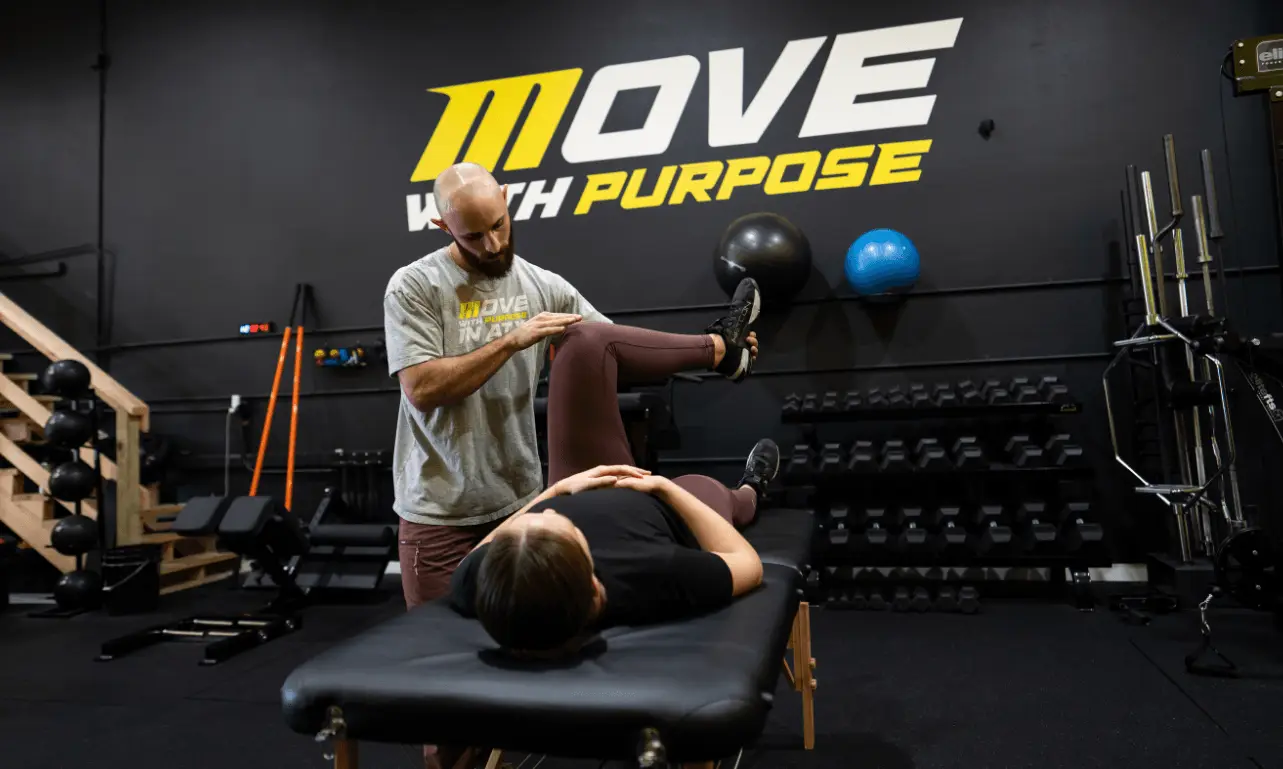
This is why we start with a Functional Range Assessment. Before prescribing mobility work, we evaluate how each joint moves, where passive range exists without control, and where true limitations live.
Without that clarity, mobility work is guessing.
With it, mobility becomes targeted.
Stretching Feels Good. It Rarely Builds Capacity.
There is nothing inherently wrong with stretching. It can temporarily reduce tension and create a sense of relief.
But stretching is usually passive.
Mobility training, at least the way we apply it, is active and progressive. It improves how a joint rotates, flexes, extends, and stabilizes under load. It builds strength in positions you currently cannot control.
That distinction matters.
Our system is rooted in Functional Range Conditioning, which focuses on expanding usable range of motion and strengthening it. When new motion is supported by strength, it tends to stay.
If you want to see how that looks in a structured setting, our overview of KINSTRETCH explains how controlled joint training develops long-term resilience without relying on passive stretching flows.
Mobility training works when it builds ownership, not just sensation.
Austin Has Predictable Patterns
Lifestyle matters.
Austin tech workers sit long hours. Cyclists and runners log repetitive miles. Lifters stack pressing volume. Add long summers and more indoor time, and certain movement patterns become dominant.
We regularly see stiff thoracic spines, limited hip internal rotation, shoulders that elevate without true scapular control.
Mobility training in Austin has to reflect those patterns. It has to account for what people are actually doing every day.
If someone presents with persistent upper back or neck discomfort, we rarely isolate the neck. We look at shoulder blade mechanics, ribcage positioning, and thoracic rotation. Improvements there often reduce strain upstream. Our article on Scapula Exercises You Need for Healthier Shoulders breaks down why that connection matters.
Real mobility training solves real pain by addressing the chain, not just the symptom.
Athletes Need Integration, Not Isolation
For active adults and athletes, mobility training is often treated as an accessory. Something separate from strength work.
That separation limits its effectiveness.
When mobility work is integrated into strength programming, the results compound. Improved hip rotation changes how you squat and sprint. Better thoracic control influences pressing and rotational power.
We outline that integration in Mobility Training South Austin: Enhancing Your Movement Potential. The goal is not flexibility for its own sake. It is usable motion that carries into performance.
Mobility training works when it connects to the bigger plan.
The Standard Should Be Higher
Mobility training should be specific. Progressive. Measurable.
It should start with evaluation. It should target the weakest links. It should integrate into your broader strength plan.
If you are searching for mobility training in Austin because something keeps flaring up, start with clarity. Understand how your joints actually move. Identify where capacity is missing. Build from there.
You can learn more about our one-on-one coaching approach through the South Austin Personal Trainer page or begin directly here: Schedule With Us.
Mobility is infrastructure.
It works—but only when it solves the real problem.
Written by

Brian Murray, FRA, FRSC
Founder of Motive Training
Motive Training is a coaching studio in South Austin built around assessment, joint health, and strength you can use. Train with us in the studio, come to a KINSTRETCH class, or work through the progressions in KINSTRETCH Online.