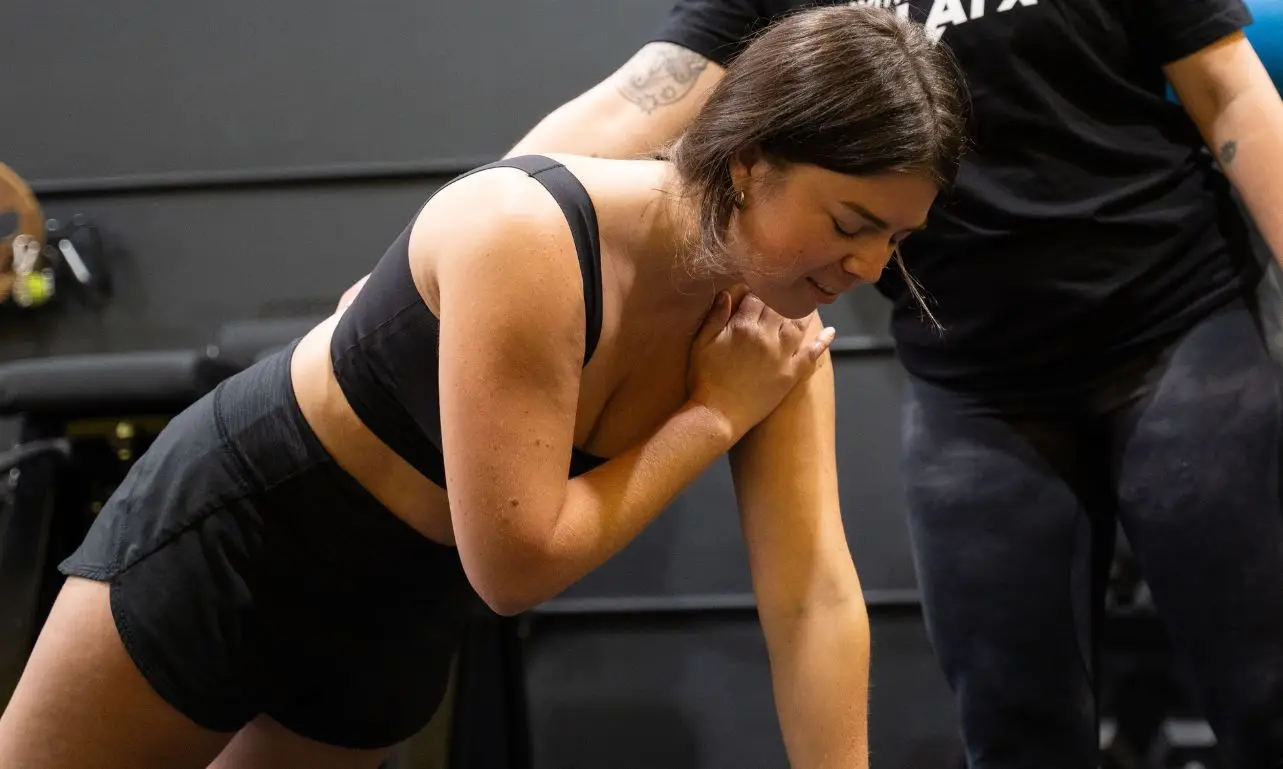
Proprioception is the body’s sense of where its parts are and how they are moving, without looking. It’s how you can touch your nose with your eyes closed or find the bottom stair in the dark. Most of the signal comes from muscle spindles, which report changes in muscle length and how fast those changes happen (1). Tendon organs add information about tension, and receptors in the joint capsule, ligaments and skin fill in the rest. The brain fuses all of it into a running estimate of body position, a map it keeps updating as you move.
That’s the textbook definition. The part that matters for training is that the map isn’t equally detailed everywhere. Some parts of a joint’s range generate more sensory signal than others, and the part that generates the most is a part most adults rarely visit.
What proprioception exercises usually train
Search the term and the results are mostly balance work: wobble boards, single-leg stands on foam, eyes-closed standing, the occasional BOSU circuit. Standing on an unstable surface forces the ankle and hip to make constant small corrections, and people do get better at it, though the improvement turns out to be narrow.
A meta-analysis on balance training in healthy people pulled together studies that tested both the trained balance task and other balance tasks nobody had practiced (2). Improvement on the trained task was large. On the untrained tasks the effect was close to zero, including tasks performed in similar body positions. The pool was small, six studies and about a hundred people, and the authors said as much. Still, the direction is hard to ignore. Get good at a wobble board and what you have mostly built is wobble board skill.
Balance work also lives in a small corner of the body. Most of the corrective effort happens at the ankle and foot, near the middle of their ranges, in one stance. The foot is a legitimate input source, and giving it more to feel is the argument behind training barefoot. A balance board says almost nothing to a shoulder, though, or to a hip at the far end of internal rotation.
Joints report the most near their edges
When researchers recorded directly from single nerve fibers supplying the finger joints of conscious subjects, most of the joint receptors they found responded only toward the limits of joint rotation (3). A minority fired throughout the range. Many of the skin receptors behaved the same way, staying quiet through the middle of a movement and joining in near the end.
That study was in the hand, with eighteen joint fibers in the sample, and I’d be careful about mapping it neatly onto a hip. Muscle spindles carry much of the position sense through the middle of a range, and the same authors concluded that joint receptors on their own are poor at signalling position. Still, the pattern fits how the tissue is built. The capsule and ligaments come under tension near end range, and since tension is what their receptors respond to, the edges of a joint’s range are where an extra set of sensors comes online.
Now picture an adult who sits most of the day and trains in mid-range, so a hip or a shoulder almost never gets near its limits. Those receptors rarely get a reason to fire. The brain’s estimate of what happens out there is built on scant recent input, and it shows the moment someone is asked to move into that territory.
In assessment, the most common version is substitution the person can’t feel. Ask someone to rotate a hip as far as it will go with the pelvis still, and the pelvis moves, and the person reports that it stayed put. The joint ran out of range it could produce and borrowed motion from next door, and the map at that edge was too vague to register the swap.
Why hypermobile people make a useful contrast
People with more range than usual seem like they should have the opposite problem. A systematic review comparing people with and without benign joint hypermobility syndrome found poorer lower limb joint position sense and slower detection of movement in the hypermobile groups (4). Reaching the edge of a range easily doesn’t mean the body knows where it is once it gets there, so range and the sense of it have to be trained together. We cover that population in more depth in our piece on hypermobility and mobility training.
Proprioception training across a whole joint
If position sense depends on input, and the richest input from a joint arrives near its edges, then proprioception exercises need to take each joint to its edges slowly, with the person paying attention. That’s a fair description of controlled articular rotations.
A CAR is a slow rotation of one joint through the largest circle it can produce under its own muscle power, with the rest of the body held still. The stillness is the proprioceptive part. Keeping the pelvis quiet while the hip circles forces the person to feel where the hip ends and the pelvis begins, which is the boundary the map tends to blur. Tension through the rest of the body (irradiation, in FRC terms) gives the nervous system a stable reference to move against. Done daily, CARs work as a scan, so a joint whose circle has shrunk or developed a sticky spot gets noticed in a week instead of a year.
End-range isometrics add force to that input. Contracting hard at the limit of a range loads the tissue around the joint at the angle where the map is weakest, and the effort gives the brain an unambiguous signal about where the joint sits. Lift-offs, where you try to move a limb past its passive position using muscle alone, ask the joint to produce position at its edge with no outside support. Slowing everything down and closing the eyes takes vision away as a crutch, the same trick the balance research uses, applied to joints a balance board never reaches.
That’s the daily structure behind KINSTRETCH Online. CARs scan every joint first, and the end-range work that follows goes to whichever joints the scan flags, at a pace slow enough to pay attention. Balance training still earns a place for anyone who has to stand on a moving boat or a sports field, and it sits comfortably on top of a joint-by-joint practice like this one.
Proprioception gets filed under balance because balance is where its absence is easiest to spot; somebody wobbles, and everyone in the room can see it. A hip that has lost track of its last fifteen degrees of rotation doesn’t wobble. It borrows a little motion from the pelvis and carries on, and nothing about that looks like a proprioception problem until someone asks the hip to go there on its own.
References
- Proske U, Gandevia SC. The proprioceptive senses: their roles in signaling body shape, body position and movement, and muscle force. Physiol Rev. 2012;92(4):1651-1697. https://doi.org/10.1152/physrev.00048.2011
- Kümmel J, Kramer A, Giboin LS, Gruber M. Specificity of balance training in healthy individuals: a systematic review and meta-analysis. Sports Med. 2016;46(9):1261-1271. https://doi.org/10.1007/s40279-016-0515-z
- Burke D, Gandevia SC, Macefield G. Responses to passive movement of receptors in joint, skin and muscle of the human hand. J Physiol. 1988;402:347-361. https://doi.org/10.1113/jphysiol.1988.sp017208
- Smith TO, Jerman E, Easton V, et al. Do people with benign joint hypermobility syndrome (BJHS) have reduced joint proprioception? A systematic review and meta-analysis. Rheumatol Int. 2013;33(11):2709-2716. https://doi.org/10.1007/s00296-013-2790-4
Written by

Brian Murray, FRA, FRSC
Founder of Motive Training
Motive Training is a coaching studio in South Austin built around assessment, joint health, and strength you can use. Train with us in the studio, come to a KINSTRETCH class, or work through the progressions in KINSTRETCH Online.