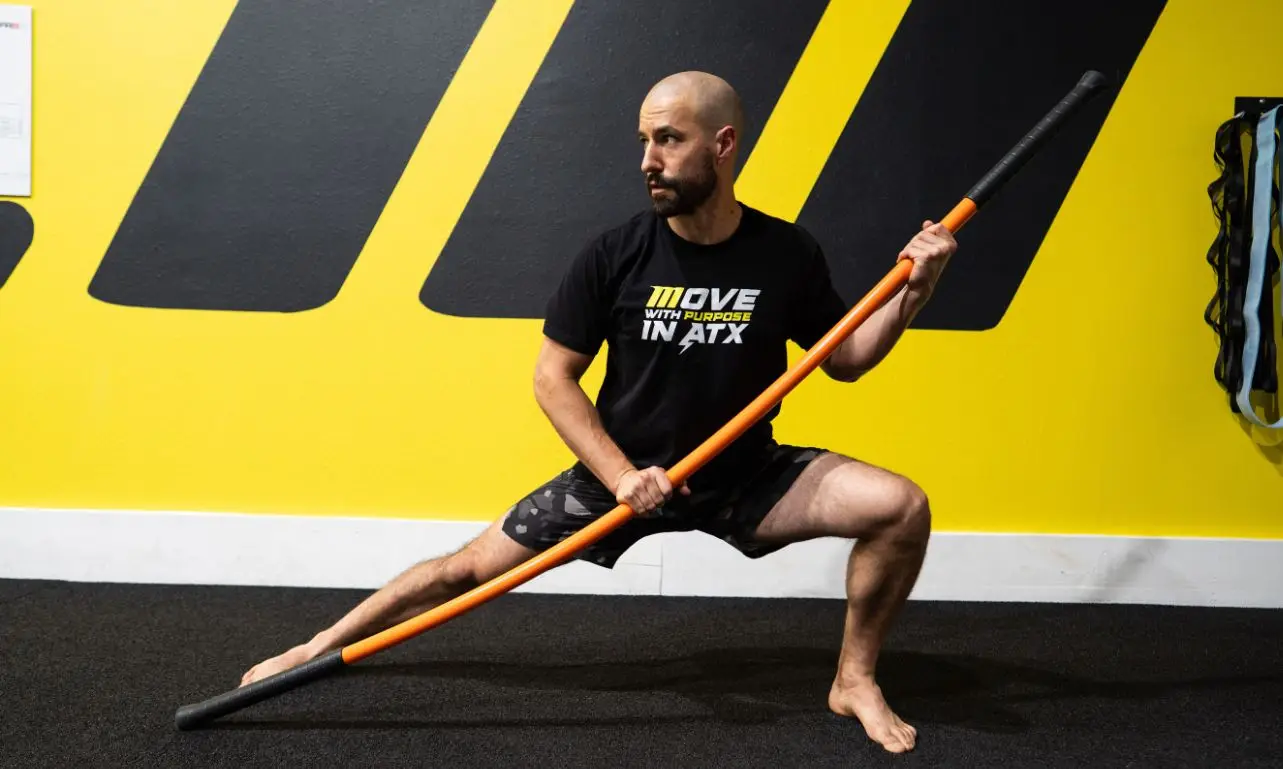
Someone will tell me they cannot come to class because they are already flexible. Their thumb touches their forearm, their elbows hyperextend, they can put their palms flat on the floor without warming up, and they have decided this means the room is not for them. Then they mention their shoulder subluxes sometimes, or their knees ache after a long day, or they rolled the same ankle three times in two years.
That combination is common enough that it has a name and a scoring system, and the fact that so few people know about it is one of the more fixable problems in this space.
Generalised joint hypermobility gets screened with the Beighton score, a nine-point scale from 1969 that checks five things: little fingers bending past 90 degrees, thumbs to forearms, elbows and knees hyperextending past 10 degrees, and palms to the floor with straight legs. Four or five out of nine is the usual cutoff, though there is no global consensus on where exactly the line sits (1). Prevalence estimates run somewhere between 10 and 30 percent of the population depending on age, sex, and which criteria the study used, with substantially higher rates in women. Which is to say this is not rare. In a class of eight people, two or three of them may be in this category.
The reflex reading of hypermobility is that these people are weak, and that the laxity is a strength problem in disguise. A 2025 study in Scientific Reports tested that directly on 83 adults, splitting them into hypermobile (Beighton 4 to 9, n=46) and non-hypermobile (0 to 3, n=37) groups (2). Grip strength showed no difference between groups. Functional stability testing showed no difference either. What did separate them was joint position sense at the elbow and the knee, measured as the ability to reproduce a target angle without looking. The hypermobile group was meaningfully worse at knowing where their limbs were in space.
That single finding reorganizes the whole problem. The issue in a lax joint sits in the information rather than the force production. The system has poorer data about where the joint currently sits, and a joint with a large range and imprecise position sense is a joint that can arrive somewhere unplanned under load.
Why more stretching is the wrong tool here
If your passive range is already at the far end of the distribution, adding passive range does nothing useful and probably makes the gap worse. The gap being the distance between the range you can be moved into and the range you can control under your own force. That gap is where things go wrong for everyone, and hypermobile people start with a wider one by definition. This is the same problem as being flexible but still stiff, arriving from the opposite direction.
The training implication is direct. Load at end range, not more range. Isometric work at the outer edges of a joint’s arc gives the nervous system a reason to develop better positional information there, because contraction generates proprioceptive input that passive positioning does not. That is the mechanism behind end range work generally, and it happens to be exactly what a lax joint is short on.
The other thing worth saying plainly: hypermobile people often feel tight. This confuses everyone, including them. A joint with a lot of available range and poor control frequently sits in a low-grade guarding state, and the sensation of tightness is not the same variable as available range. Someone can score an 8 on the Beighton scale and still feel locked up, and stretching into that sensation gives temporary relief followed by the same feeling by afternoon. If that pattern sounds familiar, the distinction between mobility and flexibility is where I would start.
Where the honest limits of this are
I want to cap this properly. The 2025 study was 83 people, cross-sectional, and it measured proprioception at two joints in a healthy young sample. It tells us hypermobile joints have worse position sense. It does not tell us that training fixes that, because it did not test an intervention. The authors themselves called for neuromuscular training on the basis of the deficit they found, which is a reasonable inference and still an inference.
There is also a line here I am not qualified to cross. Generalised joint hypermobility is a movement finding. Hypermobile Ehlers-Danlos syndrome and hypermobility spectrum disorders are diagnoses, and they come with systemic considerations that are outside what a training studio evaluates or treats. If someone has widespread pain, fatigue, skin involvement, frequent dislocations, or autonomic symptoms alongside the laxity, that belongs with a physician first. Training still has a role afterward, and it should not be the first stop.
For everyone else, the practical version is short. Find out where your range sits rather than guessing from a party trick, which is what a movement and mobility assessment is for. Then spend your training time building force production in the ranges you already have instead of chasing more of them. The flexibility was never the asset. Knowing where you are inside it is.
References
- Effect of Plantar Sensory Stimulation on Sensorimotor Organization in General Joint Hypermobility (Beighton scoring and GJH prevalence). J Clin Med. 2025
- The effects of joint hypermobility on strength, proprioception, and functional performance. Sci Rep. 2025
Written by

Brian Murray, FRA, FRSC
Founder of Motive Training
Motive Training is a coaching studio in South Austin built around assessment, joint health, and strength you can use. Train with us in the studio, come to a KINSTRETCH class, or work through the progressions in KINSTRETCH Online.