The desk worker version of this is the same story almost every time. The neck gets sore. The person tries stretching, ergonomic adjustments, chin tucks at the desk. None of it sticks for very long.
The reason it does not stick is that what people are doing for tech neck does not match what tech neck actually is. The neck has been overworking, and the reason it has been overworking is that the cervical spine has lost active control of its range. That is a training problem. Stretching does not train.
The cervical spine is one of the most undertrained joints in your body
In most strength and conditioning programs, the neck is barely an afterthought. Athletes train pressing and pulling, lifters program squats and hinges, mobility work covers hips and shoulders and ankles. The cervical spine is left to fend for itself, which is how it ends up where it ends up. A joint complex with seven vertebrae, capable of meaningful rotation, lateral flexion, extension, flexion, and translation, that has rarely been asked to produce any of that under active control.
The numbers track. Annual prevalence of neck pain runs above 30 percent in adults, with office workers landing somewhere between 20 and 50 percent in most studies (1). More than two-thirds of adults show signs of forward head posture (2). Those numbers are not surprising once you accept the basic premise: a joint that does not get trained loses range and control of that range. The cervical spine is no different from a hip or a shoulder in that respect. It just does not get the same treatment.
What that looks like in practice is limited active rotation under load, restricted lateral flexion, and reduced ability to actively retract the head over the body. The capacity is gone before pain shows up. The pain is the signal that the system has been compensating for a long time.
The control piece behind forward head posture
Forward head posture gets framed almost entirely as a tightness story. Tightness in the upper traps, the pectorals, and the suboccipitals is part of the picture, but it is downstream of the actual problem. The soft tissue is being asked to do a job the joint can no longer do on its own.
The load math is the part most people skip. Every inch the head sits forward of the shoulders adds roughly ten pounds of effective load to the cervical spine. At a phone-looking angle of forty-five degrees, the cervical spine sees around fifty pounds of load. At sixty degrees, it climbs to sixty (3). The neck musculature has to hold that load every second the head stays out there. The traps and the levator scapulae and the suboccipitals are tight for a reason. They are working overtime to do what the joint cannot do passively.
That is the part stretching does not address. You can lengthen those tissues all you want. As long as the cervical spine lacks active control to keep the head over the body, the same tissues will go right back to overworking the second you stand up.
Why neck pain is rarely just a neck problem
The cervical spine sits on top of the thoracic spine. The scapula slides on the rib cage that the thoracic spine builds. When any of those structures stops moving well, the others compensate.
This is the part the research has gotten clearer on. A 2024 study of office workers found that thoracic spine range of motion mediated the relationship between cervical range of motion and neck pain. Thoracic ROM had a strong negative correlation with the Neck Disability Index (4). An RCT of office workers with chronic neck pain found that adding thoracic mobility work produced significant improvements in cervical ROM, pain, and disability (5). Treating the neck without addressing what the neck is sitting on tends not to work very well.
The same is true of the scapula. The shoulder blade is the platform for the cervical and upper thoracic spine. When it sits stuck in protraction and downward rotation, the upper traps and levator scapulae have to take up the slack to hold the head up. We dig into the scapular side of the same problem in our piece on training the scapula for healthier shoulders.
Vladimir Janda named this pattern Upper Crossed Syndrome a few decades ago. Short, overactive upper traps, levator, pectorals, and suboccipitals. Lengthened, inhibited deep cervical flexors, mid and lower traps, serratus, rhomboids. The list is consistent across populations. What that means practically is that tech neck is a multi-segment control problem at the cervical spine, the thoracic spine, and the scapula. Treating one segment in isolation just shifts the compensations around.
What stretching does, and what it does not do
The static stretching research has held up pretty consistently. Stretching produces short-term ROM gains primarily through increased stretch tolerance, meaning the nervous system becomes more comfortable with the position (6). The actual tissue length and structural change are limited in most protocols.
So when a desk worker stretches their neck and reports that it feels looser for a few hours, the sensation is real, and the short-term range increase is real. What is also real: the cervical spine did not gain any active control of the range that just opened up. The tissue is more tolerant of the stretch. The joint is not more capable of holding the head over the body under load. The same patterns return as soon as the static posture returns, which for most desk workers is later that morning.
This is the part of the FRC argument that holds up well. Passive range is the ceiling. Active range is what gets used. The gap between them is the range your nervous system will not let you access under speed or load because it does not trust the position. Closing that gap is the entire point of training. Stretching is fine for what it is. It does not close that gap.
What training the cervical spine actually looks like
The cervical spine gets trained the same way any other joint gets trained. Assess, expand, reinforce.
Cervical CARs are the entry point. The head and neck go through their full active rotation, lateral flexion, and translation under tension, with the rest of the body held still. The output is two things. You see where the joint moves well and where it runs out of control. And over time, you build the daily input the joint needs to maintain and expand that range. The full mechanics of CARs as a tool are covered in our deeper guide to Controlled Articular Rotations. Cervical CARs follow the same logic, with extra attention to keeping the torso quiet so the neck actually has to do the work.
After CARs, PAILs and RAILs at the cervical spine train the active control of the range that is already there. A cervical PAILs at end-range rotation looks like pressing the head into a fixed point at the limit of rotation, building tension over ten seconds or so, then producing a contraction that pulls the head further into the rotation. The intensity stays moderate. The point is teaching the nervous system that the position is owned and accessible under tension.
T-spine and scapular work belong in the same program. Thoracic CARs and segmental rotation drills give the cervical spine a base that actually moves. Scapular CARs and end-range scapular control work restore the platform. None of this is exotic. It is the same set of principles applied through the kinetic chain.
Five minutes of chin tucks at the desk is something different. Chin tucks function as a position reminder. They do not function as a training stimulus, and the volume being asked of the cervical spine over eight hours of desk work is not going to be offset by five minutes of position reminders. The training has to look like training.
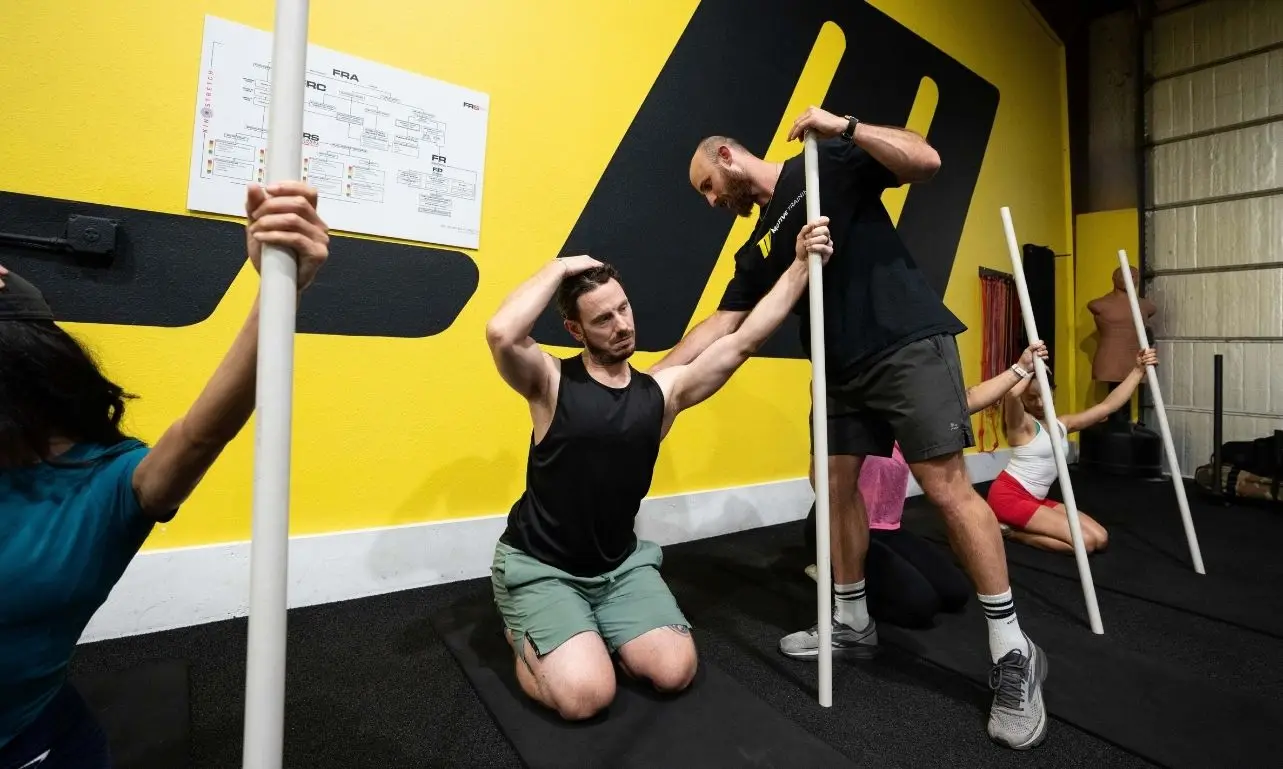
This is also where a structured group format gets practical. A KINSTRETCH class gives the cervical spine the same kind of training environment the rest of the body gets, with coaching, with enough volume and frequency to actually adapt, and with the t-spine and scapular work programmed in the same hour. The desk worker version of the neck problem responds well to that combination.
The training principle behind it
Tech neck has been framed almost entirely as an ergonomics problem. Sit up straighter, adjust your monitor, take more breaks. None of that is wrong. None of it is enough either. The cervical spine is going to spend hours a day in positions that load it, and the only meaningful intervention is to build the capacity to handle that load.
The mechanism is not a mystery at this point. The cervical spine, the thoracic spine, and the scapula all need active range, end-range strength, and the daily input that keeps the system alive. Stretching the sore tissue does not produce any of those. Training does. The full framework around that work lives inside Functional Range Conditioning, which is the methodology we run the cervical spine version of the problem through at the studio.
If you are dealing with the desk worker version of this in Austin and want to know where to start, the right first move is an honest read of where the cervical spine, the thoracic spine, and the scapula actually move, and where they do not. That is what a Functional Range Assessment is built for. From there, the training writes itself.
References
(1) Hogg-Johnson S, van der Velde G, Carroll LJ, et al. The burden and determinants of neck pain in the general population: results of the Bone and Joint Decade 2000-2010 Task Force on Neck Pain and Its Associated Disorders. Spine. 2008;33(4 Suppl):S39-S51. https://pubmed.ncbi.nlm.nih.gov/18204398/
(2) Mahmoud NF, Hassan KA, Abdelmajeed SF, Moustafa IM, Silva AG. The relationship between forward head posture and neck pain: a systematic review and meta-analysis. Curr Rev Musculoskelet Med. 2019;12(4):562-577. https://pubmed.ncbi.nlm.nih.gov/31773477/
(3) Hansraj KK. Assessment of stresses in the cervical spine caused by posture and position of the head. Surg Technol Int. 2014;25:277-279. https://pubmed.ncbi.nlm.nih.gov/25393825/
(4) Kuligowski T, Skrzek A, Cieślik B. Influence of sagittal cervical and thoracic range of motion on neck pain severity in young white-collar workers: a cross-sectional study. J Clin Med. 2024;13(18):5412. https://www.mdpi.com/2077-0383/13/18/5412
(5) Seo J, Song C, Shin D. A single-center study comparing the effects of thoracic spine manipulation vs mobility exercises in 26 office workers with chronic neck pain: a randomized controlled clinical study. Med Sci Monit. 2022;28:e937316. https://medscimonit.com/abstract/full/idArt/937316
(6) Hayes BT, Harter RA, Widrick JJ, Williams DP, Hoffman MA, Hicks-Little CA. Lack of neuromuscular origins of adaptation after a long-term stretching program. J Sport Rehabil. 2012;21(2):99-106. https://pubmed.ncbi.nlm.nih.gov/22387932/
Written by

Brian Murray, FRA, FRSC
Founder of Motive Training
Motive Training is a coaching studio in South Austin built around assessment, joint health, and strength you can use. Train with us in the studio, come to a KINSTRETCH class, or work through the progressions in KINSTRETCH Online.