Most “personal training” isn’t personal. That’s the honest version of what the industry has built, and it’s worth saying out loud before getting into what private training should be.
In a commercial gym, “personal” usually means a trainer who works for the gym, writes you a program off a short intake form, and runs you through it the same way they run the next person through theirs. Plenty of capable trainers operate this way. The output is generic work with your name on it. The trainer is paid by the gym, the gym is paid by selling sessions, and the structural pressure is to keep the schedule full, not to figure out what you specifically need.
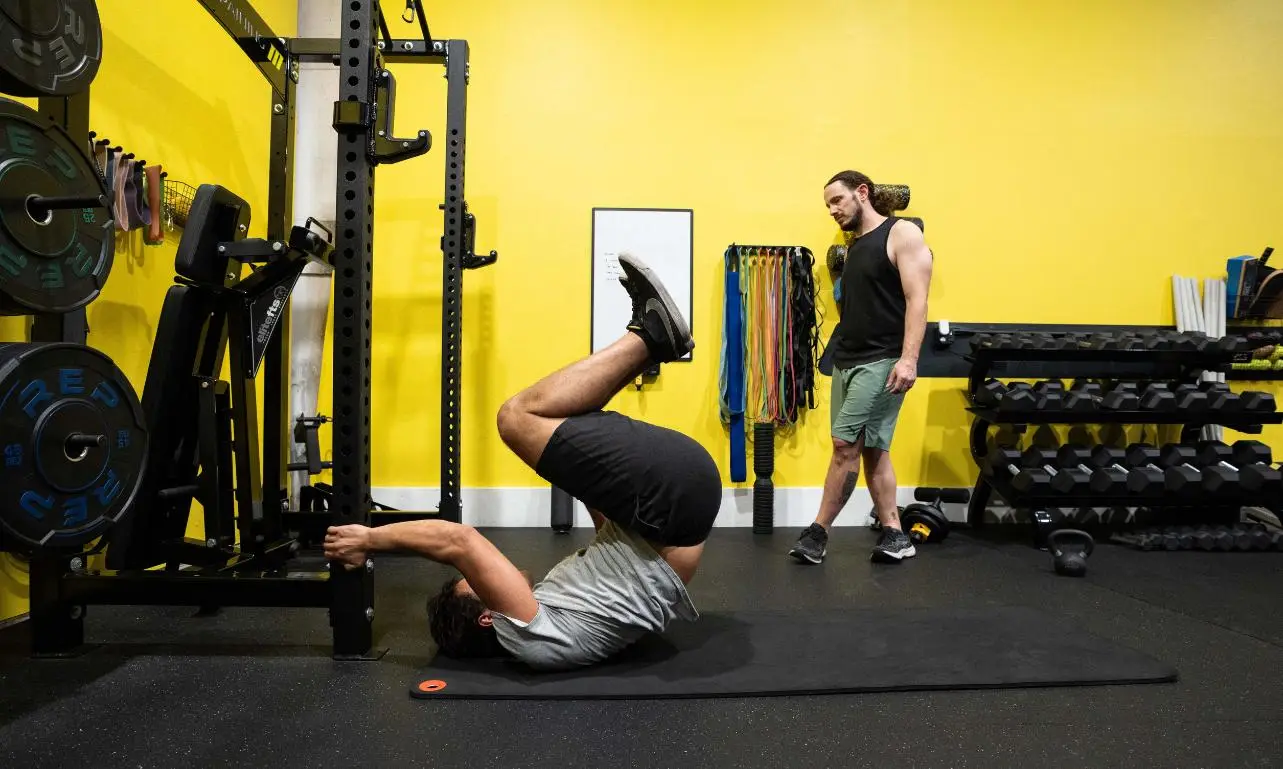
Private personal training, done seriously, is a different animal. It’s closer to a clinical model than a fitness one. The trainer’s first job is to see the body in front of them with enough resolution to actually program for it. That means an assessment that goes past “touch your toes” and into how your joints move under load, where strength sits inside that range, and what’s compensating for what.
That’s the work that justifies the investment. Without it, you’re paying someone to count reps and adjust volume on a program that was never built for your body in the first place.
Why the generic version keeps missing
The industry’s blind spot is that most adults walking into a gym aren’t a clean training problem. They’re carrying compensations from sitting, repetitive sport patterns, old injuries that healed but never got rehabbed back to full function, and years of programs designed for someone else. None of that shows up on a body composition scan. A lot of it doesn’t even show up in conversation, because people don’t know what they don’t know about their own movement.
Group classes can’t catch any of that. They aren’t built to. The class has to work for the average person in the room, which means it can’t address the specific person whose hip won’t internally rotate or whose thoracic spine has stopped extending. Generic 1-on-1 training has the same problem at a smaller scale. If a trainer’s first conversation with a new client is about what days they want to come in, they’ve skipped the part of the job that matters most.
The deeper issue is that fitness as an industry has decided “function” means being able to deadlift, push up, and squat. The body wasn’t built for those movements specifically. It was built to walk, run, throw, locomote, rotate. Foundational training is how well your hip rotates, how well your trunk and hips coordinate to create movement, how well you can express force through end ranges. Squats and deadlifts are part of that picture. They’re not the picture.
What assessment-first training looks like
The reason the Functional Range Assessment is the entry point for nearly everyone we work with is that we don’t know what you need until we look. Anyone telling you otherwise is guessing.
A proper assessment is joint-by-joint. We’re looking at how each joint moves through its active range, where the gap is between what you can do passively and what you can control actively, and where the kinetic chain is breaking down. Active range without control is borrowed range. It shows up under load as compensation, and under stress as injury risk. The work of training is closing the gap between the two.
That assessment then drives the program. Not a template, not a periodization scheme that came off a shelf. The plan you get is built for the body the assessment found. If your hip is the limiter, the program addresses the hip. If your thoracic spine is the limiter, the program addresses the thoracic spine. The strength work, the conditioning, and the mobility work all stack on top of that. None of it is generic.
This is what Functional Range Conditioning brings to the table that most personal training doesn’t. It’s a system that treats joints as the unit of training, prioritizes neurological control over passive range, and builds usable function from the inside out. From what I’ve seen across 17 years of coaching, this is the missing piece in most adult training. The strength shows up when the joints can express it.
Why private over group, and when group is fine
There’s a real case for group stretching classes. They work well for people who already know what they need, want consistent exposure to a method, and benefit from the energy of training around other people. They’re efficient and they’re sustainable.
What group classes can’t do is correct a specific compensation in real time. They can’t program around an asymmetry that nobody’s identified yet. They can’t decide that today’s session needs to back off the right hip because it lit up after Tuesday’s run. That work happens in private sessions or it doesn’t happen at all.
Most clients we work with end up using both. Private training to figure out and address the specific issues, group classes to layer in consistent exposure to the patterns that build long-term capacity. The two reinforce each other.
What to look for in a private trainer
The question to ask a prospective trainer is some version of, how will you know what I need. If the answer is “we’ll figure it out as we go,” that’s a guess. If the answer is an actual assessment process with named tests, articulated reasoning, and a structured way of translating findings into a program, that’s a coach.
Credentials matter, but only as a proxy for the work. A trainer with FRC and FRA credentials has been through a particular education about joints, neurology, and clinical thinking. A trainer with a generic certification might be excellent, or might be a personal trainer in name only. The conversation matters more than the letters on the bio page.
The other question worth asking: what does the first month look like. If the answer is “we’ll start training and see how you respond,” that’s reactive. If the answer is “we’ll assess, then build a plan, then progress it based on what we see,” that’s a process.
What this actually changes
People come to private training for a lot of reasons. Pain that hasn’t responded to anything else. A sport they want to keep doing into their fifties and sixties. Strength that doesn’t transfer outside the gym. Confidence that their body will hold up under whatever they want to do with it.
What gets them what they came for is rarely the workout itself. It’s the diagnosis underneath the workout. A program built on a real assessment will outwork a harder program built on assumption every time, because the harder program is loading dysfunction. The smart program is fixing it.
That’s what private personal training should be. If it’s something else, it’s not really private.
Written by

Brian Murray, FRA, FRSC
Founder of Motive Training
Motive Training is a coaching studio in South Austin built around assessment, joint health, and strength you can use. Train with us in the studio, come to a KINSTRETCH class, or work through the progressions in KINSTRETCH Online.