Most people hire a trainer the way they’d pick a dentist. They read a few reviews, skim a bio, check the price, and make sure the place won’t add twenty minutes to the commute. All of that is reasonable, and location matters more than people give it credit for. None of it tells you the thing you most need to know, which is how this person thinks when your body doesn’t do what the program expected.
That moment comes for everyone sooner or later. A shoulder pinches overhead, a knee gets cranky in week three, or a hip refuses to let you sit into a squat no matter how many times you’re cued. A good trainer has a process for that: look at what the joint can do, change the position or the load, and retest. You want to find out which kind of trainer you’ve hired in the first month, because finding out in the fourth costs you time, money, and sometimes a flare-up you didn’t need.
What are you paying a trainer for?
Whatever the hourly rate, the reps are the cheapest part. Counting them, demonstrating an exercise, and holding you to a 6 am slot all have value, and plenty of people need exactly that kind of accountability to keep showing up. An app can count, though, and a friend can text you when you skip.
What you’re paying for is judgment. Which exercise, in which position, at what load, for your body this week. That judgment runs on information, and a trainer only has information if they went looking for it. So the first thing to evaluate is what a trainer wants to know about you before they write a single session.
What should happen in the first session?
Expect questions about your training history, injuries old and current, what your work week looks like, and what you want to be able to do a year from now. Then expect someone to look at how you move. That can be a formal assessment or a handful of well-chosen tests, and either way it should involve measuring something at the joint level: how far your hip rotates, how your shoulder behaves overhead, how far your knee can travel past your toes before the ankle runs out of room.
The distinction worth knowing going in is passive range versus active range. Passive range is how far a joint goes when something else moves it, like a hand or gravity. Active range is how far you can take it yourself, with control. The gap between the two is range your body has access to but can’t produce force through, and from what I’ve seen it’s where a lot of training problems start. A trainer who measures only one of those (or neither) is writing your program partly blind.
That’s the reason most new clients at Motive start with the Motive Movement and Mobility Assessment. You don’t need our version to use the test, though. Ask any trainer you’re considering what they plan to measure in the first session and what they’ll do with the numbers. If the answer is body weight and a max push-up test, the program is going to be built around output, with very little attention to how your joints are producing it.
Certifications tell you less than you’d expect
Personal training isn’t a licensed profession in most of the US, so anyone can print business cards that say trainer. The baseline worth checking for is a certification accredited by the NCCA, which covers the major ones (NASM, ACE, NSCA, ACSM). It means someone passed an exam on exercise science and program design. Treat it as a floor.
The more useful information is what a trainer did after clearing that floor. Continuing education shows you what they got curious enough about to spend their own money and weekends learning. Someone who has put years into joint-level work, Functional Range Conditioning in our case, will look at a stuck squat very differently from someone whose education stopped at the first certification, because they’re asking what the training is doing inside the joint and not only how much weight moved.
Years in practice count, and so does what those years were spent on. One question I’d ask any trainer: what have you changed your mind about in the last few years? Someone with a specific answer has been watching how their clients respond and adjusting, and that habit is what you want applied to your program.
When to see a physical therapist first
Trainers don’t diagnose. Pain that’s getting worse, pain that wakes you up at night, numbness or tingling, swelling after an injury, or pain that gets in the way of ordinary daily tasks all point to a physician or physical therapist as the first stop. A trainer who takes you on anyway and starts working around it without an answer is guessing with your body, and a good one will tell you that before you ask.
Where a trainer fits is often after that care ends. Physical therapy usually wraps up when the visits run out or you meet discharge criteria, and being cleared sits a long way from being ready to deadlift, play a full match, or carry a sleeping kid up the stairs. That stretch between discharge and full capacity is where training after physical therapy earns its place, and where a trainer who can read a rehab history is worth more than one who can’t.
Signs the coaching isn’t working
Give any program six to eight weeks before you judge the results. You can judge the process much sooner.
Pay attention to how the program changes. If every session feels like a random workout, or nothing has changed since week one, nobody is adjusting anything based on what they see. Something hurting is a useful test of a trainer. The right response is to stop, ask where and when, change the position or the load, and check again; pushing through it and quietly dropping the exercise forever both skip the part where anyone learns something. You don’t need a lecture every set, but you should be able to ask why you’re doing an exercise and hear an answer that refers to you. And be wary of anyone who promises outcomes on a timeline before they’ve assessed you, since nobody knows what your body will do in twelve weeks before they’ve watched it move.
Is a local trainer better than an online one?
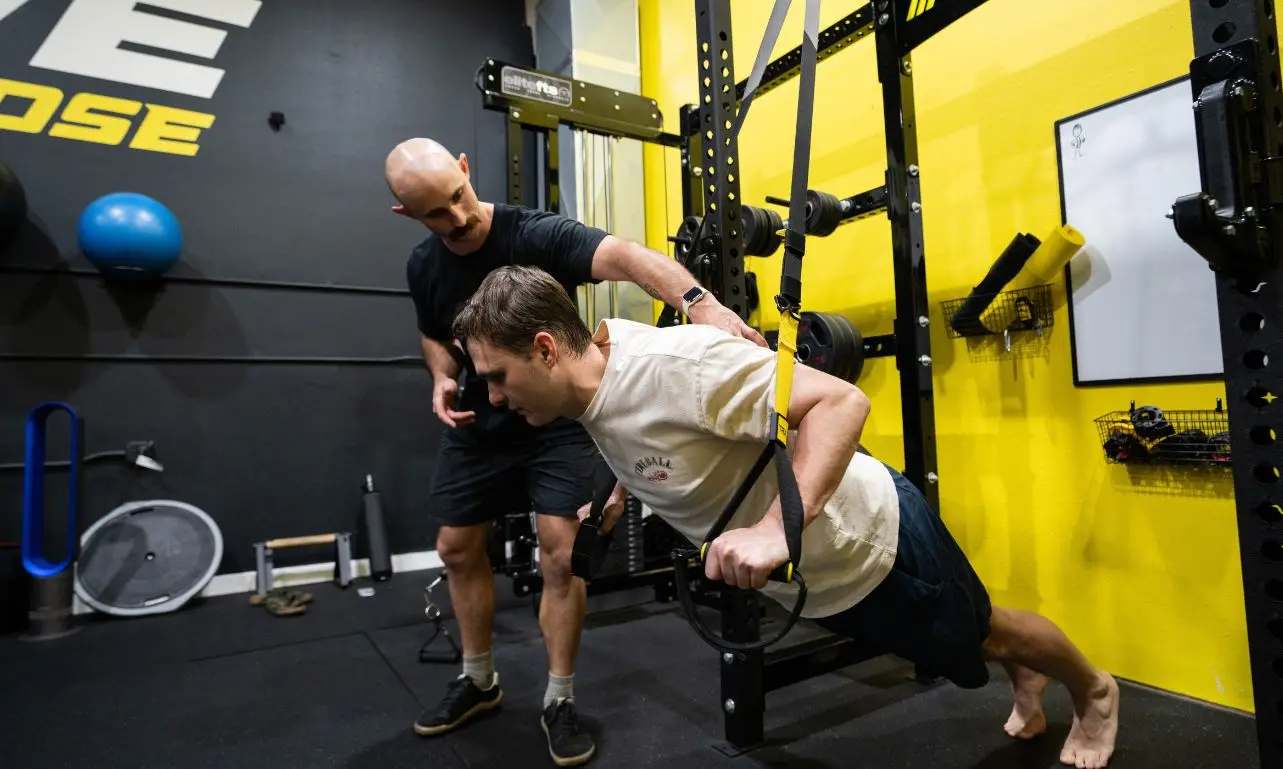
For most people starting out or coming back from an injury, in-person coaching is worth it, at least at first. Someone in the room sees what you can’t feel: the knee drifting in on the sixth rep, the low back taking over a hinge, the ribs flaring as your arms go overhead. They can put a hand on a position, change the setup in seconds, and watch what happens on the next rep. Video gets you part of that, on a delay and from a single angle.
Online training works well once you understand your own positions and mostly need structure and progression. Our KINSTRETCH Online membership is built for that person, and it’s fair to name what it can’t do: nobody is correcting you in real time.
There’s a less exciting reason local matters too. A studio ten minutes from your house or office is one you’ll still get to during a bad week, and the months of consistency add up to more than any single great session.
How we approach training at Motive
Everything above is the standard we hold ourselves to, so here’s how it plays out in our studio. Training at Motive starts with measuring what your joints can do, and your program gets written from those numbers and rewritten as they change. Sessions are one-on-one in a small studio near St. Elmo in South Austin. The work blends joint-level mobility training with strength training, because range you can’t produce force through tends to disappear under load, and a lot of the stuck lifts we see trace back to a position someone never had control of.
Personal training at Motive runs $105 to $125 an hour, depending on how often you train and how long you commit. It’s HSA and FSA eligible through Truemed with a Letter of Medical Necessity; you’re reimbursed after purchase, and we help with the paperwork once you’ve booked. I’ve been coaching since 2009, and the methods behind our work come from Functional Range Conditioning (I hold FRCms, FRSC, FRA, and KINSTRETCH Level II).
If you want to see what a first session looks like and ask us the same questions you’d ask anyone else, book a time here.
Written by

Brian Murray, FRA, FRSC
Founder of Motive Training
Motive Training is a coaching studio in South Austin built around assessment, joint health, and strength you can use. Most clients start with the Movement & Mobility Assessment. From there, train with us in the studio, come to a stretching class, or work through the progressions in KINSTRETCH Online.