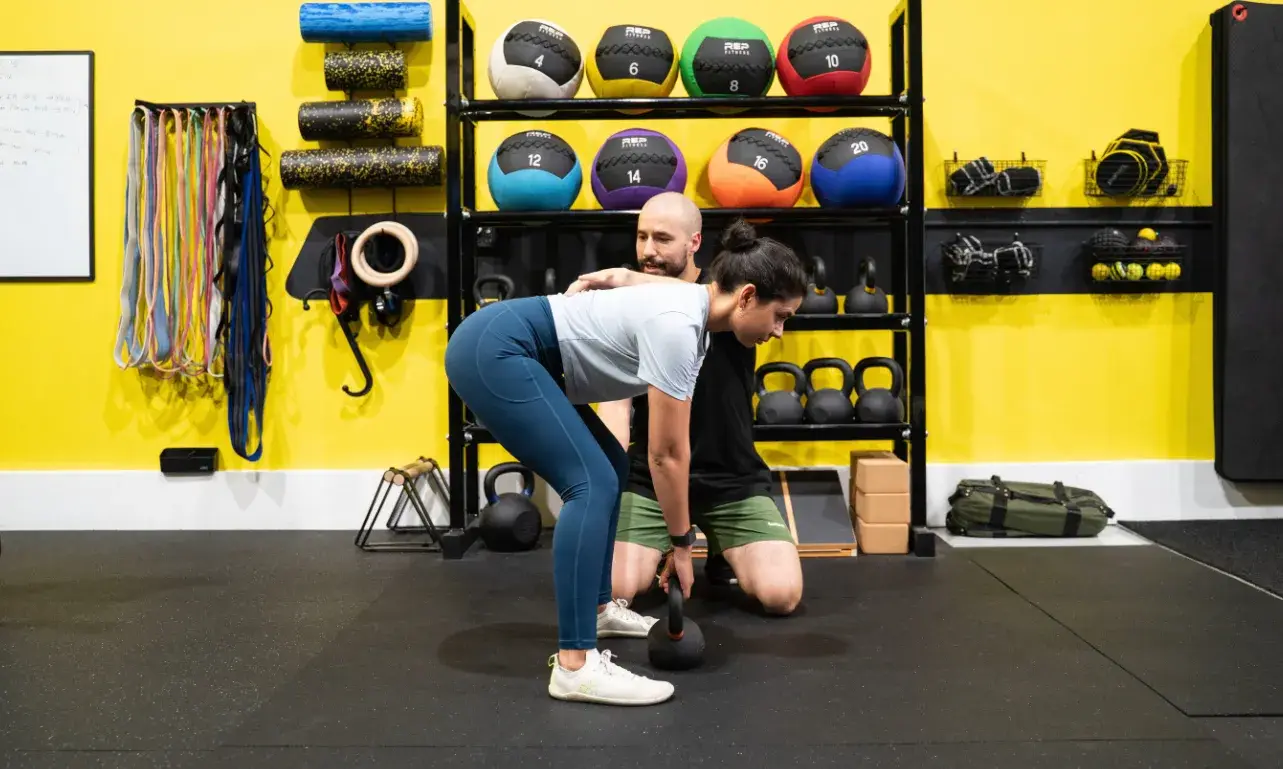
Discharge from physical therapy is not the same as being recovered. That’s the sentence I find myself saying most often to clients in the first session after they’ve been cleared. They’ve gone through six or twelve weeks of structured work, hit their benchmarks, and graduated, and now they’re sitting in a different room asking what comes next.
What discharge means is something specific. Your symptoms are managed, you’ve hit your insurance-covered functional benchmarks, and you no longer need direct medical oversight. It does not mean you’re back to your sport, your training, or the version of yourself you were before the injury. The gap between those two things is where most of the regression happens, and almost nobody talks about it honestly.
What Discharge Actually Means
Physical therapy is built around a specific scope. The PT’s job is to get you out of pain, restore basic functional movement, and clear you to resume normal life. That’s a real and important job, and the people in this field are good at it. What it isn’t built around is returning you to load, intensity, or sport at the level you were operating at before. That’s a different scope of practice entirely, and it usually isn’t in the insurance-covered timeline either.
Most people get six to twelve weeks of PT for an injury that, depending on severity, can take a year or more to fully come back from. Research on ACL recovery, which is the most-studied population in this space, shows that returning to sport before nine months post-surgery substantially increases reinjury risk, and that quadriceps strength asymmetries can persist for years even in patients who feel fine. The PT discharge is the start of the recovery, not the end of it.
When clients show up after discharge, they tend to fall into one of three patterns.
Pattern One: Picking Up Where You Left Off
This is the most common one and the most expensive. You feel mostly fine, you’ve been cleared, and you go back to the lifts or the runs or the league play you were doing before. Within three to six weeks, something flares. Sometimes it’s the original injury. Sometimes it’s the compensation pattern that built up around it.
The reason this happens is straightforward but rarely explained well. During recovery, your nervous system shifts how it organizes movement around the injured area. Other muscles take over jobs they weren’t designed for. Joints above and below adapt. Your tissue heals, but the motor patterns that built up around the injury don’t reset on their own. When you reload at the volume and intensity you used to handle, you’re loading a system that’s been quietly running on workarounds for months.
Strength research on post-injury populations consistently shows the same thing. People feel ready before they actually are, because subjective readiness lags behind objective measures of strength symmetry, neuromuscular control, and tissue capacity. The gap between feeling ready and being ready is exactly where second injuries happen.
Pattern Two: Staying Scared
The second pattern is the opposite. People get cleared, but the experience of being injured rewrote their relationship with the activity that hurt them. They run less. They stop loading the squat. They take cycling off the table. The body slowly decompensates around the avoidance, and a year later the original injury isn’t the limiting factor anymore. General deconditioning is.
This pattern is harder to see because nothing acute is happening. The person isn’t in pain. They’re just smaller, weaker, and less mobile than they used to be, and they’ve quietly accepted that as the new baseline. The PT can’t address this because by definition the person doesn’t need PT anymore. And general fitness advice doesn’t address it either, because what the person actually needs is progressive reintroduction to the specific demands that scared them, not generic strength training.
Pattern Three: Drift
The third pattern is the most common in the general population. After discharge, the person doesn’t pick up old habits or stay scared. They drift. They go back to the gym a couple of times a week, do some version of what they were doing before, and never specifically address the side that was injured. The strength comes back partway. The mobility comes back partway. The asymmetries stay, often permanently.
A year out, they still favor the side on stairs. They still feel something when they squat deep. They’ve accepted it as normal because nothing is sharply wrong, and addressing the residual gaps would require structured work that nobody told them they needed.
Why the Gains Don’t Hold Without Specific Work
The body doesn’t return to baseline on its own. Tissue heals on a biological timeline, but the qualities that make a joint resilient under load (active range of motion, end-range strength, neuromuscular control, tissue capacity at depth) only build through specific stimulus. PT often gets you to passive range of motion. It doesn’t typically get you to active control of that range under load, especially at end ranges where injuries actually happen.
This distinction matters. Passive range is what your joint can tolerate when something else moves it through space. Active control is what your joint can produce on its own, against resistance, at speed, under fatigue. The gap between those two ranges is roughly where most reinjuries occur. Closing that gap requires loading the joint progressively at the ranges it lost during the injury through specific tools like PAILs and RAILs, then teaching the nervous system to own those ranges under increasing stress.
That’s not a quick handoff. It’s months of structured work, and it’s the exact piece that gets cut from most rehab pathways because it falls outside both the PT scope and the general fitness scope.
What Training in the Post-PT Window Actually Looks Like
The post-PT window isn’t general fitness with extra caution. It’s a specific phase of training with specific priorities, and those priorities shift over time.
Early on, the work is unglamorous. Restoring active range of motion at the joints that lost it during the injury and the immobilization. Rebuilding end-range isometric strength so the joint can produce force at depth, not just in the middle of its range. Reintroducing basic load patterns at submaximal intensity to give the tissues something to adapt to without spiking risk.
A few months in, the work starts to look more like normal training. You’re loading the same patterns you used to, but with attention to symmetry, end-range control, and the specific quality the injury exposed as a weakness. Asymmetries get measured, not assumed. The injured side gets trained more, not less, because the deficit is real and won’t close on autopilot.
By the time you’re approaching return to your sport or activity, the work shifts toward speed, reactive strength, and the specific demands of what you actually want to do. This phase is the one most people skip entirely because it’s not in the PT scope and it’s not in the general gym programming. It’s also the one that most determines whether you stay back for good or end up in this same window again in two years.
When to Start
The honest answer is that the right time to start training in the post-PT window is before discharge, not after. The handoff is smoother when there’s already a relationship and a trajectory in place. If you’re working with a good PT, they’ll often welcome a trainer who understands the rehab continuum and can take what they’ve built and extend it.
If you’re already past discharge, the answer is now, with a few caveats. You should be able to perform the basic movements your PT gave you without symptoms. You should not be in active pain that flares with daily activity. If either of those is happening, you might be discharged but not actually ready to load yet. Joint irritability at this stage is information, and the right move is usually to go back to the PT or get a second opinion.
Beyond that, the longer you wait, the more the patterns described above set in. The gap closes faster when it’s addressed soon after discharge than when it’s addressed after a year of drift.
What This Looks Like at Motive
A lot of our clients come to us in this window. Some are referred by Austin-area PTs who know what we do and where the handoff makes sense. Some find us after they’ve felt the gap themselves. We’ve covered some of the specific training principles for post-rehab work in more depth elsewhere, but the short version is that the work combines structured strength training with joint-specific capacity work, and we usually start with the Motive Movement & Mobility Assessment to identify the specific deficits the injury left behind.
If you’re past PT and trying to figure out what comes next, scheduling an assessment is the cleanest first step. We’ll look at where the gaps actually are and build the plan from there.
Written by

Brian Murray, FRA, FRSC
Founder of Motive Training
Motive Training is a coaching studio in South Austin built around assessment, joint health, and strength you can use. Train with us in the studio, come to a KINSTRETCH class, or work through the progressions in KINSTRETCH Online.