Most bodybuilding culture trains against full range of motion, not toward it. Partial reps to keep tension on the muscle. Machines that lock the joint into one plane. Lockouts skipped to protect the shoulder. All of that is defensible in the moment and all of it is working against the thing that builds muscle.
What the research says about range
A 2021 systematic review and meta-analysis pooled sixteen studies comparing full range of motion training against partial range. Full range produced significantly greater strength gains and significantly greater lower-limb hypertrophy than partial range did (1). Functional performance also trended in favor of full range, though that result did not reach significance across the pooled studies.
That is not a mobility coach’s opinion about bodybuilding. It is a finding about what grows muscle, and it argues against a habit most lifters treat as neutral at worst.
The catch is the phrase full range of motion. It assumes the lifter has full range to use. A lot of bodybuilders do not, and they have usually never found out, because the training that would reveal it is exactly the training bodybuilding culture skips.
The range you can reach is not the range you can use
There is a difference between a joint’s passive range, what it can be moved through with help, and its active range, what it can move through and control on its own. Most bodybuilding training never tests the difference, because most bodybuilding training happens inside a smaller window than either one.
This shows up most obviously at the hip in a squat. Plenty of lifters can be pushed into a deep squat position by a partner or a band and look fine. Very few of them can get there under their own control and produce force once they arrive, which is why depth quietly creeps up over a training block and nobody notices until the low back starts complaining. The gap between passive and active range is exactly what limits the depth you can load, independent of how flexible you look in a stretch.
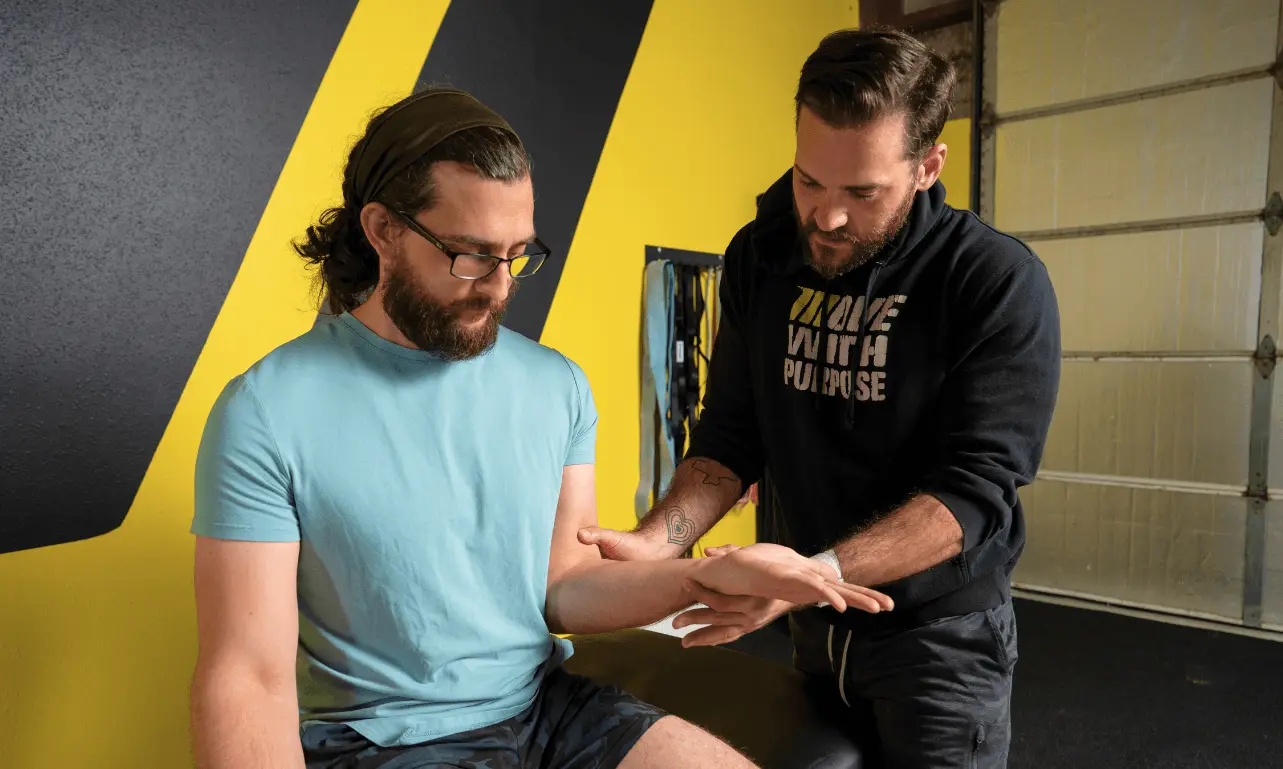
Functional Range Conditioning trains that gap directly. Controlled articular rotations take a joint through its full available circle under active control, which does two things a bodybuilder can use immediately. It tells you, honestly, where your active range ends today. And it starts closing the distance between that number and your passive range, which is the number that decides if the deeper part of a lift is available to you or is just a position you can be shoved into.
End-range strength is where bodybuilding injuries live
Most training injuries in lifters happen at the edges of a range, not in the comfortable middle of it. A shoulder that fails on the way to lockout. A hip that gives out at the bottom of a deep squat nobody trained getting out of.
PAILs and RAILs are built for exactly that territory. They load the end of a range isometrically, which is the strength most bodybuilding programs never train on purpose because most exercise selection stops well short of it. A bench press gets safer and more productive when the shoulder has real strength at full extension instead of just enough to get through the lockout. That is not a mobility argument. It is a load-tolerance argument, and it applies to a bigger chest and a longer training career alike.
Where this fits into a bodybuilding week
Not as a separate program. As maintenance and preparation around the training that is already happening.
CARs work as a short daily practice, a few minutes on the joints that are about to be loaded that day, done before the warm-up sets rather than instead of them. End-range isometric work fits into a warm-up or a cooldown on the days a joint is going to be pushed hard, shoulders before a heavy press day, hips before a squat day. None of it replaces volume or intensity. It is the layer underneath both.
The honest limitation is that this is slow work and bodybuilding is a sport that rewards visible weekly progress. Range and control change over months, not weeks, and nobody is going to see it in the mirror the way they see a pump. The payoff is fewer joints that quietly go offline three years into a training career, which is a real cost most lifters only notice after it has already happened to them.
Where to start
If you already know a joint is the problem, a shoulder that has never felt right overhead, a hip that limits your squat depth every single session, start there rather than trying to overhaul everything at once.
If you do not know which joint it is, that is what an assessment answers. The Functional Range Assessment measures active range against passive range at every major joint, which turns a vague sense that something feels off into a specific number you can train against.
References
- Steffl M, Courel-Ibáñez J. Effects of range of motion on resistance training adaptations: A systematic review and meta-analysis. Scandinavian Journal of Medicine and Science in Sports. 2021.
Written by

Brian Murray, FRA, FRSC
Founder of Motive Training
Motive Training is a coaching studio in South Austin built around assessment, joint health, and strength you can use. Train with us in the studio, come to a KINSTRETCH class, or work through the progressions in KINSTRETCH Online.