Most adults relate to the gym the way they relate to a diet. There’s a trigger (a wedding, a birthday with a zero in it, a photo they didn’t like), a start date, a goal, and then an end, usually somewhere around week six. When the project ends, the training ends with it, and the next attempt starts from somewhere close to scratch.
I think that framing is the root of most of the frustration people have with exercise. Physical capacity behaves a lot more like dental health than like a project. Your body keeps adapting to whatever you ask of it, every week, for the rest of your life, and if you ask very little, it gets very good at very little. Strength, joint range, tendon stiffness, bone density, the ability to get up off the floor without putting a hand down; all of it drifts toward what you use. The gym still works because it’s the most practical place most people have to push back on that drift, with enough load and enough variety, often enough, for decades.
Your body adapts in both directions
Tissue responds to the demands placed on it. Load a tendon progressively and it gets stiffer and more able to handle force. Load a muscle and it holds onto mass it would otherwise let go. Bone remodels around the forces that pass through it. The same machinery runs in reverse, which is the part people tend to forget. Eight or nine hours a day in a chair, a drive home, and an evening on the couch is a very specific training program, and the body follows it faithfully.
You see the result in small ways long before you see it in big ones. Stairs get noticeable. Carrying groceries from the car takes two trips instead of one. Getting down on the floor with a kid or a dog becomes something you plan for. Those changes rarely show up on a blood panel, and every one of them is trainable, at almost any age, if something in your week is asking for more.
Load you can keep adding for years
Asking for more is where home training usually runs out of road. Adjustable dumbbells top out. Bands give resistance that’s hard to measure and harder to progress in small steps. Bodyweight work gets awkward to make harder in any controlled way once the basics are easy. Plenty of people build a good base at home, and then most of them hit a ceiling somewhere in the first year without quite noticing it.
A gym gets past that ceiling with unglamorous inventory. Dumbbells in small jumps, plates that let you add a few pounds a week, a sled you can push and drag, cables for anything rotational, a bar to hang from. Each of those lets you progress a little at a time for a long time, and progressing a little at a time for a long time is most of what training is.
Train what the body does, beyond the barbell
Squats and deadlifts are useful. They build a lot of strength through the hips and legs, and they belong in most programs. They’re also one slice of what a body was built for. We were built to walk, run, carry, climb, and throw, and a huge amount of that comes down to how well the hips rotate and how well the trunk organizes itself to move with them. Any racket sport, any throw, every step of a walk asks the spine and hips to rotate and counter-rotate in coordination.
A well-equipped room lets you train that side of things too. Heavy carries, loaded rotation on a cable or a landmine, sled pushes, med ball throws against a wall, hanging from a bar until your grip gives out. That work makes you better at the physical tasks of a normal life, and very little of it fits in a spare bedroom.
A joint has to own a range before it can carry load through it
Most of the lifting injuries I’ve seen come from loading a position someone can’t control yet; a squat where the knees cave at the bottom, a press where the low back takes over in the last few inches overhead. The barbell exposes the gap between the range a joint can reach and the range it can control, and it exposes it under weight.
So strength and mobility belong in the same program. We look at each joint on its own before loading the whole pattern, using a joint-by-joint approach that tells us where someone has range to spare and where they need to build some first. For some people that means time in a KINSTRETCH class alongside their lifting. For others it’s a few targeted minutes at the start of every session.
The room matters as much as the equipment
Adherence beats any program detail. If you don’t do the training, it doesn’t matter how well it was written. At home, every session starts as a fresh decision made next to the laundry and a work laptop, and a lot of people find that harder than they expected. A gym takes part of the decision off the table. You drove there, you changed, and the only thing left to do in the building is train.
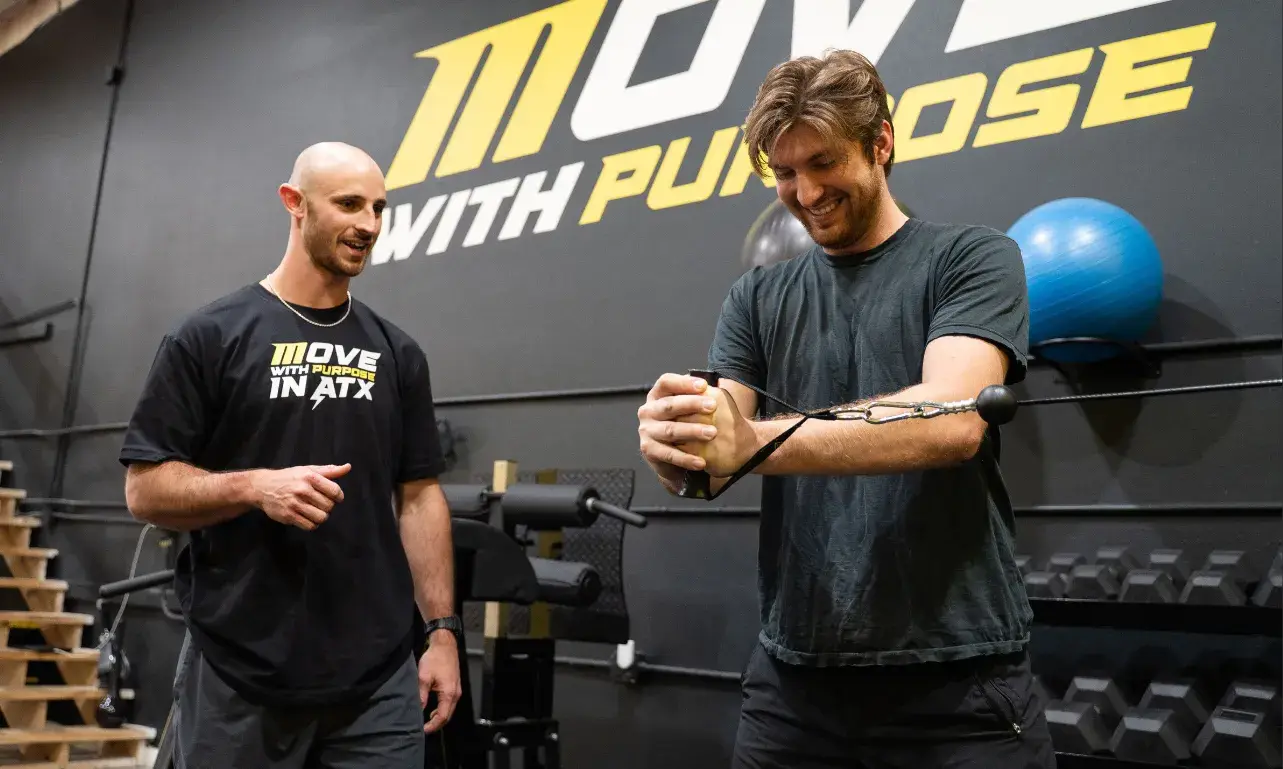
The flip side is that the room can also keep people out. Plenty of adults put off the gym because they think they need to get in shape before they’re allowed in, and the picture in their head is a big floor full of people who already know what they’re doing. That worry makes sense, and the honest fix is a different room. A small studio with a handful of people training under supervision feels nothing like a big-box floor at six in the evening. At Motive, most new clients start with a Motive Movement and Mobility Assessment, so the first session is built around what we measured and starts where you are. Our South Austin personal training page has more about the studio and how it runs.
What a coach adds
A coach compresses the learning curve and keeps the progression honest. You get a plan built around your history, positions corrected in real time, and someone who notices when your energy is off and changes the session instead of grinding through it as written. A scheduled session also means somebody is expecting you at seven, which does more for consistency than most people want to admit.
It costs more than a membership, and it’s fair to ask what that money buys. We laid that out in what you’re paying for with a personal trainer, along with the questions worth asking any trainer before you hire one.
Training as maintenance
If you treat the gym as maintenance, the deadline goes away, and with it the crash that usually shows up around week six. What’s left is a place you go a few times a week, a load that climbs slowly enough that you can keep coming back, and a body that keeps doing the things you care about ten and twenty years from now. You can start that from almost anywhere, including zero. If you’re in South Austin and want to find out where your starting point is, you can book a time with us.
Written by

Brian Murray, FRA, FRSC
Founder of Motive Training
Motive Training is a coaching studio in South Austin built around assessment, joint health, and strength you can use. Train with us in the studio, come to a KINSTRETCH class, or work through the progressions in KINSTRETCH Online.