Most of what gets written about postpartum exercise falls into one of two camps. Either it tells you to rest and wait until your body feels ready, which is not specific enough to act on, or it tells you to reclaim your strength and get your body back, which treats the whole thing like a marketing problem instead of a training one. Neither approach tells you what actually happened to your body or what that means for how you train.
Something specific and measurable changed during pregnancy and birth. Joint laxity, abdominal wall integrity, pelvic floor loading capacity, breathing mechanics. None of that responds to motivation. It responds to a training approach that accounts for what is actually different.
Your joints did not go back to normal the day you gave birth
Relaxin is the hormone responsible for a lot of the joint laxity people notice during pregnancy, and it does not clear out of the body the moment the baby arrives. Research summarized by the American Council on Exercise notes that relaxin can remain elevated for months after delivery, and some sources put the window as long as a year, longer if you are breastfeeding (1). That means the ligamentous stability you had before pregnancy is not simply back online at six weeks because a doctor cleared you for exercise.
This is not a reason to avoid training. It is a reason to prioritize control over range for a while. A joint with extra laxity and good neuromuscular control around it behaves very differently than the same joint with laxity and no control. The first is manageable. The second is where people start feeling their hips or low back get cranky three months into a new running habit they picked back up too quickly.
The core did not just get weak. It got reorganized
Diastasis recti, the separation along the linea alba where your abdominals meet at the midline, is close to universal in late pregnancy and extremely common afterward. A frequently cited study following women through the first year postpartum found roughly 60 percent still had measurable diastasis at six weeks, dropping to around a third by twelve months (2). Most cases improve on their own over that first year. Some do not, and that is worth an actual assessment rather than a guess.
The mistake most postpartum programming makes here is jumping straight to exercises aimed at closing the gap, usually some version of a crunch or a sit-up variation. That is often the wrong first move, because a diastasis is not primarily a strength problem. It is a pressure management problem. The deep core system, diaphragm, transverse abdominis, and pelvic floor, is supposed to work together to manage intra-abdominal pressure during exertion. Pregnancy changes the geometry and the coordination of that system. Loading a stretched, poorly coordinated midline with a crunch pattern before that coordination is rebuilt tends to reinforce the exact strategy that is not working, rather than fix it.
The better starting point is breath and bracing mechanics: learning to exhale and coordinate the deep core system under low load before adding the load back. That is unglamorous work, and it does not photograph well for social media, which is probably why it gets skipped in favor of ab exercises that look more like progress.
The pelvic floor deserves more precision than a hashtag
Kegels became the default answer to every pelvic floor question, and that default is often wrong. Pelvic floor dysfunction after birth can show up as weakness, but it can also show up as a pelvic floor that is already overactive and gripped, in which case more contraction work makes things worse, not better.
This is genuinely outside the scope of what a personal trainer or FRC coach should be diagnosing or treating. If you are dealing with leaking, heaviness, pain, or a sense that something is not right in that area, the right move is a pelvic floor physical therapist, not a generic exercise or a workaround from a fitness account. What a trainer can responsibly do is build a program that respects load progression, avoids stacking pressure on a system that is not ready for it, and coordinates with whatever the pelvic floor PT recommends. That handoff, done well, is worth more than any single exercise.
Real demands, not generic goals
New parents are not training for a vague sense of getting strong again. They are training for specific, repeated, asymmetric tasks. Carrying a car seat on one side of the body for months. Hip-hiking a baby who is getting heavier every week, usually on the same hip out of habit. Feeding positions that hold the thoracic spine in flexion for long stretches. Bending into a crib repeatedly with a rounded back because standing up straight from that position with a sleeping baby feels riskier than it should.
These are the actual movement demands, and they point toward specific priorities: hip strength and control on both sides, not just the dominant carrying side, thoracic extension capacity to counter all that feeding-position flexion, and a core system that can manage pressure asymmetrically instead of just bracing symmetrically for a barbell. Generic advice to do planks and go for walks misses most of this.
What a smart return to training actually looks like
There is no universal calendar for this. Cleared for exercise at six weeks does not mean identical for every person, every delivery, every recovery. What holds across most cases is a sequence, not a fixed timeline.
Start with walking and basic pressure management, breathing mechanics, and gentle joint maintenance work like Controlled Articular Rotations, which keep joints moving through available range without loading them aggressively while ligamentous stability is still catching up. From there, rebuild coordination in the deep core system before reintroducing load. Only after that foundation is in place does progressive strength training make sense, and even then, the asymmetric hip and thoracic work described above deserves priority over generic total-body programming.
This is exactly the kind of situation an actual assessment earns its place. A Functional Range Assessment gives us a joint-by-joint picture of where laxity is showing up as instability versus where it is not, which changes what gets trained first and how aggressively.
Where the mental health conversation actually fits
Exercise is broadly associated with mood benefits in the general population, and plenty of new parents report feeling more like themselves after getting back to consistent movement. That is a real and reasonable expectation. It is not the same as saying exercise treats postpartum depression or anxiety. If you are dealing with persistent low mood, anxiety, or anything that feels bigger than normal exhaustion, that is a conversation for your doctor or a therapist, not a workout plan. Movement can be part of feeling better. It is not a substitute for the right kind of support when something more serious is going on.
How we approach this at Motive Training
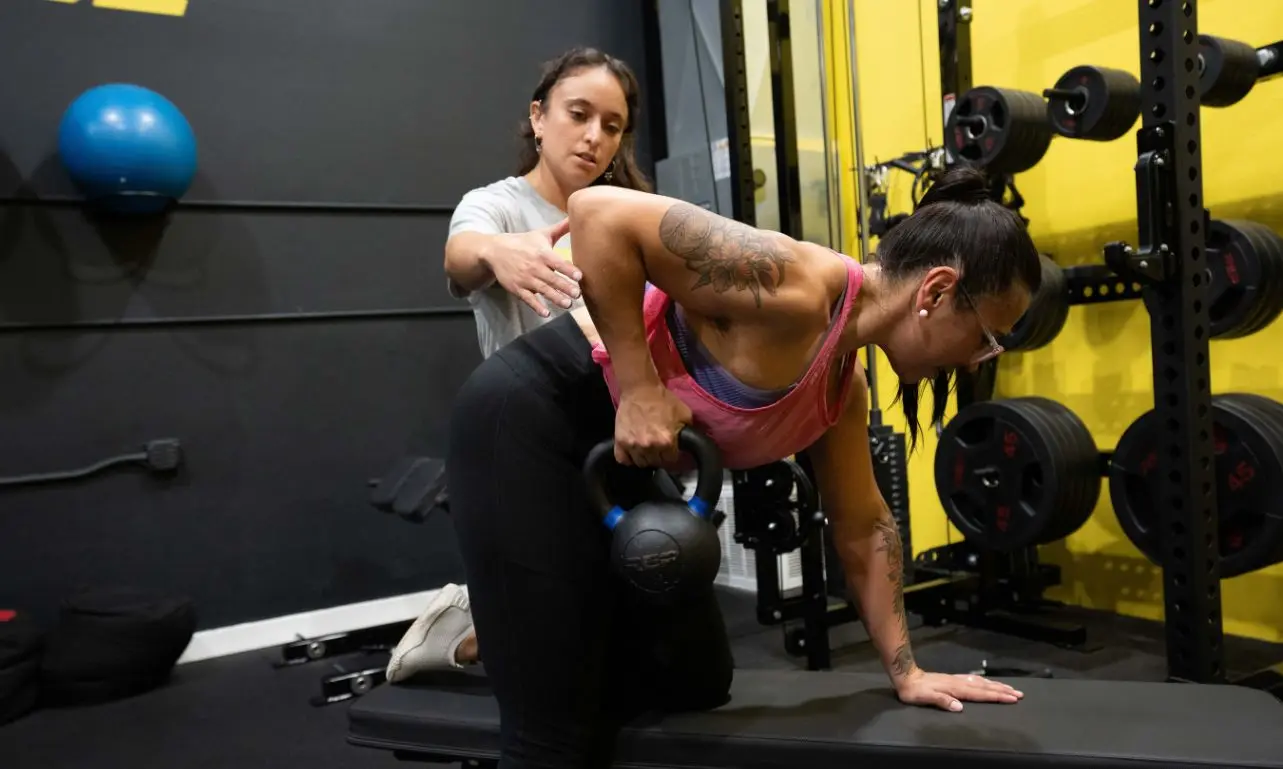
We start with an assessment, the same as we would with any client, because guessing at what someone’s body can handle six weeks or six months after birth is a bad way to build a program. From there, Functional Range Conditioning gives us the tools to rebuild joint control specifically, rather than just adding load and hoping stability follows. For ongoing mobility work between sessions, KINSTRETCH and KINSTRETCH Online let clients keep training joint control on their own schedule, which matters more than usual when sleep and time are both in short supply.
If something about your pelvic floor or your midline does not feel right, we will tell you that directly and point you toward a pelvic floor specialist before we build around it. That is not a hedge. It is how this should work.
References
- Relaxin: Pre- and Postnatal Exercise Considerations
- Diastasis recti abdominis during pregnancy and 12 months after childbirth: prevalence, risk factors and report of lumbopelvic pain
Written by

Brian Murray, FRA, FRSC
Founder of Motive Training
Motive Training is a coaching studio in South Austin built around assessment, joint health, and strength you can use. Train with us in the studio, come to a KINSTRETCH class, or work through the progressions in KINSTRETCH Online.