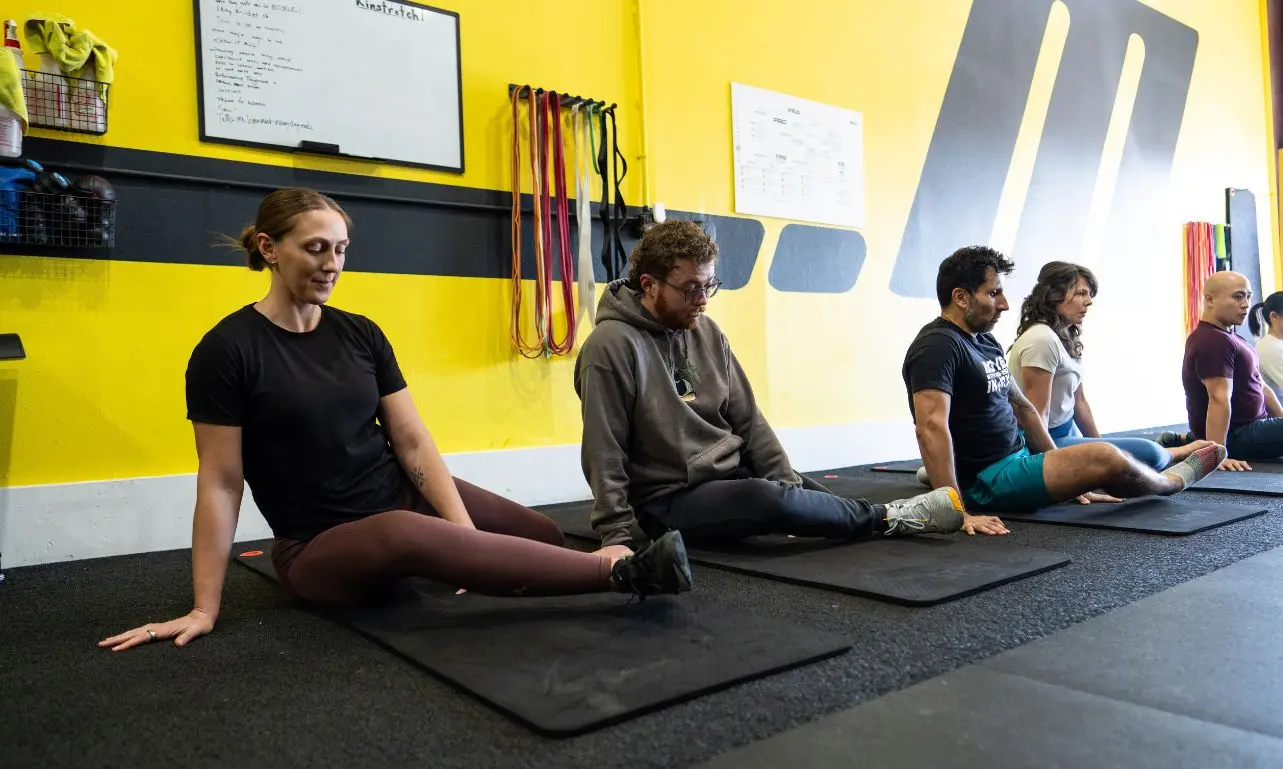
Small group training gets pitched on two things: it costs less than one-on-one, and it feels less lonely than training by yourself. Both are true and neither one tells you if it will actually work for your body. The real question is what happens to individualized coaching once a trainer’s attention gets split across four to eight people instead of one, and that answer depends entirely on how the session is built.
Attention is finite, and where it goes matters
A trainer working with one person can watch every rep. A trainer working with a group of six cannot, and no amount of enthusiasm changes that math. What determines if small group training holds up is not the trainer’s effort. It is if the program was built to make individualized coaching possible inside a shared room.
That means staggering what each person is doing so the trainer is never asked to watch six different first reps of six different exercises at the same moment. It means picking movements the group can execute safely with intermittent correction, and saving anything that requires close, continuous supervision, a new lift, a joint with a recent flare-up, for a moment when the trainer can actually be there for it. Group training that ignores this just becomes six people doing a workout near each other while a trainer occasionally speaks. Group training that accounts for it can still deliver real, individualized coaching, just not every single second of it.
The cost story is real but it is not the interesting part
Splitting a trainer’s rate across several people is a legitimate reason small group training exists, and there is nothing wrong with choosing it for that reason. But leading with price misses what actually determines if the format works for a given person, which is how much continuous, hands-on correction their body currently needs.
Someone with a straightforward goal and no complicating joint history can do well in a group format, because most of what they need is consistent programming, reasonable load progression, and periodic technique correction, all of which a well-run group can provide. Someone dealing with a recent injury, an unresolved pain pattern, or a joint that needs close monitoring through a new range is asking for something a group format was not built to give, no matter how skilled the trainer is. That person needs the kind of continuous attention that only comes from one-on-one work, at least until the picture is clearer.
What actually gets individualized in a good group session
The exercises can be shared without the programming being generic. At Motive, everyone in a small group session might be working the same broad structure, a strength block, a mobility component, a conditioning piece, while the specific exercises inside that structure are chosen based on what each person’s Functional Range Assessment actually showed. One person’s hip work looks different from another’s, even in the same room, at the same time, because the input each person needs is different.
This is the difference between a group class and group coaching. A group class runs the same choreography for everyone. Group coaching runs an individualized plan for each person inside a shared structure, which requires more design work upfront than either a template class or a fully custom one-on-one program, because it has to account for several different bodies moving through the same window of time without any of them getting a diluted version of what they actually need.
Where the format runs into real limits
Group training has a ceiling, and it is worth naming plainly instead of pretending otherwise. Complex technical lifts that require constant feedback do not belong in a group format until someone already owns the pattern. Anything involving acute pain, a recent surgery, or a joint that is actively unstable needs eyes on it every rep, which a group session cannot reliably provide. And someone who genuinely does not know how their body should feel during exercise, which describes a lot of people early in a training relationship, benefits from the kind of close monitoring a group setting is not designed to give.
None of that makes small group training a lesser option. It makes it a format with a specific range of fit, the same as any other tool. The mistake is choosing it purely on price or atmosphere without asking if your current situation is inside that range.
What to actually look for before joining one
Ask how the trainer handles six people doing different things at once. If the answer is some version of everyone does the same workout, that is a group class wearing a personal training label. Ask if programming is based on an actual assessment or a standard template rotated across clients. Ask what happens if something starts to hurt mid-session, if there is a real plan for pulling someone aside and adjusting on the spot, or if the group just keeps moving.
A well-run small group program, built around individual Functional Range Conditioning programming rather than a shared script, can deliver real coaching at a lower cost than one-on-one work. It just has to be built that way on purpose. If you want to see what that structure actually looks like before committing, book a call and we will walk you through how sessions are organized and if your situation fits the format or needs something more individualized first.
Written by

Brian Murray, FRA, FRSC
Founder of Motive Training
Motive Training is a coaching studio in South Austin built around assessment, joint health, and strength you can use. Train with us in the studio, come to a KINSTRETCH class, or work through the progressions in KINSTRETCH Online.