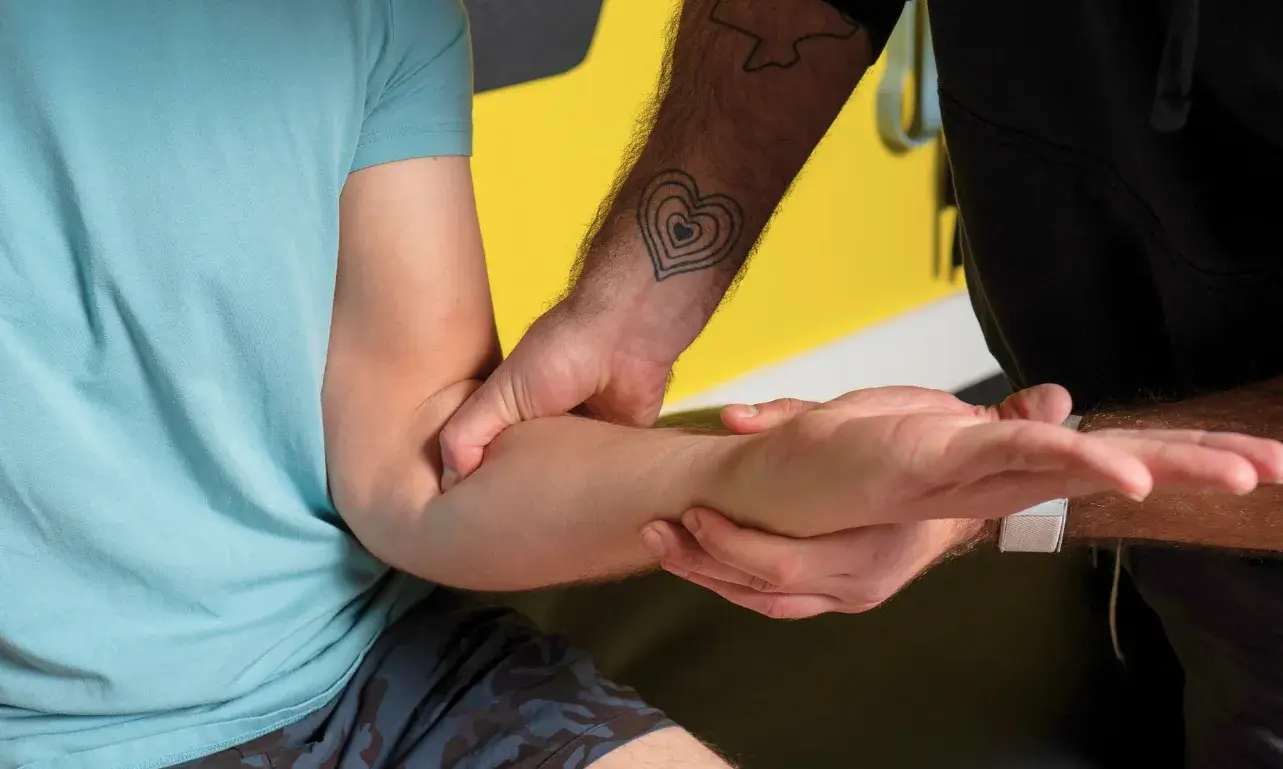
Manual therapy is a wide category. Massage, mobilization, fascial work, scraping tools, the various “something-style” bodywork schools that came out of clinical or athletic settings. Most of it gets sold the same way. Come in tight, leave looser. The version worth understanding is the one that changes the actual mechanics of how a joint moves, not just how the area feels for a few days. Functional Release is built to do that, and to integrate with the active training that has to follow it.
It is also the manual therapy side of the same system we use on the training floor. The hands-on work and the active work share a logic, share a vocabulary, and were built to be sequenced together. Most manual therapy traditions are excellent at what they do on the table. Few of them have a built-in mechanism for closing the loop between what happens there and what the body does when it gets up.
What Functional Release actually is
Functional Release, or FR, is a soft tissue assessment, treatment, and rehabilitation system developed by Dr. Andreo Spina, the same person who created Functional Range Conditioning. It is part of the larger FRS family, which includes FRC, the Functional Range Assessment, KINSTRETCH, and the Internal Strength Model. Each piece is designed to fit the others. FR is the manual therapy piece.
The full proper name is Functional Range Release. It is a credential, not a generic term. The practitioner has gone through certification covering Upper Limb, Lower Limb, or Spine, and works inside a system of palpation and treatment principles that was built to be teachable and reproducible rather than feel-based and intuitive. That distinction matters more than it sounds.
A standard massage credential teaches you how to apply soft tissue techniques. A standard mobilization credential teaches you how to move joints with your hands. FR teaches both, then frames them inside the same physiological model that FRC uses on the active side. The tissue work and the conditioning work share a language, share a logic, and were built to be sequenced together.
The “knots and scar tissue” framing problem
Most manual therapy is sold with a specific story. The therapist will find your knots. They will break up your scar tissue. They will release your adhesions. The pain will go away because the bad tissue gets unstuck.
The honest version is more careful. Human touch receptors are not capable of distinguishing a single fiber of disorganized collagen from a fiber of organized collagen. Saying you can palpate scar tissue at that level of resolution is, as the FR literature puts it directly, an inaccurate and unscientific claim. What you can feel is tension. Areas where the tissue resists movement, where the layers will not slide past one another, where there is more pull than the local anatomy says there should be.
FR replaces the scar tissue story with a tissue tension story, which is more honest and more usable. The practitioner is not finding magical adhesions. They are finding regions where the connective tissue has reorganized in ways that restrict movement, and they are distinguishing between mechanical tension (a structural issue in the tissue itself) and neurological tension (a tissue that is tight because the nervous system is holding it that way). Those two findings require different responses. Treating them the same way is one of the more common failures in standard manual therapy work.
Why the target is connective tissue, not muscle
The other thing FR gets right is what it is actually treating. The body of “knot work” assumes the muscle itself is the problem and that we need to break something apart inside it. The actual physiology says something different.
Muscle tissue is composed of contractile proteins arranged in series and bundled into fibers. Around every fiber, every bundle, and every muscle, there is fascia. That fascia is continuous with the next layer of connective tissue, which is continuous with the next, all the way out to tendons, ligaments, capsules, and bone. When tissue is injured, what gets remodeled and laid down in restrictive patterns is not the contractile protein. It is the connective tissue around it. The disorganized fiber direction, the cross-linking, the reduced ability of layers to slide past one another, all of that happens in the connective tissue, not the muscle belly proper.
This changes what the treatment is built around. The goal is not to dig into a muscle and pull it apart. The intent is to apply specific, sustained force to the connective tissue in ways that may influence how it remodels over time. That remodeling is slow. It does not happen in a single session. The aim is structural change rather than purely symptomatic relief, which is a longer game than most manual therapy gets sold as.
How FR fits with the training side
Static stretching can expand passive range of motion. It does this primarily by changing what the nervous system will tolerate, not by changing the tissue length in any meaningful structural way. Most range of motion gains from stretching alone are gains in tolerance, which fade quickly if the new range is never controlled or loaded.
FRC closes that gap from the other direction. Through CARs, PAILs and RAILs, and active end-range work, FRC teaches the nervous system to own the range that already exists. Range without control is borrowed range. PAILs and RAILs are how borrowed range becomes earned range.
The piece neither stretching nor FRC alone can fully address is the tissue itself. Where there is genuine structural restriction, where the connective tissue has reorganized in a way that blocks the range from expanding even with patient conditioning, you need something that operates on the tissue. That is what FR is intended for. The manual work is designed to reduce tissue tension that is restricting available range. The conditioning work then takes whatever range becomes available and turns it into something the body can actually use.
This is why we do not view manual therapy and training as competing services. They are two halves of one system. The tissue side and the training side both have to be honest about what they cannot do alone. Together, they cover the gap.
PAILs and RAILs inside an FR session
Most manual therapy is rightly described as a passive intervention, in the sense that the person on the table is receiving the treatment. FR refuses to stop there. The manual techniques are followed, in the same session, by active loading at any new range that becomes available. The same PAILs and RAILs framework used in FRC training gets applied at the table.
The reason is mechanical and neurological at the same time. When the manual portion is done, range that was not previously available can show up, but the body has not yet learned to access it under its own control. Loading isometrically into the new range is intended to tell the nervous system that the range is real, that there is muscular capacity available there, and that this is safe to use. Without that step, the change tends to revert. The tissue may have responded, but the nervous system never accepted the new boundary.
This is the structural difference between FR and most soft tissue traditions. Other systems can be excellent at moving the tissue. Few of them have a built-in mechanism for closing the loop between tissue change and active control. FR has that step built into every session.
What FR is not the answer to
FR is not pain management in the way most people want it to be. It is not a substitute for working through the actual mechanics of your body under load. It will not make conditioning unnecessary.
Tissue tension can be reduced. The joint will still move the way the rest of the chain organizes it to move. If the hip is stuck because the hip flexor is genuinely restricted, manual work has a role. If the hip is stuck because the trunk and the opposite leg are not doing their job during gait, the table is not where that gets solved. Coaching is.
The pattern I see most often in people arriving from years of bodywork is that they expect the tissue work to do the whole job. They get adjusted, they get worked on, they feel better for a few days, and then they come back. Nothing has changed in how they organize their bodies under real load, so the gains never compound. This is what happens when manual therapy is treated as the answer instead of one piece of an integrated approach.
If you have been getting bodywork for years and the same restriction keeps coming back, the tissue is not the only problem. The next conversation is about what your training is doing or not doing, and about an actual joint-level assessment by someone who can tell you what is yours and what is borrowed.
Where this fits at Motive
The training side of FRS is the foundation of Motive. FRC, KINSTRETCH classes, joint-level assessment, the patient work of turning passive range into something the body can use under load. The manual therapy piece is the other half of the same system. How we think about tissue restrictions comes out of that framework. Some get addressed at the table. Others get worked around through training. The framework is the same either way.
For someone who has been getting tissue work elsewhere and not seeing it transfer to how the body actually moves, the missing piece is usually on the conditioning side. The tissue change has to be followed by active loading at the new range, or the body does not accept it. The reverse is also true. If your training is hitting the same restriction every cycle, the answer may not be more training. It may be specific work on the tissue.
What separates bodywork that compounds from bodywork that does not is what comes after it.
Written by

Brian Murray, FRA, FRSC
Founder of Motive Training
Motive Training is a coaching studio in South Austin built around assessment, joint health, and strength you can use. Train with us in the studio, come to a KINSTRETCH class, or work through the progressions in KINSTRETCH Online.