There’s a version of strength training that works for a while. You add weight, your numbers go up, you feel like things are moving in the right direction. Then something starts to ache. The shoulder that’s been a little cranky gets crankier. The knee that bothers you on stairs starts bothering you under load. You modify, work around it, eventually stop doing the thing that was causing the problem. And now you’re not quite training anymore; you’re just avoiding things.
Most people at that point assume they need to train less intensely, or that this is just what getting older means. That’s usually not what’s happening. What’s more often happening is that the structure of the training was never built on an accurate picture of what the body could handle.
That’s the version of strength training we don’t do here.
What assessment changes about the whole picture
Before we put someone through a strength program, we need to know what their joints can actually do. Not in theory, and not based on what they’ve been able to do in other gyms. Based on what’s happening right now, in this body, with this history.
The Motive Movement and Mobility Assessment looks at each joint individually: how much passive range is available, how much of that range the person can actively control, and where the gap between those two numbers sits. That gap matters. If you load a joint in a range where the active control is significantly less than the passive range, you’re training in borrowed territory. The joint can get there, but it can’t manage what happens once it’s there. That’s where things go wrong.
We assess first, then build the strength program around what we find. A shoulder with limited external rotation gets trained differently than a shoulder with full range and good control. A hip missing internal rotation shapes how we approach squatting patterns. None of this is complicated, but it requires taking the extra step of actually looking.
What strength training looks like when joint health is part of the design
Strength training doesn’t have to be at odds with joint health. In fact, done well, they reinforce each other. The issue is that conventional strength programming often treats mobility as a separate thing you do before the “real” training, and that separation is where problems start.
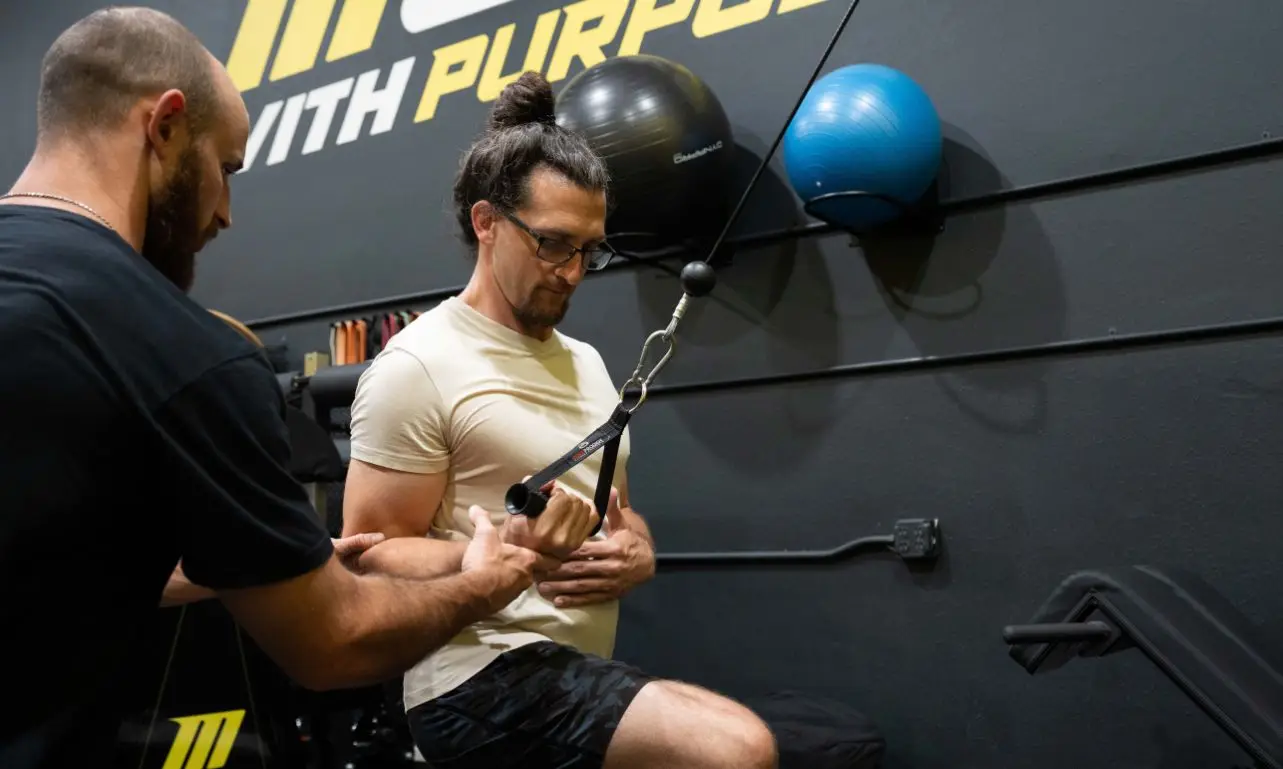
At Motive, mobility and strength exist inside the same training session. We’re not doing CARs for ten minutes and then switching to an unrelated lifting block. The controlled articular rotation work informs which positions you’ll be loaded in. The PAILs and RAILs work builds end-range strength at the joints that need it most. The strength programming then operates within a range the body can actually access and control.
This produces a different kind of strength. Not just bigger numbers on the bar, but capacity that holds up under real conditions, under fatigue, under the variability of actual life. The shoulder that can press because it was trained through its full controllable range performs differently than the shoulder that learned to press by working around a restriction.
The progression logic
One of the more practical questions people ask is how intensity gets managed in this model, especially if someone is coming in with pain or a history of injuries.
The short answer is that load follows range. You don’t load a range you don’t own. That’s not a permanent ceiling; it’s a starting point. As mobility work expands the joint’s usable range and the nervous system builds confidence in new positions, the load ceiling rises with it. The progression is tied to the body’s actual state, which means it tends to be durable in a way that arbitrary percentage-based progressions often aren’t.
For someone starting from a place of chronic pain or significant restriction, the early months of training look different than they might expect. Less intensity, more precision, more attention to what the body is doing rather than how much it’s doing. That’s often frustrating for people who are used to measuring progress by weight on the bar. But the clients who come through that phase build a training foundation that’s genuinely transferable, and they stop cycling through the injury-modification-avoidance pattern that brought them in. The full methodology behind this approach lives in Functional Range Conditioning.
Who this works for
People who train this way range from clients managing chronic pain who haven’t been able to train consistently in years, to athletes who have performance goals and want a methodology that keeps them durable while they chase them.
What they share is that they’ve usually tried the standard approach and found a ceiling on it. The ceiling is sometimes pain. Sometimes it’s plateau. Sometimes it’s just a nagging sense that training isn’t translating the way it should be.
Assessment-driven personal training tends to work well for exactly that population. When you know what you’re actually working with, the programming can be honest. That honesty often unlocks things that more generic approaches leave stuck.
South Austin is where we do this work in person at our studio at 714 Shelby Ln, but we also coach online through Motive Mobility for people who are working with us remotely. The methodology is the same regardless of format.
A practical note on getting started
If you’re interested in what this looks like, the best place to start is an assessment rather than jumping directly into a training program. The assessment gives us the joint-level picture we need to build something that actually makes sense for your body rather than a template that assumes everyone starts from the same place.
If you already have a clear picture of your movement limitations and want to get into the training side directly, reach out and we’ll figure out the right starting point.
The goal is training you can sustain and build on, not training you have to keep modifying around. That’s a realistic outcome when the foundation is built correctly. It’s harder to sustain when it isn’t.
Written by

Brian Murray, FRA, FRSC
Founder of Motive Training
Motive Training is a coaching studio in South Austin built around assessment, joint health, and strength you can use. Train with us in the studio, come to a KINSTRETCH class, or work through the progressions in KINSTRETCH Online.