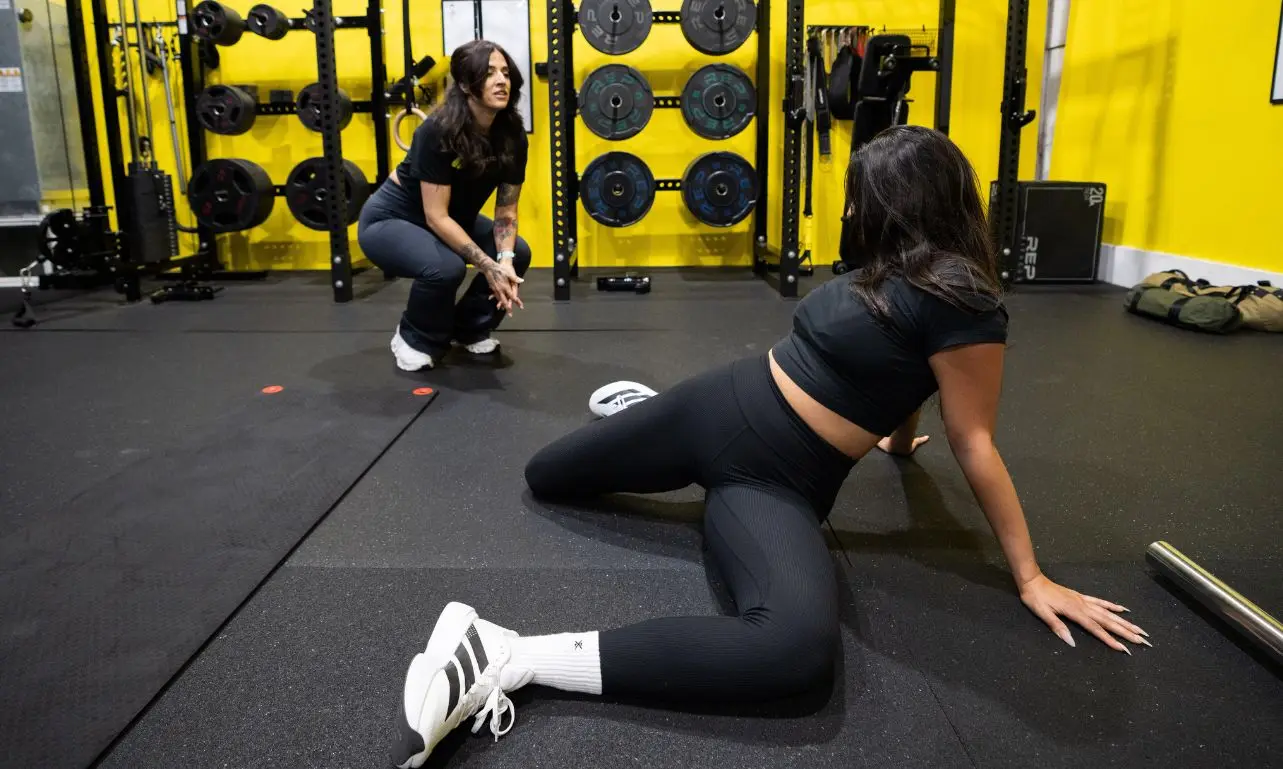
Hip internal rotation is the femur turning inward in the socket. Sit on a table with your knees bent and swing one foot out to the side; the foot travels outward, but the thigh bone is rotating inward. It’s a small movement, and it’s one of the ranges I find missing most often in people who have no idea it’s missing. Nobody walks into the gym complaining that their hip won’t internally rotate. They talk about tight hips, a squat that pinches at the bottom, or a stride that feels stuck on one side, and the internal rotation number shows up once somebody measures it.
That measurement is where this whole conversation has to start. Hip internal rotation can be limited by several different things, and the test is how you learn what this particular hip can do before deciding how to train it.
How to test hip internal rotation at home
There are two simple positions, and you want both, because the number changes depending on where the hip is.
Seated is the version most people know. Sit tall on the edge of a table or high bench so your thighs are supported and your knees hang at roughly 90 degrees. Keep both sit bones heavy on the surface. Now swing one foot outward as far as it will go using only your own muscle, without leaning your trunk or letting the opposite hip lift. Note where the shin ends up. Then use your hand to gently push the foot a little further, and note that position too.
Prone is the second version. Lie face down with your knees bent to 90 degrees and let both shins fall outward. Gravity does most of the work here, so this reads closer to your passive range with the hip in extension.
Textbook norms for internal rotation usually land somewhere around 35 to 45 degrees, depending on which textbook you open. I care less about that number than about three comparisons: left side against right, seated against prone, and active against passive. A hip that rotates well prone but poorly seated is telling you something different from a hip that’s limited everywhere.
The active-against-passive comparison needs a little context. Everyone has a gap between what they can produce on their own and what a hand can push them into; that’s how the nervous system works, and a gap by itself isn’t a problem. What we look for is a bigger gap than there should be. The FRC standard is that active range should sit within about 85 percent of passive range. A lot of people miss that in a lot of joints, and the hip in internal rotation is one of the most common places I see it.
Watch for the compensations, because they’re how the test lies to you. The trunk leans away. The opposite sit bone lifts off the table. The knee slides inward instead of the shin rotating. If any of those show up, the shin position you recorded is borrowing range from somewhere else.
Why the position changes the number
The hip capsule and the muscles around it don’t hold the same tension at 90 degrees of flexion as they do with the hip straight. So when someone has decent internal rotation lying on their stomach and almost none sitting up, that’s a useful clue; it points toward the structures that get tight when the hip is flexed. When internal rotation is limited in both positions by about the same amount, it’s harder to say what’s going on, which is part of why we don’t spend long guessing.
There’s a muscular detail here I find interesting. Most anatomy references describe the piriformis as an external rotator with the hip straight, but as the hip flexes past roughly 60 degrees, its line of pull shifts and it starts contributing to internal rotation instead. The exact angle varies by source and by person, so don’t quote me on the number. The point holds anyway: the hip doesn’t have a fixed list of internal rotators and external rotators, and a position-specific restriction can come from a muscle you wouldn’t expect.
What limits hip internal rotation
Bone shapes the range. The angle of the femoral neck relative to the shaft (femoral version) has a large effect on how far the hip can turn inward. In a cohort of 220 patients with hip pain, femoral version measured on CT predicted passive internal rotation more strongly than a cam-type deformity did, with internal rotation dropping as version decreased (1). That’s a population trend in people with painful hips. It doesn’t tell you where one person’s rotation ends, and as far as I know, no scan does; imaging can give clues, and that’s about it.
The capsule and ligaments come next. The posterior capsule and the ischiofemoral ligament both tighten as the femur turns inward, and capsular tissue adapts to the positions it spends time in. A hip that lives in flexion and external rotation for years tends to lose access to the inward turn.
Then the muscles: the deep external rotators, the posterior fibers of the glute medius, and anything else that resists the femur spinning inward. They can limit range by being short or by staying guarded.
And then control. Your nervous system governs how much of your passive range it lets you use, and it holds back from positions where you’ve never shown it you can produce force. When that holding back is bigger than it should be, the active-versus-passive comparison shows it.
So what do we do with all that? If someone is pain free, we train the rotation regardless of what might be limiting it. We don’t know what we don’t know. Capsular limits can be obvious in some hips and very hard to pin down in a hip that’s completely stuck, and a bony limit can’t be confirmed from the outside. None of that changes the decision, because training rotation is in the hip’s best interest either way. If the range opens, good. If it doesn’t open much, the hip still ends up stronger and more controlled in the range it has, and sometimes that’s the goal from the start. Sometimes the point is owning what you have and getting strong in it, more than chasing extra degrees.
Why stretching into internal rotation rarely holds
Stretching does increase range. Nobody serious argues otherwise. The question is what changes when it does, and the stretching research points mostly at tolerance; the joint learns to accept being pushed further without learning to do anything once it’s there. I went through that research, and why an isometric hold at the edge of range changes the picture, in the piece on isometric training at end range.
For range alone, stretching doesn’t hold an advantage over strength work either. A meta-analysis of 11 randomized trials found no meaningful difference in range of motion gains between strength training and stretching (2). The studies varied a lot in design, so I’d hold that loosely. But if loading a joint through its range gets you a similar amount of new range and builds strength in it at the same time, there isn’t much of a case for stretching alone.
This shows up constantly with lifters. They spend five minutes in a pigeon variation or a seated internal rotation stretch before squatting, feel looser, then load the bar and the range they found is gone by the second set. The hip had permission to be pushed there with no capacity to hold position under load, so the nervous system takes the range back.
How to train hip internal rotation
The progression we use follows Functional Range Conditioning principles, and each step asks the hip to own a little more of what it can reach.
Start with hip CARs. A controlled articular rotation is a slow, full circle of the joint under tension, and the internal rotation portion of a hip CAR is usually where people find the speed bump; the circle gets jagged or the pelvis starts helping. Done daily, CARs work as both maintenance and a running check on where your range is. The CARs guide walks through the setup.
Before any of the loading, it helps to understand what your hip can do right now. That’s most of what the test is for, and it’s why we show people their own range before asking them to work on it.
Next comes passive range plus isometric loading. Get into an internal rotation position you can access (seated, prone, or the back leg of a 90/90 sit) and spend a couple of minutes there with the hip relaxed into it. Then press the leg back out against the floor or your own hand, building tension gradually, so the tissue being lengthened is also contracting. That’s the PAIL. Then try to pull further into internal rotation using the muscles on the inside of the movement. That’s the RAIL. The PAILs and RAILs explainer covers the mechanism, and the programming guide covers hold times and intensity.
On 90/90, a quick aside. It’s become the default hip internal rotation position online, and there’s a reason: it puts the capsule in a good position to “stretch” (stretch in quotes, since there’s more going on than tissue getting longer). We use it when it’s relevant and the person can get into it well. Plenty of people can’t. Not every hip, knee, or low back tolerates a good 90/90, and the front leg sits in external rotation, which can be its own limitation and make it harder to find the internal rotation stretch on the back leg. So we use whatever position gets the job done and that the person can access. Prone and seated work hit the same joint action.
Then active end range work. Liftoffs are the common version: from the internal rotation position, take your hand or the floor out of the picture and try to lift the foot or shin a little further using only the hip. The movement is usually tiny, and it tends to cramp. That cramp is the nervous system meeting a range it hasn’t been asked to control before. Eccentrics fit here too, slowly lowering out of the end position under control. Which tools come in, and when, depends on the person; the progression is different for everyone.
Last, take it somewhere it matters. Internal rotation has to show up in standing and under load to be of much use. That might mean controlled rotation on a single leg, a split stance where the front hip turns inward over the foot, or narrowing a squat stance so the hips have to use some internal rotation at depth. The B-stance Romanian deadlift below is one I like for a lot of reasons, and internal rotation is one of them; the hip hinges and turns inward over the working leg with load in hand. I’d only use it for internal rotation once the position has been opened up and the person can feel a good internal rotation stretch in an internally rotated stance. When internal rotation is stuck, the pelvis is often part of the problem too (not always), and loading a position someone can’t get into just moves the compensation somewhere else. Until then, something else does the job.
As for frequency, CARs daily, the heavier isometric work two or three times a week with recovery between, and retest every few weeks using the same seated and prone checks. From what I’ve seen, the active range moves slower than people expect and holds better than passive gains do.
Desk workers, lifters, and everyone else
Missing internal rotation is across the board. Sitting puts the hip in flexion for hours and rarely asks it to rotate at all, and capsules and muscles adapt to where they spend time. The average lifter doesn’t train it either. A wide stance with toes turned out is a perfectly good way to squat, and it also means the hip rarely uses internal rotation under load.
Some people find mechanical workarounds. They get depth from extra hip flexion or a lot of ankle dorsiflexion, and their squat looks fine. That still leaves internal rotation worth training, because it’s a fundamental motion of the joint, and a hip that has it and controls it has more options than a hip that’s working around its absence. When a hip loses rotation, the movement still has to happen somewhere; restrictions in the hip often show up as complaints in the low back or knee. That’s a pattern worth knowing, and it’s also why I’d never tell anyone their back pain comes from their hip without measuring both.
Start with the measurement
Here’s the thing about hip internal rotation. You don’t need to know exactly why a hip is limited to start training it, as long as it’s pain free. You do need to know what it can do now, how big the gap is between what you can reach and what you can control, and how that compares side to side. The test gives you that, and it gives you something to retest against. If you want somebody to run it with you and sort out what’s limiting the range, that’s what we do when people get assessed. If you’d prefer to work through it on your own, KINSTRETCH Online runs this kind of progression as guided classes.
References
- Kraeutler MJ, Chadayammuri V, Garabekyan T, Mei-Dan O. Femoral version abnormalities significantly outweigh effect of cam impingement on hip internal rotation. J Bone Joint Surg Am. 2018;100(3):205-210. https://doi.org/10.2106/JBJS.17.00376
- Afonso J, Ramirez-Campillo R, Moscão J, et al. Strength training versus stretching for improving range of motion: a systematic review and meta-analysis. Healthcare (Basel). 2021;9(4):427. https://doi.org/10.3390/healthcare9040427
Written by

Brian Murray, FRA, FRSC
Founder of Motive Training
Motive Training is a coaching studio in South Austin built around assessment, joint health, and strength you can use. Train with us in the studio, come to a KINSTRETCH class, or work through the progressions in KINSTRETCH Online.