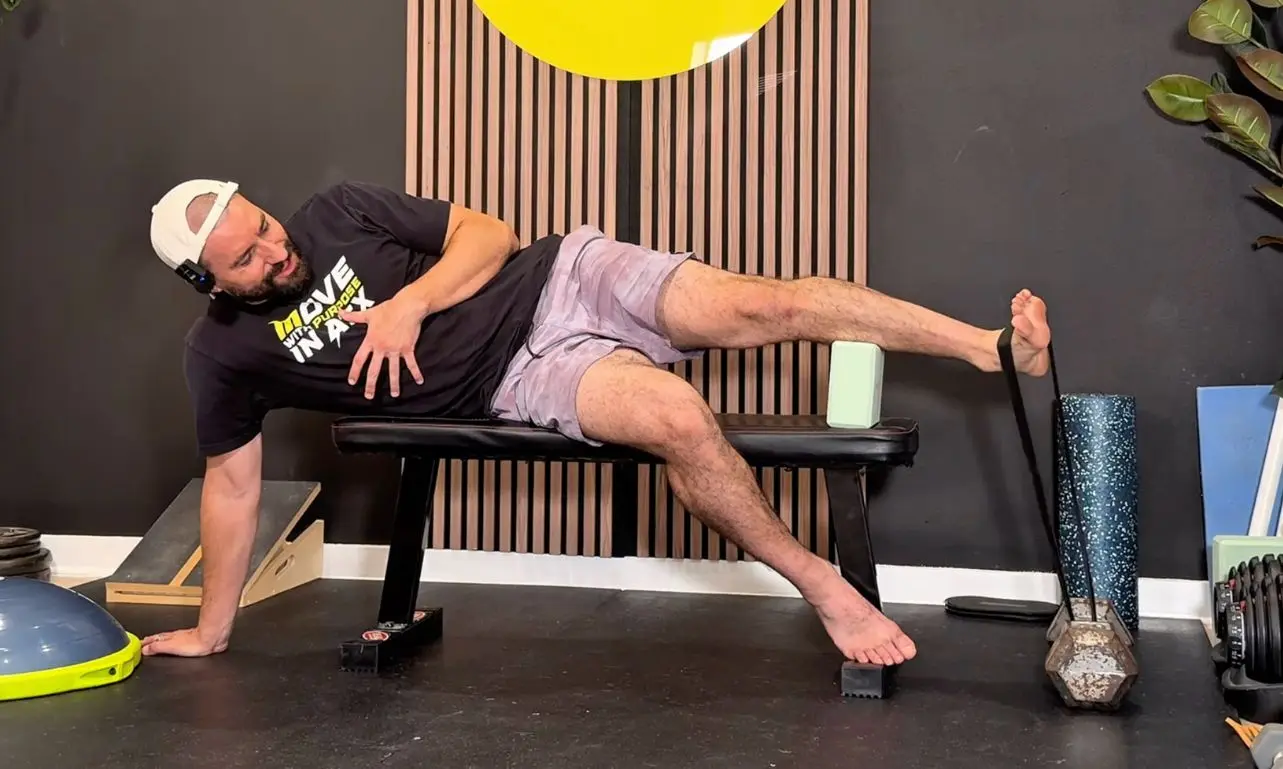
Most lists of isometric exercises look alike. Plank, wall sit, glute bridge hold, dead hang, maybe a Pallof press, each held somewhere comfortable for thirty to sixty seconds. They’re reasonable exercises, and they make isometrics look like a category of endurance drill, a way to sit under tension until the timer goes off.
That’s a narrow use of one of the most adaptable tools in training. The angle you hold at decides most of what you get back, and the angle that pays the most is the one those lists leave out.
What isometric training is
An isometric contraction is muscle producing force without the joint angle changing. Pushing against a wall and holding a weight dead still both qualify. Isometric training is the deliberate use of those contractions at a chosen angle and effort, for a chosen length of time.
Isometrics get treated as the beginner version of strength training because nothing moves. Some are easy, and some of the hardest efforts in the gym are isometric too; a maximal contraction at the end of a hip’s range has little in common with a wall sit.
Isometric strength stays close to the angle you train
The best-known finding about isometrics is how specific they are. In a classic study, subjects trained calf isometrics at a single ankle angle for six weeks. Voluntary strength went up at the training angle and at the angles immediately beside it, within a few degrees, and nowhere else (1). Electrically evoked strength didn’t change, which pointed the authors toward a neural explanation: the nervous system learned to drive the muscle harder at that angle.
Later work refined it. When people trained knee extension isometrics at short muscle lengths, strength improved mostly around the training angle, driven by neural changes. When they trained at long muscle lengths, the gains spread across a wider span of angles and the muscle grew (2). A systematic review of isometric training landed in the same place, with holds at longer muscle lengths producing more hypertrophy than equal volumes at shorter lengths and transferring better to dynamic performance (3).
Two practical consequences fall out of that. Isometrics held only at comfortable mid-range angles build strength at comfortable mid-range angles. And the long end of a muscle’s range, where most people are weakest, is also where isometrics seem to give the broadest return. That’s the case for end-range mobility training in research terms.
Why a hold at the edge changes the range you can use
Passive range is where a joint can be placed, and active range is the portion of that the joint can reach and work in on its own. The difference is mostly a control problem, and the FRC model explains it through the nervous system’s protective role, with the body limiting access to ranges it has no evidence it can control.
The stretching research supports the first half of that idea. In one well-known study, three weeks of calf stretching increased dorsiflexion range by about 20 percent, and the change was explained mostly by greater tolerance to the stretch, with the nervous system allowing more range before calling a stop (4). Stretching by itself gives the body no evidence of control at that new range. The person reaches further while in the position, and in my experience the gain tends to fade once they stop stretching.
An isometric contraction at end range supplies that evidence. The muscle produces force at the angle in question while the joint holds still, and nothing bad happens. The working model is that repeated exposures like this teach the nervous system the range is safe to use, so it eases off the restriction. I’d call it a model because nobody has measured that mechanism directly. What has been measured fits it well enough: isometric strength responds at the trained angle (1), and long-length training produces broader strength and tissue change. The step from stronger at this angle to more range granted by the nervous system is a reasonable one, built on what shows up in assessments again and again, but it’s still inference.
The logic behind PAILs and RAILs
PAILs and RAILs are the FRC method for putting isometric contractions at the edge of range in order. You move into a position near end range and stay there long enough for the tissue to settle. Then comes the PAIL (progressive angular isometric loading), where you contract the tissues being lengthened, pressing against the floor or your own limb as if trying to come out of the stretch, and ramp the effort up slowly. The RAIL (regressive angular isometric loading) follows, contracting the tissue on the other side of the joint to pull further into the range with no outside help. The technique itself is laid out in our PAILs and RAILs breakdown.
Read against the research above, the two halves do different jobs. The PAIL loads the lengthened tissue at a long muscle length, the condition that produced the broadest strength gains and the most tissue change in the isometric literature. The RAIL loads the shortened tissue at a short muscle length, where gains tend to stay close to the trained angle and come mainly from the nervous system learning to drive the muscle there. For a RAIL that suits the purpose. Its job is control at one specific angle, the last few degrees the person can reach, and angle-specific neural gains are what that job calls for.
I don’t know of a trial that has tested PAILs and RAILs as a package, so this is the general isometric research read onto the technique. It’s a good fit, though a fit is all it is until someone tests it directly.
Why isometrics are the most controllable way to load a joint
Every other way of loading a joint brings in something you can’t fully manage in the moment. Concentric and eccentric work involve speed and a changing angle, so the hardest part of a rep can land on a position the joint can’t handle before the person has time to react. An isometric strips that out. The angle gets chosen in advance and stays put, and effort is set by intent, so it can rise or fall second by second. If something feels wrong the contraction stops instantly, with no weight in motion to deal with.
That control is why isometrics show up so often in rehab settings, and why they make the right first contact with a range a person has never loaded. Someone working at the edge of their hip rotation for the first time can contract at twenty percent effort, see how the joint responds, and climb from there. Try the same thing with a loaded movement at that angle and the load decides the effort for you.
It also explains the order of a KINSTRETCH Online class. Sessions open with joint rotations to see where each joint stands that day, and most of the work then lives in held end-range positions where effort is something the person dials in. Moving through those ranges under load comes after the hold is solid.
From one angle to a whole path
Angle specificity also sets the limit of a single hold. Gains stay near the angle trained, so a hold at one position mostly builds one position. The FRC answer is to string angles together: hold, move a few degrees while keeping tension, hold again, and keep going until the whole range has been worked under control. We call that the isometric movement path, and it’s where single-angle isometrics turn into range that holds up while you move through it.
A plank held for thirty seconds builds what it builds, and there’s nothing wrong with it. The question worth asking of any isometric is where in the range it’s happening, because the body pays close attention to that and almost none to the timer.
References
- Kitai TA, Sale DG. Specificity of joint angle in isometric training. Eur J Appl Physiol Occup Physiol. 1989;58(7):744-748. https://doi.org/10.1007/BF00637386
- Noorkõiv M, Nosaka K, Blazevich AJ. Neuromuscular adaptations associated with knee joint angle-specific force change. Med Sci Sports Exerc. 2014;46(8):1525-1537. https://doi.org/10.1249/MSS.0000000000000269
- Oranchuk DJ, Storey AG, Nelson AR, Cronin JB. Isometric training and long-term adaptations: effects of muscle length, intensity, and intent: a systematic review. Scand J Med Sci Sports. 2019;29(4):484-503. https://doi.org/10.1111/sms.13375
- Blazevich AJ, Cannavan D, Waugh CM, et al. Range of motion, neuromechanical, and architectural adaptations to plantar flexor stretch training in humans. J Appl Physiol (1985). 2014;117(5):452-462. https://doi.org/10.1152/japplphysiol.00204.2014
Written by

Brian Murray, FRA, FRSC
Founder of Motive Training
Motive Training is a coaching studio in South Austin built around assessment, joint health, and strength you can use. Train with us in the studio, come to a KINSTRETCH class, or work through the progressions in KINSTRETCH Online.