Why People End Up Comparing These Two
KINSTRETCH and Pilates don’t look alike on the surface. One involves slow, controlled joint circles on a mat. The other involves reformers, springs, and choreographed movement sequences. But they attract a similar audience—people who want to move better, reduce pain, and build a body that holds up over time—and that overlap is why the comparison keeps coming up.
If you’ve done Pilates for years and want to know whether KINSTRETCH would add anything, or if you’re new to both and trying to figure out where to start, this article is worth reading before you commit to either.
What Pilates Actually Is
Pilates was developed by Joseph Pilates in the early 20th century, originally as a rehabilitation system for injured dancers and soldiers. The method centers on controlled movement, breath coordination, and what Pilates called “the powerhouse”—the deep core musculature including the transverse abdominis, pelvic floor, and multifidus.
Modern Pilates comes in two primary forms. Mat Pilates uses bodyweight exercises on the floor. Reformer Pilates uses a spring-resistance machine to create variable load through movement. Both emphasize alignment, postural control, and movement quality over raw strength or cardiovascular output.
Pilates is genuinely effective for building core stability, improving posture, developing body awareness, and recovering from certain injuries. It has a strong evidence base for lower back pain rehabilitation and is widely used in clinical and fitness settings. The limitations aren’t about quality—they’re about scope.
What KINSTRETCH Actually Is
KINSTRETCH is a movement enhancement system developed by Dr. Andreo Spina as part of the Functional Range Conditioning framework. Where Pilates is built around movement patterns and postural control, KINSTRETCH is built around joints.
The central premise is that the nervous system governs movement. Your brain constantly monitors every joint in your body and will limit range of motion in any area it perceives as uncontrolled or unsafe. KINSTRETCH works by systematically expanding joint range of motion while simultaneously building strength and neurological control within that range—so the brain stops treating those positions as threats.
The primary tools are Controlled Articular Rotations (CARs), which take each joint through its full available range under active muscular control, and PAILs/RAILs (Progressive and Regressive Angular Isometric Loading), which build strength at end range through isometric contractions. The work is slow, deliberate, and demanding in a way that doesn’t look intense from the outside but produces significant neurological fatigue.
A KINSTRETCH class moves joint by joint through the body—hips, shoulders, spine, ankles, wrists—addressing each one individually rather than training movement patterns that assume those joints already work well. If you want a deeper look at what the methodology is built on, our introduction to Functional Range Conditioning covers the full system.
The Fundamental Difference
Pilates trains movement. KINSTRETCH trains the joints that make movement possible.
This distinction matters more than it might seem. Pilates assumes a certain baseline of joint function and builds on top of it. If your hip internal rotation is limited, a Pilates instructor will cue you to engage your core and find a neutral pelvis—which is useful, but doesn’t address why the hip isn’t rotating. The limitation stays. The compensation continues.
KINSTRETCH starts one level deeper. Before any movement pattern is trained, the question is: can each joint actually do what the movement requires? If the answer is no, KINSTRETCH provides the tools to change that. CARs assess and maintain joint health daily. PAILs/RAILs expand usable range and build the strength to control it.
This is why many people find that KINSTRETCH changes the way their Pilates practice feels. When the hip joint can actually move through its full range, the Pilates exercises that require hip mobility stop being a struggle. The movement becomes available instead of approximated.
How the Training Experience Compares
A Pilates class—especially reformer—has a specific texture. There’s equipment, a choreographed sequence, an instructor cueing form through familiar exercises. The pace is moderate. The work is rhythmic. It’s accessible to most fitness levels and the learning curve is gradual.
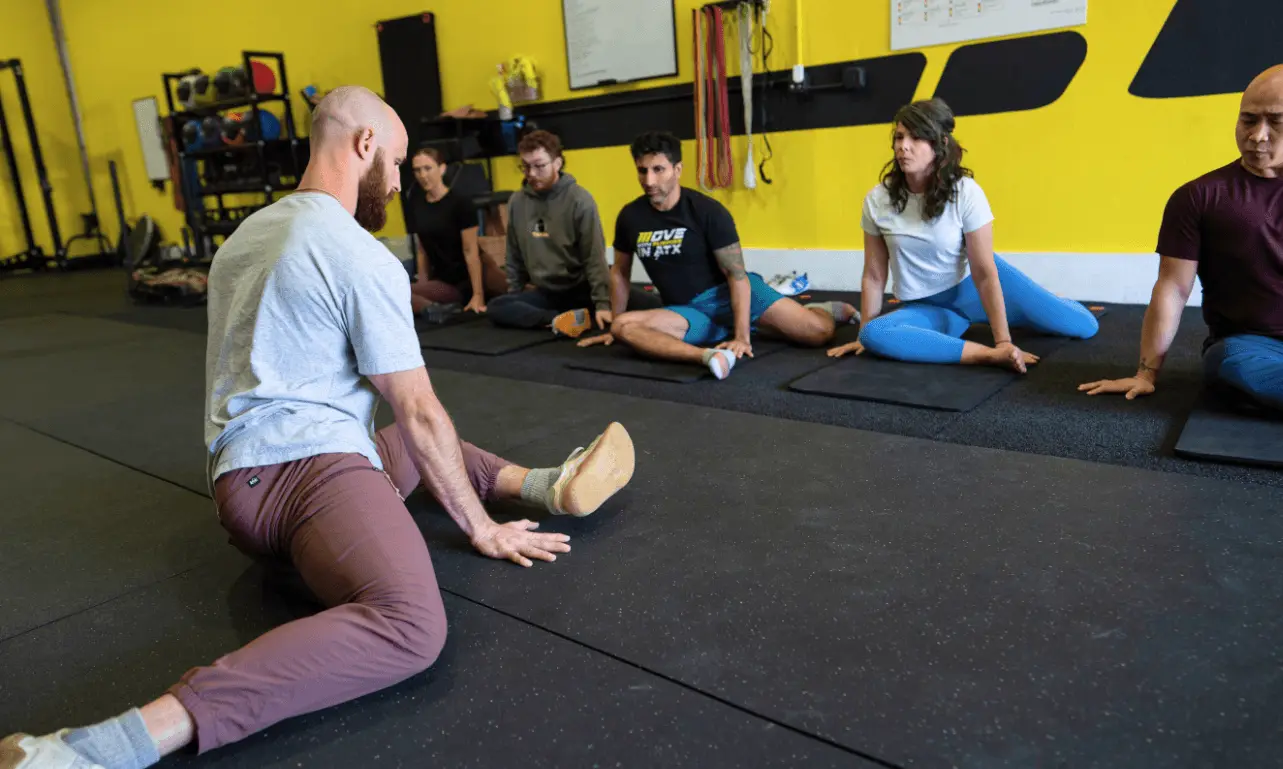
A KINSTRETCH class is different in almost every way. You’re on the floor. There’s no equipment. The exercises look simple—slow joint rotations, holds at end range, controlled contractions—but the internal demand is high. You’ll feel muscles working that you didn’t know existed, in positions that feel unfamiliar because your body hasn’t been there under load before. The learning curve is steeper in the early sessions, and the discomfort is neurological rather than muscular.
Both require consistency to produce results. Neither is a quick fix. But the timeline looks different. Pilates builds over months of accumulated movement practice. KINSTRETCH can produce noticeable changes in joint range and pain levels within a few weeks because it’s working at the neurological level—changing what the nervous system will allow, not just improving coordination within existing limits.
Where Each One Falls Short
Pilates doesn’t address joint-level restrictions directly. If you have genuinely limited hip flexion, ankle dorsiflexion, or shoulder rotation, Pilates will work around those limitations rather than resolving them. For many people this is fine—they never push far enough into end range to notice. For active people, athletes, or anyone dealing with chronic pain, those unaddressed restrictions eventually become the limiting factor.
KINSTRETCH doesn’t build the kind of whole-body movement integration that Pilates develops. It won’t give you the postural awareness, the breath-movement coordination, or the progressive challenge of sequenced movement patterns that make Pilates valuable. KINSTRETCH also doesn’t address cardiovascular fitness or build functional strength through full movement patterns the way a complete training program would. For that, it works best when paired with structured personal training.
Neither is a complete system on its own. The question isn’t which one is better—it’s which one addresses what you’re actually missing.
Who Should Choose KINSTRETCH
KINSTRETCH is the right starting point if you have specific joints that feel stiff, restricted, or painful, if you’ve done Pilates or yoga for years but still feel tight in certain areas, if you’re an athlete or active person dealing with recurring injury or limitation, if you want to understand why your body moves the way it does rather than just improving how it looks, or if you’re coming out of physical therapy and want to build on what you recovered.
For clients dealing with pain specifically, the Functional Range Assessment we use at Motive Training gives a precise picture of which joints are restricted and what needs to change before any other training can fully work. It’s a useful starting point regardless of whether you end up doing KINSTRETCH, Pilates, or both.
Who Should Choose Pilates
Pilates is the right choice if you want a structured movement practice with a long track record and wide availability, if postural awareness and core stability are your primary goals, if you’re recovering from certain back or hip injuries where the Pilates evidence base is strong, or if you genuinely enjoy the reformer environment and the community that comes with a consistent studio practice.
Pilates is also more accessible in Austin by volume. There are dozens of studios. KINSTRETCH is offered by a much smaller number of providers—and among those, the depth of instruction varies significantly depending on the practitioner’s credentials and training.
Can You Do Both?
Yes, and for many people it makes sense. KINSTRETCH addresses the joint-level restrictions that limit what Pilates can accomplish. Pilates builds the movement integration and postural control that gives KINSTRETCH work somewhere to go.
The sequencing matters though. If you’re dealing with pain or significant restriction, starting with KINSTRETCH and adding Pilates later tends to produce better outcomes than the reverse. Trying to build movement patterns on top of unresolved joint limitations is why a lot of people plateau in Pilates after a certain point. If pain is part of the picture, our article on pain relief personal training explains how we approach that layer before anything else.
FAQ: KINSTRETCH vs Pilates
Is KINSTRETCH the same as yoga or Pilates?
No. KINSTRETCH is a joint training system built on neurological principles—specifically the idea that the nervous system controls how much range of motion you can access. Yoga and Pilates are movement practices with different philosophical and methodological foundations. KINSTRETCH shares some surface-level similarities with yoga in that it involves floor-based movement, but the mechanism and intent are fundamentally different.
Can KINSTRETCH help if Pilates hasn’t fixed my pain?
Often yes. If Pilates hasn’t resolved a recurring pain pattern, it’s frequently because the underlying joint restriction driving that pattern was never directly addressed. KINSTRETCH works at the joint level—assessing and expanding actual range of motion and building strength within it—which is a different intervention than movement pattern training.
Do I need to be flexible to start KINSTRETCH?
No. KINSTRETCH works with whatever range of motion you currently have. The goal is to expand and strengthen that range over time, starting exactly where you are. Lack of flexibility is one of the primary reasons to start, not a reason to wait.
How is KINSTRETCH taught in Austin?
KINSTRETCH is taught by practitioners certified through Functional Range Systems. At Motive Training in South Austin, KINSTRETCH classes are integrated into both group and individual programming. Certification requires significant ongoing education, which is why the quality of instruction varies considerably between providers.
How often should I do KINSTRETCH?
For most people, two to three sessions per week produces meaningful change over 8 to 12 weeks. Daily CARs—the joint rotation component of KINSTRETCH—can and should be done every day as a maintenance and assessment tool. The more intensive PAILs/RAILs work requires recovery time between sessions.
The Bottom Line
Pilates and KINSTRETCH are both legitimate, effective practices. They’re solving different problems. Pilates builds movement integration, postural control, and core stability on top of whatever joint function you currently have. KINSTRETCH expands and strengthens that joint function directly.
If you’re moving well and want to move better, Pilates is a reasonable choice. If something isn’t working—a joint that won’t cooperate, a pain pattern that keeps returning, a range of motion that never improves—KINSTRETCH addresses the layer underneath.
Book a free strategy session to find out which approach fits where you are right now.
Written by

Brian Murray, FRA, FRSC
Founder of Motive Training
Motive Training is a coaching studio in South Austin built around assessment, joint health, and strength you can use. Train with us in the studio, come to a KINSTRETCH class, or work through the progressions in KINSTRETCH Online.