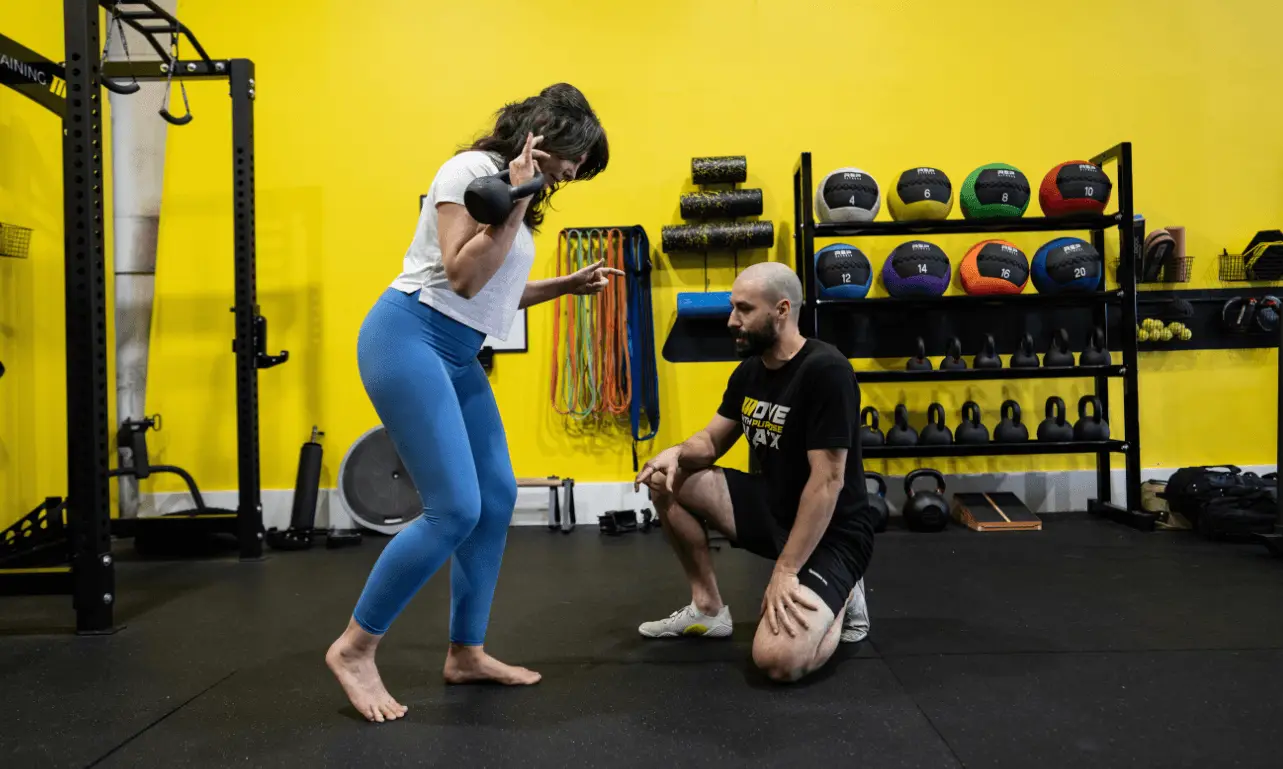
The Problem With How Most Trainers Handle Pain
Most personal trainers in Austin do one of two things when a client mentions pain. They refer out immediately, or they work around it—skipping the exercises that aggravate it and hoping the rest of the program fills the gap.
Neither approach solves anything.
Referring out makes sense when something is acutely injured and needs clinical care. But most people who walk into a gym with chronic pain aren’t dealing with an acute injury. They’re dealing with years of accumulated movement restrictions, compensations, and joints that have never been trained to work through their full range. That’s not a medical problem. It’s a movement problem.
Working around pain has its own issues. If your hip hurts during a squat and the solution is to just not squat, the hip never gets stronger. The restriction stays. The compensation pattern deepens. And eventually something else starts to hurt because it’s been covering for the hip the whole time.
At Motive Training, we take a different approach entirely.
Why Pain and Movement Are Inseparable
Pain is information. In most chronic cases, it’s the body signaling that a joint is being loaded in a range it doesn’t have the capacity to control.
This is the foundation of Functional Range Conditioning—the methodology that underlies everything at Motive Training. Developed by Dr. Andreo Spina, FRC operates on the principle that the nervous system governs movement. When a joint lacks strength and neurological control at end range, the brain treats that range as a threat. The response is pain, stiffness, or both.
Stretching alone doesn’t fix this. Passive stretching can temporarily increase range of motion, but because no muscular control is built at the new range, the nervous system doesn’t trust it. The restriction returns. The pain returns with it.
What actually changes the pattern is building strength and control within the range that’s been avoided—teaching the nervous system that the joint is safe to use. This is what FRC tools like Controlled Articular Rotations and PAILs/RAILs are designed to do, and it’s why clients who’ve spent years managing pain through stretching and rest often feel a meaningful difference within weeks of starting this kind of training.
The Most Common Pain Patterns We See in Austin
Austin’s population has a specific physical profile. A large percentage of the city’s workforce sits at a desk for most of the day. Tech workers at Tesla, Dell, Samsung, Apple, and Google make up a significant portion of our client base, and they tend to come in with the same overlapping patterns.
Lower back pain is the most common. It’s almost always connected to restricted hip mobility. When the hips can’t move through their full range, the lumbar spine compensates. Over time that compensation creates load the lower back wasn’t designed to handle. Addressing hip mobility directly—not just stretching the back—is what resolves it. We go deeper on this in our article on conquering back pain with Functional Range Conditioning.
Neck and shoulder pain follows a predictable pattern called Upper Crossed Syndrome. Prolonged screen time creates tightness in the upper traps, levator scapulae, and pectorals while the deep cervical flexors and mid-back muscles go underactive. The result is forward head posture, rounded shoulders, and a thoracic spine that stops rotating. Most people treat this by stretching their neck. The actual fix involves restoring thoracic mobility and reactivating the muscles that have gone quiet.
Knee pain in active clients—runners, cyclists, pickleball players—is frequently a hip problem presenting at the knee. Restricted hip internal rotation or weak glutes create a valgus pattern at the knee that accumulates stress over time. Treating the knee without addressing the hip is why so many people manage knee pain for years without resolving it.
How Assessment Changes the Starting Point
Every client at Motive Training starts with a Functional Range Assessment before any training begins. This is a joint-by-joint evaluation that maps exactly how each joint moves, where control breaks down, and what restrictions are present.
For pain relief clients, this is especially important. It removes the guesswork from the process. Instead of building a program around what hurts and hoping the rest falls into place, we build it around a precise picture of what’s actually limiting movement—and what needs to change first.
This also means we know when to refer. If an assessment reveals something that needs clinical attention before training can progress, we say so clearly. Austin has excellent physical therapists, and Motive Training works as the bridge between clinical rehab and full training capacity—not as a replacement for medical care.
What Pain Relief Training Actually Looks Like at Motive
Training at Motive doesn’t look like physical therapy and it doesn’t look like a conventional gym program. It sits in the space between the two.
Sessions are built around restoring joint function first, then layering strength on top of that restored function. For most pain relief clients, the early weeks focus heavily on joint-specific mobility work—Controlled Articular Rotations and isometric end-range loading—to rebuild capacity in the ranges that have been restricted or avoided. If you’re unfamiliar with that approach, our KINSTRETCH page explains the methodology behind it.
As joint capacity improves, progressive resistance training is introduced in those ranges. This is the critical step that most programs skip. Building strength through full range of motion—not just in the comfortable middle—is what creates durable change and reduces the likelihood of pain returning.
The process is gradual and deliberate. It’s also cumulative. Each session builds on the last, and the reassessment built into every 90-day block gives us clear data on what’s changed and what to address next.
Why No Personal Trainer in Austin Is Doing This
The intelligence gap in Austin’s fitness market around pain is significant. A search for pain-related training queries in Austin surfaces physical therapists, chiropractors, and spine surgeons. Zero personal trainers appear.
This isn’t because trainers don’t have clients with pain. It’s because most trainers don’t have a methodology that equips them to address it. General certifications from ACE or NASM cover exercise programming. They don’t cover joint-specific assessment, neurological primacy, or the distinction between passive range and active range that determines whether a movement restriction is a training variable or a clinical referral.
FRC credentials—FRCms, FRSC, FRA, KINSTRETCH Level II—exist specifically in this space. They represent a level of joint health education that sits well above standard personal training certifications and well below clinical licensure. It’s the credential set that makes pain relief training possible without overstepping into diagnosis or treatment.
Motive Training holds these credentials. In Austin, almost no one else does. You can read more about how we structure our personal training programs around this foundation.
Who This Is For
This approach is the right fit for people who have been managing chronic pain for months or years without resolution, who have been cleared by a doctor or physical therapist but still don’t feel right, who have avoided training because they’re not sure what’s safe, and who want a program that addresses the root cause rather than working around it.
It’s also well suited for people coming out of physical therapy who aren’t sure how to bridge back to full training. The post-rehab gap—the period between being cleared from PT and feeling genuinely capable again—is one of the most underserved spaces in Austin’s fitness market, and it’s one Motive Training is specifically equipped to fill.
FAQ: Pain Relief Personal Training in Austin
Can a personal trainer help with chronic pain?
A personal trainer with the right credentials and methodology can address many chronic pain patterns through movement-based training. At Motive Training, Functional Range Conditioning provides a structured framework for identifying restricted joints, building strength at end range, and reducing the compensations that create chronic pain. This is different from treating pain clinically—if something requires diagnosis or manual therapy, we refer to the appropriate provider.
What is the difference between personal training and physical therapy for pain?
Physical therapists diagnose and treat injury and pathology. Personal trainers build capacity, strength, and movement quality. For many people with chronic pain, the issue isn’t an active injury—it’s a long-standing movement restriction that has never been trained. In those cases, structured personal training through an approach like FRC is often more appropriate than ongoing PT.
Is it safe to train with lower back pain?
In most cases, yes—with the right approach. Lower back pain is one of the most common conditions we see at Motive Training, and it’s almost always connected to hip mobility restrictions that can be addressed through training. A Functional Range Assessment gives us a clear picture of what’s safe to load, what needs to be restored first, and how to build a program that reduces pain rather than aggravating it.
How long before pain improves through training?
Most clients notice meaningful improvement in pain levels and movement quality within 4 to 8 weeks of consistent training. Full resolution of chronic patterns typically takes longer—3 to 6 months depending on how long the restriction has been present and how consistently the underlying issues are addressed. The goal is durable change, not temporary relief.
Do you work with clients who are post-surgery or post-physical therapy?
Yes. The post-rehab bridge is one of the most common entry points at Motive Training. If you’ve been cleared by your surgeon or physical therapist but don’t feel ready to train on your own, a Functional Range Assessment gives us a clear picture of where you are and what the path forward looks like.
If Pain Has Been Keeping You Out of the Gym, This Is Where to Start
Chronic pain doesn’t have to be the reason you don’t train. In most cases, it’s the reason you should.
At Motive Training in South Austin, every program starts with understanding how your body actually moves—not just what it can’t do. That starting point changes everything.
Book a free strategy session and find out what’s actually limiting your movement and what training can do about it.
Written by

Brian Murray, FRA, FRSC
Founder of Motive Training
Motive Training is a coaching studio in South Austin built around assessment, joint health, and strength you can use. Train with us in the studio, come to a KINSTRETCH class, or work through the progressions in KINSTRETCH Online.