Most people treat strength and mobility as separate pursuits. Strength days look one way. Mobility work, if it happens at all, gets squeezed in before or after as an afterthought. The problem is that this separation is exactly why both tend to plateau.
Strength and mobility aren’t competing priorities. They’re the same priority, expressed differently. And once you understand why, the way you train changes permanently.
What Mobility Actually Is (And What It Isn’t)
Mobility is not flexibility. This distinction matters more than most people realize.
Flexibility is passive—it’s the range your tissues will allow when an external force is applied. Mobility is active—it’s the range you can actually control with muscular effort. You can be extremely flexible and have terrible mobility. In fact, hypermobility without strength is one of the most common sources of joint pain and injury in people who stretch regularly but never load those ranges.
The practical definition is simple: mobility is strength within your range of motion. A hip that can move through 120 degrees of rotation passively but only 60 degrees actively has a 60-degree gap. That gap is where injuries live. It’s range the nervous system doesn’t trust, range the body can’t control under load or speed, range that looks fine on a table and fails on a field or a trail.
Functional Range Conditioning is built entirely around closing that gap—not just expanding range, but building the strength and neurological control to own every degree of it.
Why Strength Training Alone Hits a Wall
Strength training produces real, measurable adaptations. Muscle grows. Tendons stiffen. The nervous system learns to recruit more motor units. These are not small things.
But strength training done without attention to joint range of motion has a ceiling—and most people hit it sooner than they expect.
Here’s why: the body will only produce force through ranges it considers safe. If your hip flexors are chronically shortened, your glutes won’t fire at full capacity regardless of how much you train them. If your thoracic spine is stiff, your shoulder press will compensate through the lower back and neck. If your ankle dorsiflexion is limited, your squat pattern will break down before your legs are anywhere near their strength potential.
This is what coaches mean when they say mobility is the foundation of strength. It’s not philosophical. It’s mechanical. Joint range of motion determines the range over which your muscles can produce force. More usable range equals more total strength potential.
If you’ve been strength training consistently and feel like you’ve hit a ceiling, restricted joint range of motion is the first place to look.
Why Mobility Training Without Strength Doesn’t Stick
The other side of this equation is equally important and less commonly discussed.
Passive stretching and mobility work that doesn’t include strength components produces temporary change at best. You feel looser after a session. You might have genuinely expanded your passive range. But if you haven’t built the muscular control to access and use that range actively, the nervous system will quietly shrink it back down—because unused range is untrustworthy range, and the brain is conservative about what it allows.
This is the physiological reason people stretch the same spots for years without lasting improvement. The tissue tolerance changes. The structural adaptation doesn’t follow. And the neurological ownership—the brain’s willingness to let you use the range under load and speed—never develops.
Real mobility gains require two things happening simultaneously: range expansion and strength at that new range. That means the end of a stretch is also the beginning of a strengthening exercise. The position you can barely hold passively is exactly the position you need to train actively.
This is the core principle behind PAILs and RAILs—progressive and regressive angular isometric loading at end range. You expand the range, then immediately load it isometrically to signal the nervous system that the new range is safe and controllable. That combination produces changes that last.
What This Looks Like for Runners
Runners are one of the clearest examples of what happens when strength and mobility get treated as separate concerns.
The typical runner’s problem set: tight hip flexors from repetitive sagittal plane movement, limited hip internal rotation, restricted ankle dorsiflexion, and stiff thoracic spine. These aren’t isolated issues. They’re a connected chain of restrictions that alter running mechanics, reduce efficiency, and eventually produce injury—usually at the knee, hip, or lower back, which are the joints absorbing the compensation load.
Stretching the hip flexors helps temporarily. Foam rolling the IT band feels productive. Neither addresses the actual problem, which is that the hip isn’t strong through its full range of motion and the ankle can’t dorsiflex adequately under load.
Strength and mobility training for runners means building hip extension strength at end range, ankle dorsiflexion under load, and rotational capacity through the thoracic spine—not as separate workouts, but as integrated training that develops both simultaneously. The result isn’t just fewer injuries. It’s more powerful, more efficient running mechanics.
What This Looks Like for Beginners
If you’re new to structured training, the strength-mobility integration isn’t a complication. It’s actually the clearest possible starting point.
Beginning with movement quality—learning to control your joints through full ranges before adding significant load—builds the foundation that determines how far your strength training can ultimately go. It’s also significantly safer. Loading restricted patterns produces injury. Loading well-controlled patterns produces adaptation.
The most common mistake beginners make is skipping this foundation entirely and jumping straight into loading. Progress feels fast at first because any stimulus produces adaptation in a deconditioned body. But the ceiling arrives quickly, and the injuries arrive with it.
Starting with a movement assessment before building a training program isn’t slowing things down. It’s the only way to build something that lasts.
Training Both at the Same Time
The practical implication of all this is that your training sessions shouldn’t have a “strength part” and a “mobility part.” They should have movement that develops both simultaneously.
That means warming up with controlled articular rotations that assess and load joint range of motion before adding external resistance. It means choosing exercises that require full range of motion and building to heavier loads gradually rather than cutting range short to move more weight. It means including end-range strengthening—isometric holds, liftoffs, loaded stretches—as core training components rather than accessory work.
It also means that when you feel restricted somewhere, the answer isn’t to stretch it more. It’s to ask whether you have strength in that range—and if not, to build it.
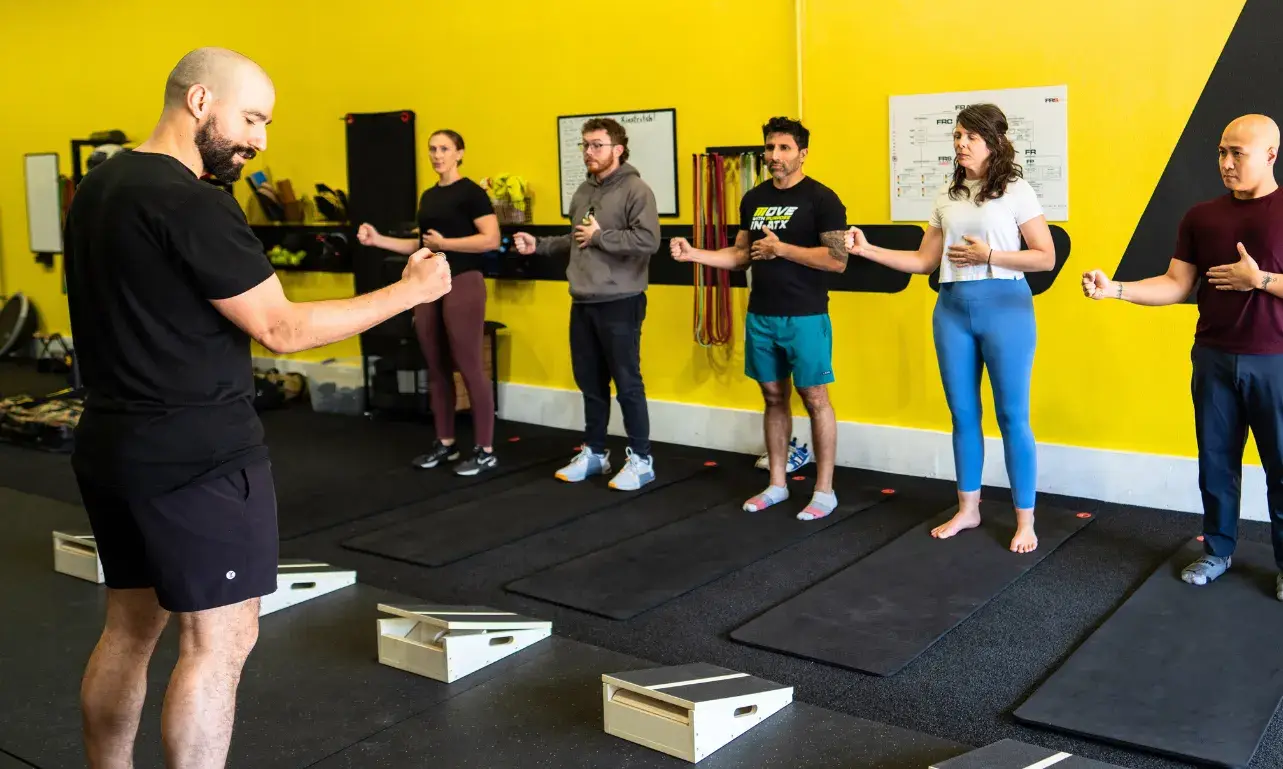
This is what KINSTRETCH does in a group class setting, and what structured personal training does in a one-on-one environment. The two modalities reinforce each other because they’re working on the same underlying problem from different angles.
Strength and mobility aren’t a balance to strike. They’re a system to build. If you’re ready to train that way, we can show you what that looks like.
Written by

Brian Murray, FRA, FRSC
Founder of Motive Training
Motive Training is a coaching studio in South Austin built around assessment, joint health, and strength you can use. Train with us in the studio, come to a KINSTRETCH class, or work through the progressions in KINSTRETCH Online.