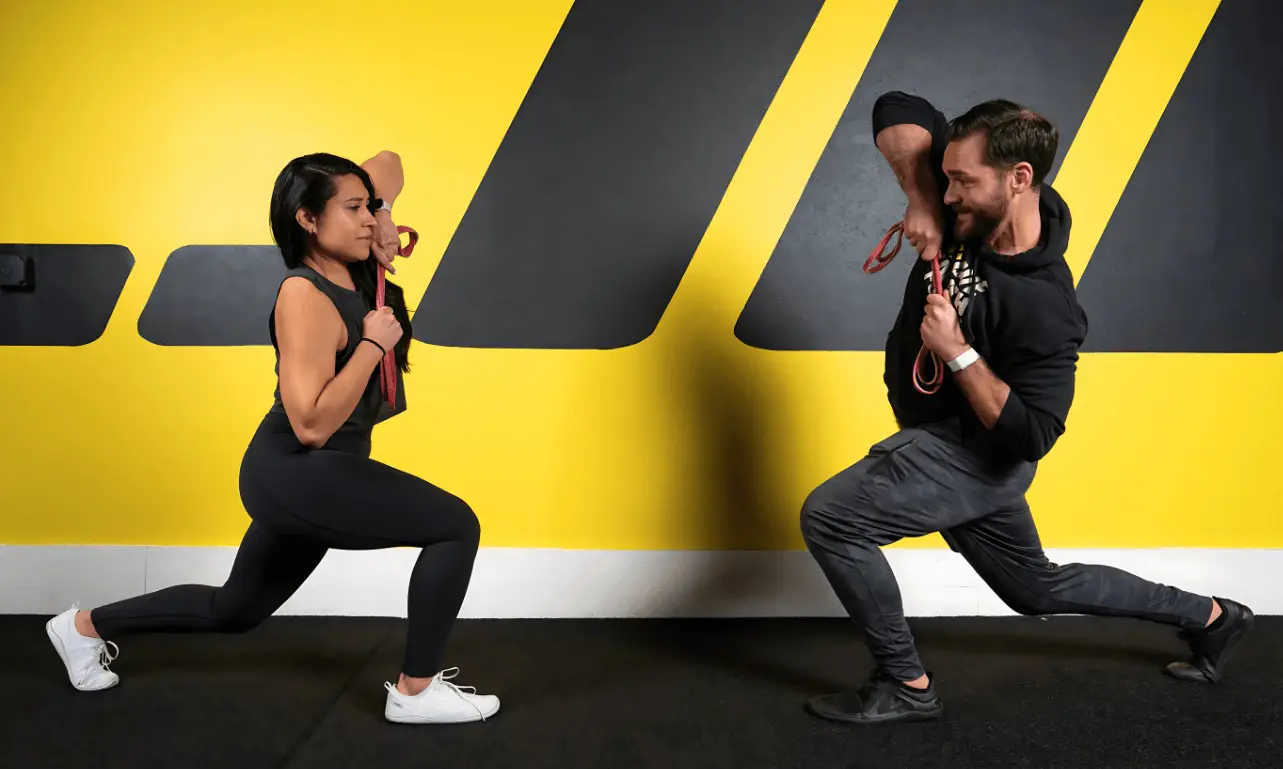
David Weck invented the BOSU ball, which means a lot of people have stood on his work without ever hearing his name. What he has spent the years since on is harder to fit onto a product shelf. Rotational Movement Training, or RMT, is his case that the human trunk was built to rotate, that most of how we move depends on it, and that a training culture organized around keeping the spine still has left a lot of capacity on the table.
The tools that come out of that idea are the parts most people see first. The RMT Club, Ropeflow, and coiling core training all live under WeckMethod, the system Weck built around rotation. This piece is about the thinking underneath them, since the tools make a lot more sense once the idea is clear, and since the idea deserves a harder look than it usually gets from people selling it.
The claim underneath it
Weck leans heavily on spinal engine theory, which Serge Gracovetsky proposed in 1985 (1). In his model the spine drives the pelvis during gait, through the coupling of side bending and rotation that its curves allow, and the legs amplify and express that motion. His best-known supporting observation came from a man born without legs who could still “walk” on his ischial tuberosities with trunk muscle activity that resembled normal gait.
That is a striking idea and a useful one for a coach. It also carries the word hypothesis in the title of the original paper, and forty years later it is still best read that way. It fits a lot of what we see in gait and throwing, and it has shaped a great deal of thinking about the trunk. It has not been tested the way a training claim would need to be. I use it as scaffolding for how I think about rotation, and I would be uncomfortable seeing it presented as settled biomechanics.
Where rotation is supposed to come from
This is the part of RMT that holds up best, because it rests on anatomy nobody disputes. The lumbar spine rotates very little. An MRI study of healthy volunteers found each lumbar segment contributed roughly 1.2 to 1.7 degrees of axial rotation when the trunk turned 45 degrees (2). The sample was ten people lying on their backs, so the exact numbers deserve some caution. The direction they point is clear enough, and it agrees with earlier cadaver studies: the rotation a person produces when they throw, swing, or walk briskly has to come mostly from the thoracic spine and the hips.
Coiling is Weck’s way of training exactly that. WeckMethod organizes the trunk around two landmark positions, the front side coil and the back side coil, and much of the early work is learning to get into each one and hold it with the ribcage and pelvis organized, then moving between them under control. The point is rotation you can produce on purpose, distributed through the segments built for it, with the lower back asked to do the small share it can handle.
Where it pushes against bracing
Most core training still follows the stiffness model that came out of Stuart McGill’s spine research. Planks, bird dogs, side bridges, and anti-rotation presses teach the trunk to resist movement. McGill’s work has kept a lot of people with back pain training who otherwise would have stopped, and bracing is the right skill under a heavy barbell. We cover the two side by side in coiling core vs bracing core.
My own view sits close to Weck’s here. The trunk is one of the most dynamic structures we have. It flexes, extends, side bends, and rotates, and any throwing or racket sport asks for a lot of all of it at speed. Training it only to stiffen asks a mobile structure to shrink itself down to one of its jobs. Anti-rotation work still has a place in a program. As a whole approach it leaves a piece out, and RMT is one of the better attempts to fill it in.
The order we use it in
Here is where RMT meets the rest of what we do. Coiling assumes the thoracic spine can rotate and the hips have usable internal and external rotation. Plenty of adults have neither, and when those joints cannot contribute, the rotation still has to come from somewhere. The lumbar spine is usually the next candidate, which is exactly the outcome coiling is supposed to prevent.
So at Motive, rotation training sits after joint work. We check hip and thoracic rotation first, build what is missing with Functional Range Conditioning, and load rotation once those joints can take their share. The same logic runs through our piece on rotational strength training for athletes. With that foundation in place, the WeckMethod tools do what they are designed to do. The RMT Club puts an offset load in your hands that keeps trying to twist out of line, so the trunk has to organize to control it. Ropeflow is lighter and faster, and it exposes stiffness in the shoulders and spine within a few minutes of picking up the rope.
What I would not claim about it
A lot of RMT content, including an earlier version of this article, promised faster sprint times, harder punches, less back pain, and fewer injuries. I have seen people move better with this work, and I believe the mechanism is sound. None of those outcomes has been tested as a result of RMT specifically, and I am not going to write them down as if they had been.
What I can say is narrower. Rotation is a trainable skill, and the anatomy says it should come mostly from the thoracic spine and the hips. Most conventional programs spend almost no time training it on purpose. RMT is a coherent system for filling that gap, built by someone who has spent decades on one question, and it earns its place in a program once the joints underneath it are ready for it.
References
- Gracovetsky S. An hypothesis for the role of the spine in human locomotion: a challenge to current thinking. J Biomed Eng. 1985;7(3):205-216. doi:10.1016/0141-5425(85)90021-4
- Fujii R, Sakaura H, Mukai Y, et al. Kinematics of the lumbar spine in trunk rotation: in vivo three-dimensional analysis using magnetic resonance imaging. Eur Spine J. 2007;16(11):1867-1874. doi:10.1007/s00586-007-0373-3
Written by

Brian Murray, FRA, FRSC
Founder of Motive Training
Motive Training is a coaching studio in South Austin built around assessment, joint health, and strength you can use. Train with us in the studio, come to a KINSTRETCH class, or work through the progressions in KINSTRETCH Online.