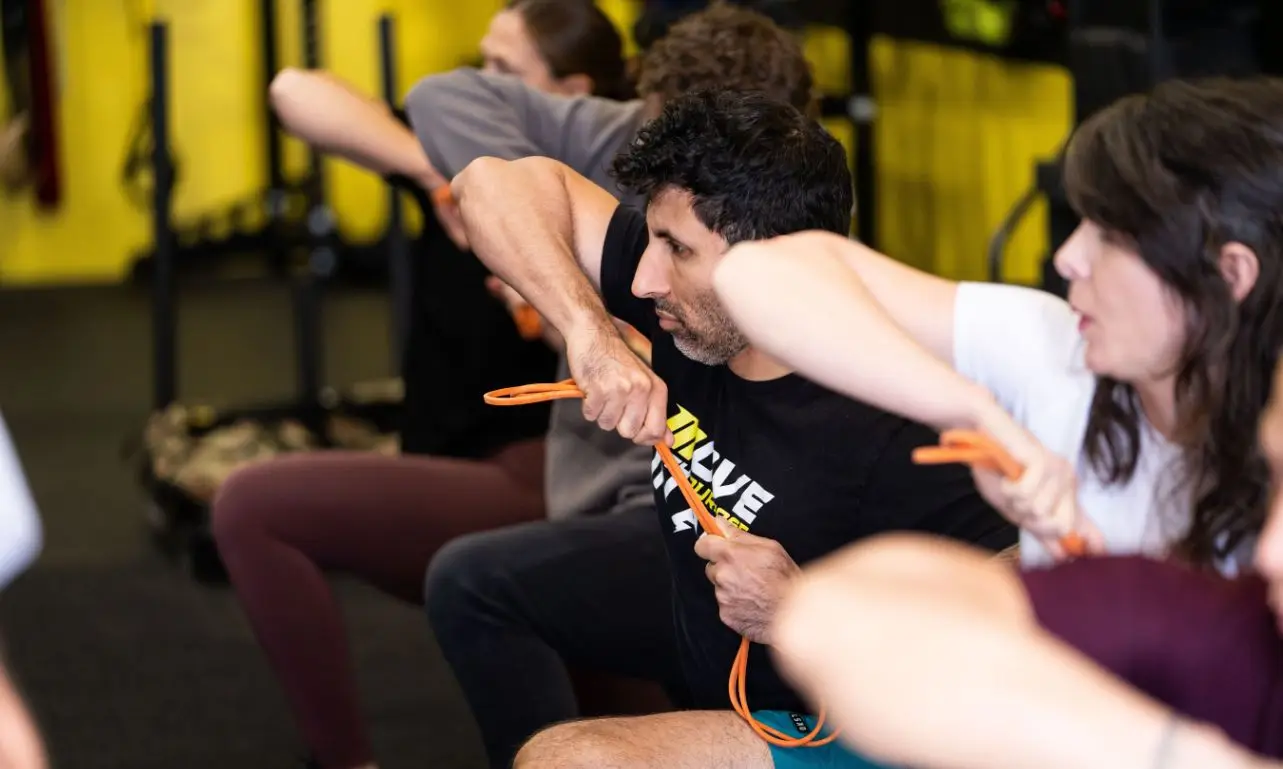
The RMT Club looks, at first glance, like a novelty item. It’s a club-shaped tool with a weighted head, swung in patterns that look part kettlebell, part battle rope, part something you’d see in an old strongman demonstration. People who haven’t used one tend to assume it’s a gimmick, and the thing that changes their mind is usually one design detail most people miss on first look: the weight sits offset from the handle, so every swing creates a rotational demand your body has to control rather than just resist.
What it actually trains
David Weck built the RMT Club as an extension of his broader Rotational Movement Training philosophy, laid out more fully in our piece on understanding RMT. A standard weighted implement like a dumbbell or kettlebell centers its mass along the line of the handle, so your job is mostly to move it and control momentum in a single plane. The Club’s offset head means the weight wants to twist out of your hand’s grip line the moment you start swinging it, which forces your shoulder, trunk, and hips to organize rotationally just to keep the tool under control. You’re not choosing to add rotation to the movement. The tool is demanding it.
This matters because most strength training genuinely undertrains rotation. Barbells, dumbbells, and machines are almost all built around linear or single-plane resistance. The Club is one of the few tools designed specifically to make rotational control the point of the exercise rather than an accident of bad form. That single design choice puts it in a different category from most of what’s sold as functional training equipment, which tends to add instability without actually demanding coordinated rotational sequencing.
Where that rotation has to come from
This is the part that decides if the Club ends up a useful tool or an expensive way to irritate your lower back, and it’s worth understanding before you buy one.
Rotation through the trunk is not distributed evenly. In vivo MRI work measuring healthy volunteers rotating 45 degrees found each individual lumbar segment contributing only about 1.2 to 1.7 degrees of axial rotation (1). The lumbar spine simply is not built to twist; the facet joints are oriented to resist it. The thoracic spine is where trunk rotation actually lives, with roughly 30 to 35 degrees available to each side (2), and the hips supply the rest.
So when you swing an offset load and your thoracic spine and hips can’t produce the rotation the movement requires, that demand doesn’t disappear. It gets taken up by segments with almost no rotational range available, and the margin there is thin. Bogduk’s work on lumbar mechanics has been cited for the position that rotation beyond roughly three degrees at a single lumbar segment starts putting the articular surface and disc fibers at risk, which is a small number when you consider that healthy segments are only producing one to two degrees in the first place. I’d treat that specific threshold as a reasonable working caution rather than a hard line, since segment-level loading in a live swing is difficult to measure directly. But the general shape of it holds, and it’s the actual reason the sequencing advice in this review matters more than the sizing advice.
How it compares to clubbells and steel maces
The RMT Club isn’t the first rotational tool to use an offset weight. Clubbells and steel maces have been around for years and work on a similar principle, an off-center load that forces the body to control torque rather than just resist a straight pull. The differences come down to design intent. Clubbells tend to be heavier and built around traditional strength-endurance patterns, mills, swipes, shield casts, that emphasize shoulder and grip conditioning over full-body rotational sequencing. Steel maces sit further out on the lever, which increases the torque demand dramatically even at lower absolute weights, and tends to be less forgiving for someone still learning to organize a rotational swing.
The RMT Club splits the difference in a way that makes it more approachable for someone coming from an FRC background specifically. The offset is real enough to demand genuine rotational control, but the tool is built around patterns that connect directly to gait and locomotion mechanics rather than purely to shoulder conditioning. If your interest is specifically in how rotation transfers into full-body movement rather than upper-body endurance work, the Club is the more direct tool for that goal. If you’re mainly after shoulder and grip conditioning in a rotational context, a clubbell is a reasonable alternative and often costs less for a comparable weight.
Who this is actually worth buying for
If you’re a rotational athlete, someone who throws, strikes, swings a racket or a golf club, or does any grappling or combat sport, the Club trains a quality that’s genuinely hard to load any other way. It’s also useful for anyone working through thoracic and hip rotation restrictions who wants a tool that makes rotation harder to fake, since a stiff, non-rotating trunk shows up immediately as a Club that gets away from you.
It’s less useful, and probably not worth the investment, for someone whose primary goal is straightforward hypertrophy or general strength, since better, cheaper tools exist for that. It’s also not a substitute for the joint-specific work that should come first if you’re dealing with real thoracic or hip restrictions, for the anatomical reason above. A stiff thoracic spine doesn’t become less stiff because you swung a heavier object at it. It changes through CARs and end-range isometric work, the same principle behind joint-by-joint training and the segmental control covered in spinal segmentation training. The Club becomes genuinely valuable once that groundwork exists and you’re ready to express the range under load and speed.
Sizing and getting started
The Club comes in a range of weights, and the instinct to grab something heavy to feel like you’re getting a real workout is the wrong instinct here. Control is the entire point of the tool. A weight that’s too heavy just gets muscled through with the shoulders and arms, which defeats the purpose and starts to look like the exact compensatory pattern the tool is supposed to train out of you. Most people new to rotational tools do better starting at the lightest available weight for their bodyweight category, sometimes a size that feels almost too light in the hand, until the swing pattern actually looks like coordinated rotation rather than a fight against momentum. Add weight only once that pattern holds up consistently across a full session, not just for a few clean reps.
Where it fits at Motive
We don’t treat the Club as a replacement for FRC-based joint training. It’s a later-stage tool, something that gets introduced once a client has built real hip and thoracic rotation through Controlled Articular Rotations and PAILs and RAILs and is ready to express that range dynamically under load. If you’re dealing with rotational restrictions and don’t yet know where your actual limitations are, a functional mobility assessment is the right starting point before any tool gets added to the mix.
One clarification worth making, since the terms get used interchangeably: the Club is the equipment, not the system. Coiling core training is the broader movement approach it comes out of, and the WeckMethod page covers the wider set of tools and concepts Weck has built beyond this one implement. You can train the ideas without owning the tool, which is worth knowing before spending the money.
Last thing, and I’d rather say it than not. There is no meaningful body of independent research on the RMT Club specifically. What exists is the anatomy of where rotation comes from, which is well established, plus a design rationale that follows sensibly from it, plus practitioner experience including mine. That’s a reasonable basis for using a tool. It isn’t the same standard of evidence as something like end-range isometric loading, where the underlying mechanisms have been studied directly, and anyone selling you a rotational tool as settled science is overstating what’s actually known.
References
- Kinematics of the lumbar spine in trunk rotation: in vivo three-dimensional analysis using magnetic resonance imaging, European Spine Journal
- Lumbar Rotation, Physiopedia, on thoracic versus lumbar axial rotation availability
Written by

Brian Murray, FRA, FRSC
Founder of Motive Training
Motive Training is a coaching studio in South Austin built around assessment, joint health, and strength you can use. Train with us in the studio, come to a KINSTRETCH class, or work through the progressions in KINSTRETCH Online.