Ask most people what core stability means and they describe the same picture: a midsection that holds still under pressure. Planks. Dead bugs. Anti-rotation presses, resisting a cable or band trying to twist the trunk sideways. That model dominates gyms and physical therapy clinics alike, and most of it traces back to one source, Dr. Stuart McGill’s decades of spine biomechanics research and the “big three” exercises, the curl-up, the side bridge, the bird dog, that came out of it.
McGill is one of the more careful researchers working in this field, and that deserves saying before anything else. His work centers on getting people out of pain, often people who’ve already been failed by generic strengthening advice, and the big three exist because they build spinal stability without loading the disc or provoking a flare-up. A huge number of people walking around with chronic low back pain have gotten real relief through exactly this approach.
The trouble starts once that model gets treated as the whole picture of what the trunk is for.
What anti-rotation training builds
Anti-rotation work rests on a real skill, what McGill calls torsional buttressing, the trunk’s ability to resist an external force trying to twist it. Building that capacity matters, especially for someone rebuilding trust in a spine that’s been hurt before. Somewhere along the way, though, resisting rotation quietly became the entire working definition of core function for a lot of coaches and clinics. The trunk was built for more than holding still. It was built to move, and to rotate specifically, which is where a second training system enters the picture.
What coiling core trains instead
Coiling core training, developed by David Weck, also the inventor of the BOSU ball, starts from a different premise, rooted in Dr. Serge Gracovetsky’s spinal engine theory. First published in 1985, Gracovetsky’s model treats the spine as an active engine in human locomotion, not a passive column stacked on top of the hips. The theory rests on three components: curvature, lateral bending, and axial torsion, with any two producing the third automatically. Walking depends on exactly this. As one hip drives forward, the opposite side of the trunk rotates and compresses, and the spiral created by that lengthening and shortening is a real part of what makes efficient gait possible.
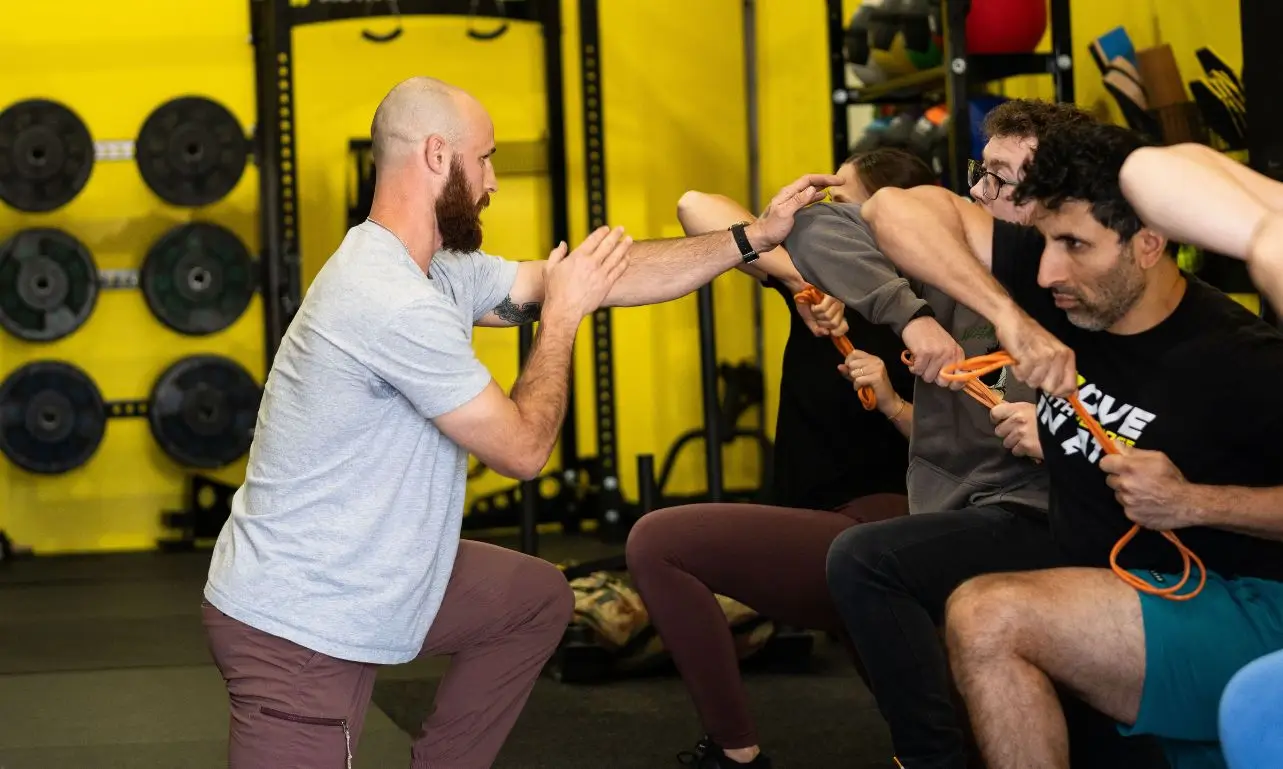
Coiling core drills build around two foundational positions, a front side coil and a back side coil, each held as an isometric or moved through dynamically in a lunge or squat pattern, then expressed further through tools like the RMT Club and a length of rope. The cueing holds constant across both positions: the head staying over or just outside the base of support, eyes locked on a target, and the working elbow, heel, and knee all driving toward that same target while the coiled side of the body stays short and the opposite side stays long. It looks nothing like a plank. It looks like the rotational demand inside a throw, a swing, or a sprint, because that’s exactly what it’s built to prepare the body for.
The lumbar spine’s actual rotation budget
Here’s the part both camps tend to skip: the lumbar spine has very little rotation to offer in the first place. Biomechanics research generally puts total axial rotation across the whole lumbar region somewhere around ten to fifteen degrees, only a few degrees at any individual segment. Asking that region to produce most of a body’s rotational output is asking it to do a job it was never built for. The rotation that shows up in throwing, swinging, and sprinting has to come mostly from the thoracic spine and the hips, a claim about where rotation training belongs, not that rotation itself is dangerous.
Where both belong in a real program
Weck has said directly that coiling core is meant to complement braced core training, adding a rotational dimension the anti-rotation model doesn’t train on its own. Someone rebuilding a spine after injury, or someone who’s never learned to resist an outside force without the low back absorbing the hit, likely needs anti-rotation work as a starting point. Stopping there and calling it a complete program leaves out nearly every sport that exists. Throwing, swinging a club or a racket, sprinting, wrestling, rotational athletic movement of every kind depends on coordinated spinal rotation, generated through the hips and thoracic spine and guided through the trunk.
In practice, this usually shows up as sequencing, not a permanent choice between camps. Someone early in recovery from a back injury, or someone who can’t hold a plank without their low back taking over, typically needs anti-rotation work first, long enough to build a baseline of control the spine can trust. Once that baseline exists, coiling core work adds back what the anti-rotation phase deliberately left out: the ability to produce and absorb rotational force on purpose, in the hips and thoracic spine, instead of avoiding it indefinitely. Neither phase is the finished product. Each one sets up the next.
A trunk trained only to hold still and a trunk trained only to spin are both missing something in equal measure, just from opposite ends. The actual coaching question is what a given trunk needs more of right now, not which camp happens to be correct.
Written by

Brian Murray, FRA, FRSC
Founder of Motive Training
Motive Training is a coaching studio in South Austin built around assessment, joint health, and strength you can use. Train with us in the studio, come to a KINSTRETCH class, or work through the progressions in KINSTRETCH Online.