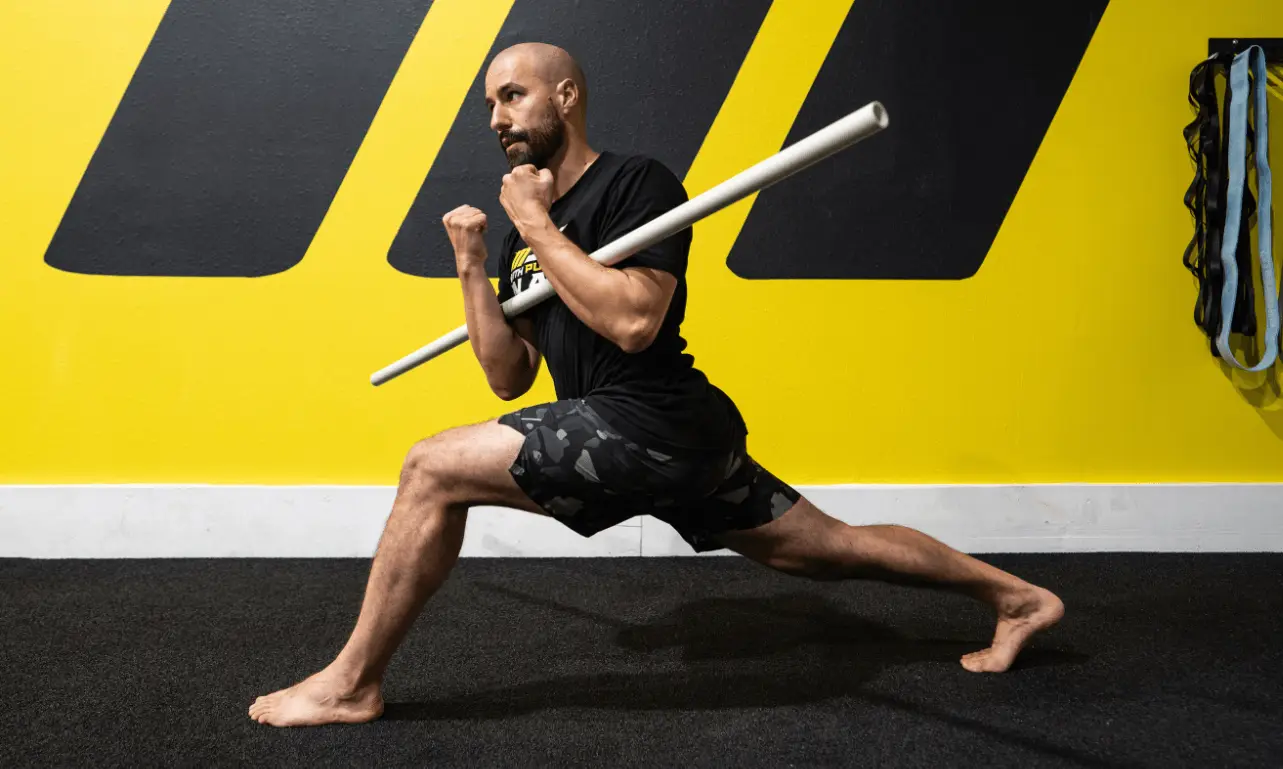
KINSTRETCH is a group class system for training your joints, developed by Dr. Andreo Spina as the class format of Functional Range Conditioning. Its purpose is to take range a joint can reach and make it range you can control, hold, and produce force through. Everything in a class serves that one idea, and once you understand it, the class stops looking like stretching.
Most people approach mobility the way they approach a stretch. They find a position that pulls, sink into it for thirty seconds or so, feel a little looser, and move on. The time involved is short, nothing gets loaded, and there is no progression from one week to the next. KINSTRETCH treats joint range the way a good strength program treats a lift, with a measured starting point, intent behind every rep, load, and a plan that builds over weeks.
Where it comes from
Dr. Spina built Functional Range Systems around a family of methods that share one model of how joints work. Functional Range Conditioning is the training system itself, used by coaches and clinicians one-on-one. The Functional Range Assessment is the measurement side. KINSTRETCH takes the FRC tools and organizes them into a coached group class, taught by instructors certified through Functional Range Systems.
If you have seen FRC and KINSTRETCH used almost interchangeably, that is why. The tools and principles are the same. KINSTRETCH is the format that lets a coach run them with a room full of people at once, which makes the work affordable and regular enough for most people to keep doing it.
The problem it is built to solve
Every joint has two ranges worth knowing. Passive range is how far it moves when something else moves it: gravity, a strap, a partner, the floor. Active range is how far you can take it yourself with your own muscles, and hold it there. For most adults the active number sits well short of the passive one, and the gap tends to be widest at the end of the range, which is where a fall, a missed step, or an awkward catch forces a joint to go.
Static stretching mostly works on the passive number. In one well-known study, three weeks of twice-daily calf stretching increased ankle range by nearly 20 percent. The researchers traced the gain to people tolerating more stretch and to the muscle lengthening further under it, with no change in muscle activity and no change in strength at any ankle angle (1). The participants could reach further, and they were no stronger anywhere in the range they had gained.
Strength training gets there by a different route. A systematic review of eleven randomized trials found strength training and stretching produced similar gains in range of motion, and that held for both passive and active range (2). The trials varied a lot in design and population, so the conclusion deserves some caution. It still points somewhere useful: you can build range under load, and range built that way comes with strength attached. KINSTRETCH sits right on that line, since it expands range and loads the end of it inside the same session.
How it works
A class uses a small set of tools in a consistent order. The names sound technical, and the ideas behind them are simple.
Controlled articular rotations, or CARs, come first. You take one joint through the largest circle it can make, slowly, with the rest of the body held still so nothing else can lend it motion. Holding everything else still takes whole-body tension, which FRC calls irradiation, and it is harder than it sounds. CARs keep the joint moving through its full range, and they show you and the coach where that range gets rough or disappears.
Next come positional holds, where you spend time in a position at or near the end of a joint’s range. These are longer than a typical stretch, and they are where new range gets opened.
Then the new range gets loaded with PAILs and RAILs. PAILs are progressive isometric contractions pushing into the floor or a support from the stretched position, which load the tissue being lengthened. RAILs reverse the direction: you contract to pull the joint deeper into the range you just opened, which trains the muscles on the other side to produce force there. Together they turn a position you could sink into into one you can hold with effort.
End-range work finishes the sequence. The most common version is a lift-off, where you try to lift a limb out of a supported position using only the muscles around the joint. Most people find they can reach a position but cannot hover in it, and that difference is the gap the whole class is built to shrink.
The intensity is scaled to the person and the day. Contractions can run anywhere from gentle to near maximal, and a good coach keeps someone who is training hard elsewhere that week well away from the top of that scale.
What a class looks like at Motive
Our classes run a full hour in small groups, so a coach can watch what each person’s joints are doing and adjust. Each class has a focus. One weekly class works the lower body and spine, another works the upper body and spine, and a Sunday class runs as a restore session at lower intensity. Every class opens with CARs, spends most of its time on one or two regions, and builds from holds into loading.
An hour matters here. Ten or fifteen minutes before a lift is enough to feel something loosen, and it leaves no time to load the range you just found, which is the part that makes it last. The coaches teaching our classes hold KINSTRETCH certifications, with Level I and Level II instructors on the schedule.
Do you need to be flexible first?
This is the most common question before a first class, and the answer runs the other way from what most people expect. Someone with a lot of passive range and little control over it often finds KINSTRETCH harder than someone who is stiff, because the flexible person has a bigger gap between where they can reach and where they can hold themselves. Stiff people often make quick early progress because the work meets them where they are.
Lifters come in with a hip that will not reach depth or a shoulder that catches overhead. Runners and cyclists come in with hips and ankles shaped by thousands of repetitions in one plane. Desk workers come in stiff through the hips, thoracic spine, and neck from spending most of the day in one position. None of it requires any particular starting fitness.
How it compares with yoga and stretching
People file KINSTRETCH under stretching or yoga because it involves floor work and long holds. Yoga links poses into sequences, often tied to breath, and many of those poses do build strength. KINSTRETCH isolates one joint at a time, measures what it can do, and loads the end of its range on purpose, with progression tracked over weeks. We wrote a full comparison in KINSTRETCH vs yoga, and plenty of people do both.
How often to do it
Once a week is enough to notice change. Twice a week is where most people start to feel it carry over into lifting or sport, since the nervous system needs repeated exposure to a position before it stops guarding it. That comes from years of watching people train, and I have not seen a study that pins down an ideal frequency, so treat it as a starting point. On the days between classes, a few minutes of CARs keeps the work moving.
If you want to know which joints to prioritize before you start, the Motive Movement & Mobility Assessment measures them joint by joint and tells you where the gaps are biggest.
Where to do it
In Austin, KINSTRETCH classes at our studio are pay what you can, and twenty percent of what comes in goes to FarmShare Austin. The first several weeks are when a coach’s eyes help most, while your body is still learning what control at end range feels like, so the studio is the better place to start if you are local.
If you are not in Austin, or a class time will not work for you, KINSTRETCH Online is $24 a month and runs guided sessions from short routines to full classes, including a section built for beginners. Nobody will correct your positions in real time the way a coach in the room does. For people who already know the method would help and simply never make it to a class, that trade is usually worth it.
References
- Blazevich AJ, Cannavan D, Waugh CM, et al. Range of motion, neuromechanical, and architectural adaptations to plantar flexor stretch training in humans. J Appl Physiol. 2014;117(5):452-462. doi:10.1152/japplphysiol.00204.2014
- Afonso J, Ramirez-Campillo R, Moscão J, et al. Strength training versus stretching for improving range of motion: a systematic review and meta-analysis. Healthcare. 2021;9(4):427. doi:10.3390/healthcare9040427
Written by

Brian Murray, FRA, FRSC
Founder of Motive Training
Motive Training is a coaching studio in South Austin built around assessment, joint health, and strength you can use. Train with us in the studio, come to a KINSTRETCH class, or work through the progressions in KINSTRETCH Online.