Almost everything written about training is about what to do. Do these reps, hold this position, train this range. Very little of it explains what is physically happening inside the joint while you do it, which is strange, because that is the part that actually makes the case. A joint is a living environment, not a fixed hinge with a set amount of grease. It feeds itself, it remodels around what you ask of it, and your brain keeps an actual working map of it that updates or degrades depending on use. None of that is a metaphor. It is documented at the tissue and cortical level, and once you see the research behind it, the reason to train the way we train stops being a slogan and starts being obvious.
How a joint feeds itself
The cartilage lining the ends of your bones has no blood supply of its own (1). There is a reason for that. Cartilage has to stay smooth and slick enough to let a joint glide, and blood vessels running through it would compromise that. But it creates a problem the body has to solve another way. Adult articular cartilage gets its nutrients almost entirely by diffusion from the synovial fluid, and that diffusion is driven, in large part, by the joint being loaded and unloaded (1). Load compresses the cartilage and pushes fluid and waste out; unloading lets the tissue rehydrate and pull fresh, nutrient-carrying fluid back in. Research on cartilage in prolonged unloading, most clearly documented in astronauts during spaceflight, shows measurable cartilage thinning when that load-unload cycle disappears for extended periods (1).
That has a consequence most people never hear. A range you never visit is a range that is not getting this cycle run through it the way your mid-range gets it every day. This is a real part of why a daily practice like Controlled Articular Rotations matters more than it looks like it should. Taking every joint through its full range each day keeps that pump running in territory your normal habits skip entirely.
The capsule remodels around what you ask of it
Surrounding each joint is a capsule, a sleeve made mostly of collagen that holds the joint together and helps define how far it can go. That capsule is not a fixed boundary you were issued at birth. The clearest evidence for this comes from immobilization research, much of it in animal models for obvious ethical reasons, but consistent enough to be treated as established. When a joint is immobilized for four weeks or more, the joint capsule becomes the dominant factor limiting range of motion, well past the point where muscle shortening alone would explain it (2). Fibroblasts in the capsule shift into an active, collagen-producing state, laying down new matrix and altering the crosslinks between collagen fibers, and the capsule physically contracts around the position it has been held in (2). This is the same underlying process seen clinically in conditions like frozen shoulder, where a joint that has not moved through its full range for long enough develops genuine structural restriction, not just tightness that stretching should be able to undo in a session.
The direction runs both ways. The same mechanism that tightens a capsule around a disused range is, at the cellular level, a remodeling response, and remodeling responses run on what the tissue is asked to do repeatedly. Give a capsule a real, repeated reason to organize around a larger working range, and it does the opposite of contracture. That reason is load, which is the next piece.
Connective tissue answers to load, not to lengthening
Here is where a lot of stretching goes sideways. Collagen-rich tissue, in tendon, ligament, and capsule alike, is metabolically active and remodels in direct response to mechanical loading (3). Load triggers the release of growth factors and increases in collagen synthesis and turnover; unload it for long enough through inactivity or immobilization and collagen synthesis drops along with tissue stiffness (3). Passive stretching, for the most part, does not deliver a loading signal anywhere near that. A well-cited review in Physical Therapy looked directly at what short-term static stretching programs actually change, and found that increases in range of motion after three to eight weeks of stretching were not explained by measurable changes in the passive length or structure of the muscle-tendon unit at all (4). The gains tracked instead with an increased tolerance to the stretch sensation itself, not a longer tissue (4). That is the honest answer to why the range you stretch into tends to leave by tomorrow. You changed how the position felt, not what the tissue can do.
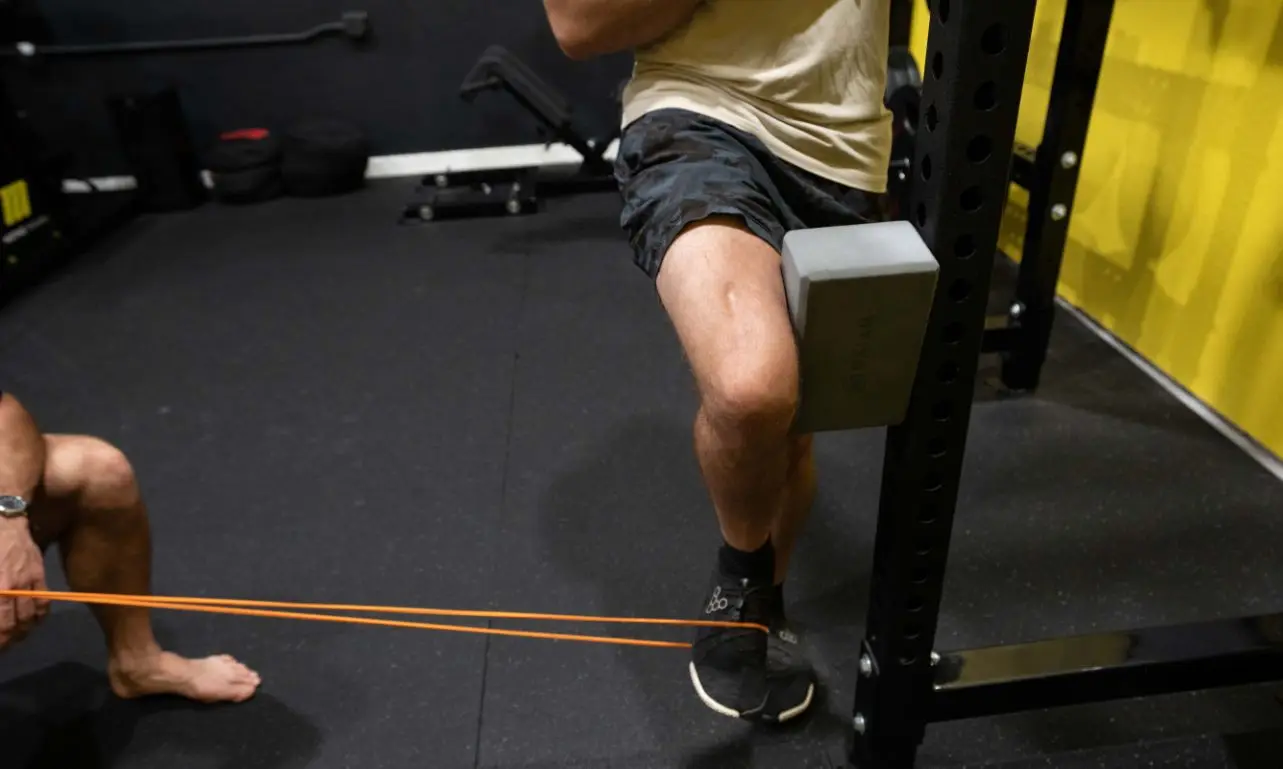
Loading a joint at the edge of its range is what actually delivers the mechanical signal collagen responds to. Producing real force at end range, the kind of work covered in end-range training, gives connective tissue a reason to reorganize in the exact position you want to keep, rather than just teaching your nervous system to tolerate being there for thirty seconds. This is the mechanism underneath the whole Functional Range Conditioning approach: build the tissue where you want the range, with load, so the change has a structural basis instead of a sensory one.
The joint your brain keeps a map of
The last piece is the one people find hardest to believe, and it might be the most important. Your brain keeps an active, updating map of where your joints are and how much of each one you can control, built from the somatosensory cortex processing constant input from the joint itself. That map is not fixed either. A study using functional MRI found that a few weeks of hand and arm immobilization in a cast measurably reduced tactile acuity in the fingers, and this tracked directly with reduced activation in the corresponding hand representation in the somatosensory cortex (5). Less use produced a less detailed cortical map in a matter of weeks, in adults, not children with more plastic brains. The reverse direction is equally well established: repeated, attentive use of a joint through a range is one of the documented ways cortical representation of that body part sharpens over time.
A surprising amount of what gets written off as aging or as a joint simply wearing out is this map going blurry from disuse rather than the tissue itself failing. The map is trainable in both directions. Slow, controlled movement through a full range, with actual attention on the position, is how you keep it detailed, and it is a real part of why CARs and deliberate end-range work do more than they appear to on the surface. You are not just moving the joint. You are keeping your brain’s picture of it sharp enough to actually use.
Why this changes the point of the work
Put those four things together and the goal of mobility training looks different than the usual pitch. The work is keeping the load-unload cycle running through cartilage your habits would otherwise starve, giving the capsule a real reason to remodel around more range instead of less, loading connective tissue so the change has a structural basis instead of a sensory one, and keeping your brain’s map of the joint detailed enough to access what is actually there. None of it is cosmetic, and none of it happens by accident. It happens because something asked the tissue and the nervous system to keep up, repeatedly, in the exact position that mattered.
References
- Articular cartilage loss is an unmitigated risk of human spaceflight, npj Microgravity
- Noninflammatory Joint Contractures Arising from Immobility: Animal Models to Future Treatments, PMC
- Role of Extracellular Matrix in Adaptation of Tendon and Skeletal Muscle to Mechanical Loading, Physiological Reviews
- Weppler CH, Magnusson SP. Increasing Muscle Extensibility: A Matter of Increasing Length or Modifying Sensation? Physical Therapy, 2010
- Immobilization Impairs Tactile Perception and Shrinks Somatosensory Cortical Maps, Current Biology
Written by

Brian Murray, FRA, FRSC
Founder of Motive Training
Motive Training is a coaching studio in South Austin built around assessment, joint health, and strength you can use. Train with us in the studio, come to a KINSTRETCH class, or work through the progressions in KINSTRETCH Online.