We usually describe what desk life and age do to a body in terms of range. You got tight. You lost some motion. You cannot reach what you used to. That is true as far as it goes, but it describes the surface of a deeper loss, and the deeper one is the thing that actually makes a body fragile. What you are really losing is options: the number of different ways your body can solve a given movement.
You can see it in people before you can measure it. Watch a few different people bend down to pick something off the floor. One of them has a single way to do it, the same hip and back angle every time. Another can get down there five different ways without thinking about it. That visible difference turns out to be one of the more studied ideas in motor control science, and it has a name.
Options are what make a body resilient
Almost any movement can be solved more than one way, and this is not a coaching observation, it is a formal problem in motor control research going back to the Russian physiologist Nikolai Bernstein. Bernstein pointed out that the human body has so many joints, muscles, and possible trajectories that there is essentially never one correct way to perform a task; there is a near-infinite set of them, and the nervous system has to select one on the fly, every time, a phenomenon he called repetition without repetition (1). A body with a full set of these solutions can pick whichever one fits the moment and switch to another when the first is not available, because you are tired, the angle is awkward, or you are under load. A body that has lost most of that redundancy has one solution for each task and runs every repetition through the same joints and the same tissue.
That is the quiet mechanism behind a lot of wear. When there is only one usable solution to a movement, the tissue on that one path absorbs every repetition, with no way to share the load and no backup when that path gets fatigued or caught at a bad angle.
There is a name for this in the research, and a real caution built into it
Movement scientists call this variable capacity coordinative variability, and one of the more influential frameworks in the field, developed by Nicholas Stergiou and Leslie Decker, argues that healthy movement sits inside an actual optimal range of variability, not simply as much as possible (2). Too little variability produces a system that is rigid and, in their words, robotic; too much produces a system that is noisy and unstable. Both extremes leave a body less able to adapt when something unexpected happens, which is a more honest picture than mobility content usually gives this idea credit for. I want to be fair to the other side of that: more variability is not automatically better, and a body moving with no consistency at all has its own problems.
Almost none of the people this article is written for are anywhere near the too-chaotic end. Desk life, single-sport specialization, and years of running everything through two or three familiar patterns all push in the same direction, toward the rigid, low-variability end of that spectrum, which is the end associated with reduced adaptability and, in the applied research, with injury.
What that looks like when someone actually measures it
This is not just theory. Research on runners has directly measured how much the joints and segments of the leg vary in their coordination from stride to stride, using what is called coordinative variability, and found a consistent pattern: healthy runners show meaningfully more of this stride-to-stride coordination variability than runners dealing with overuse injuries like patellofemoral pain (3). The injured group was not moving less. They were moving with a narrower set of solutions, the same joint coupling pattern over and over, and that repetition concentrated the load in the same tissue every single stride instead of spreading it across a few viable options.
That is the applied version of what this whole article is arguing. A body with more usable ways to coordinate a movement distributes stress across more pathways. A body that has quietly narrowed down to one or two pathways sends every repetition through the same structures, and eventually one of those structures reaches its limit.
How the options quietly disappear
You do not lose options in a dramatic event. You lose them the way you lose anything you stop using, gradually and without noticing. Sit in the same folded shape for eight hours a day and the body reads that as the shape to keep, and the ranges and combinations you are not using start to fall off the menu. Age does the same thing, mostly because we do fewer different things as we get older, not because the years themselves erase movement. Even sport does it in its own way, since a sport that rehearses the same pattern thousands of times trains precision in one option while quietly letting the others go.
I will say this about myself. In a heavy training week, I can still catch my own squat and hip hinge collapsing back into two or three patterns I have leaned on for years, even though widening exactly that kind of narrowing is what I coach for a living. Knowing the research does not automatically widen anyone’s menu, mine included. It just means I know which patterns tend to go missing first, and I know to go looking for them on purpose instead of assuming they are still there.
None of that is a discipline problem. Adaptation is doing exactly what it is built to do, which is to keep what you rehearse and let go of what you do not. The trouble is that modern life rehearses a very narrow slice of what a body can do, so the menu it keeps ends up short. This is the same idea from the range side in why you cannot move well where you cannot move; range is the raw material, and options are what you build out of it.
Why two people doing the same thing hold up differently
This is why two people can run the same mileage, sit at the same kind of desk, or play the same sport and end up in completely different places. One of them has kept a wide set of coordination options and can distribute the work across a body with real choices. The other has been running everything through a narrowing set of paths, the exact pattern the running research above measured directly, and eventually one of those paths reaches its limit. What looks like one person being durable and the other being injury-prone is often just one body having options and the other having quietly run out of them.
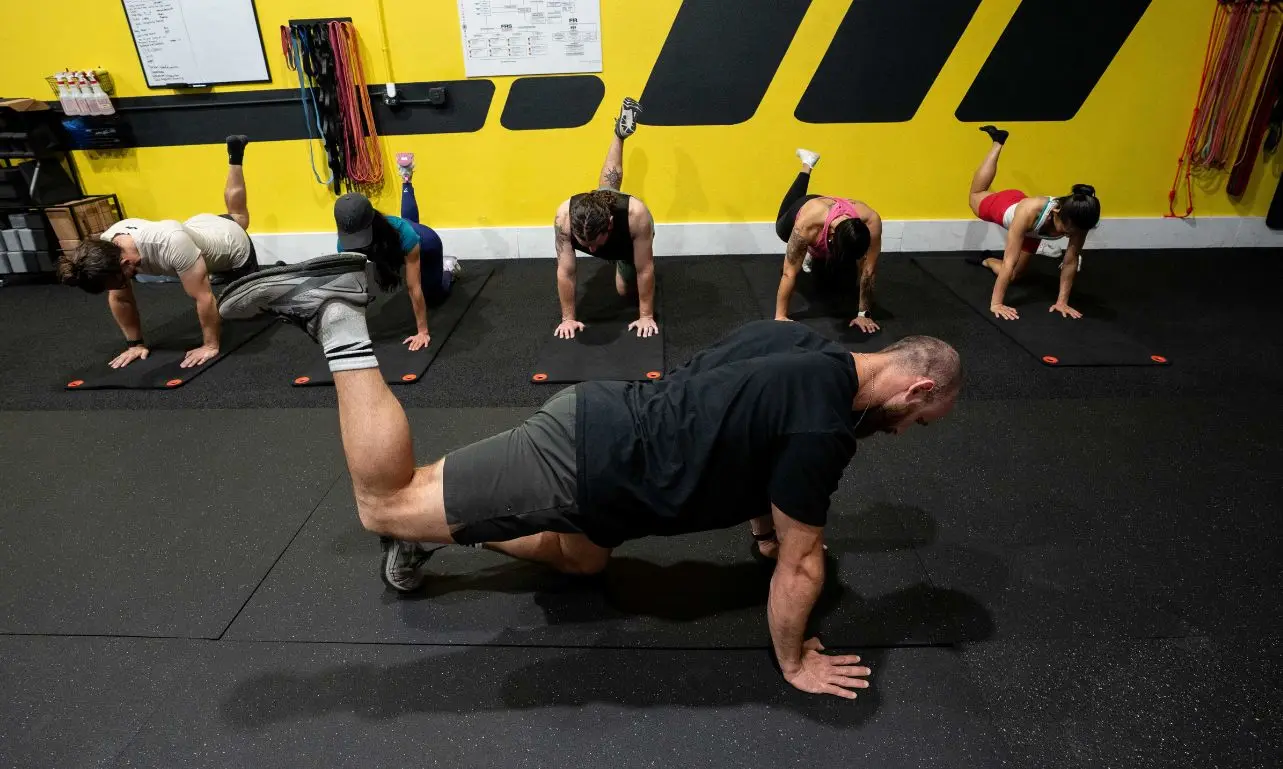
It also reframes what training for the long game means. That kind of durability is a real part of what work like rotational and multi-directional training is building when it takes the body outside the single plane most of daily life happens in. It widens the set of situations your body already has a workable answer for.
Rebuilding the menu is the real point
Once you see it this way, mobility training stops being about collecting range for its own sake and becomes about restoring choices. Every joint that gets its full, controlled range back is another usable solution on the menu, another way for the body to solve a problem when its default path is unavailable or already fatigued. That is why the work is joint by joint and why it emphasizes control at the edges of a range, not just reaching it once. A range you can only reach passively is not really an option yet. A range you can control under load is, and structured daily practice is what actually turns the first into the second.
Finding out how short your own menu has gotten is what a real movement assessment is for. Not just how far each joint goes, but how many different ways you can still organize yourself to solve the same problem, and where you have quietly been down to one option for longer than you realized.
References
- Explaining human motor coordination via the synergy expansion hypothesis, PNAS
- Stergiou N, Decker LM. Human movement variability, nonlinear dynamics, and pathology: is there a connection? Human Movement Science, 2011
- Hamill J, et al. Coordinative variability and overuse injury, Sports Medicine, Arthroscopy, Rehabilitation, Therapy & Technology, 2012
Written by

Brian Murray, FRA, FRSC
Founder of Motive Training
Motive Training is a coaching studio in South Austin built around assessment, joint health, and strength you can use. Train with us in the studio, come to a KINSTRETCH class, or work through the progressions in KINSTRETCH Online.