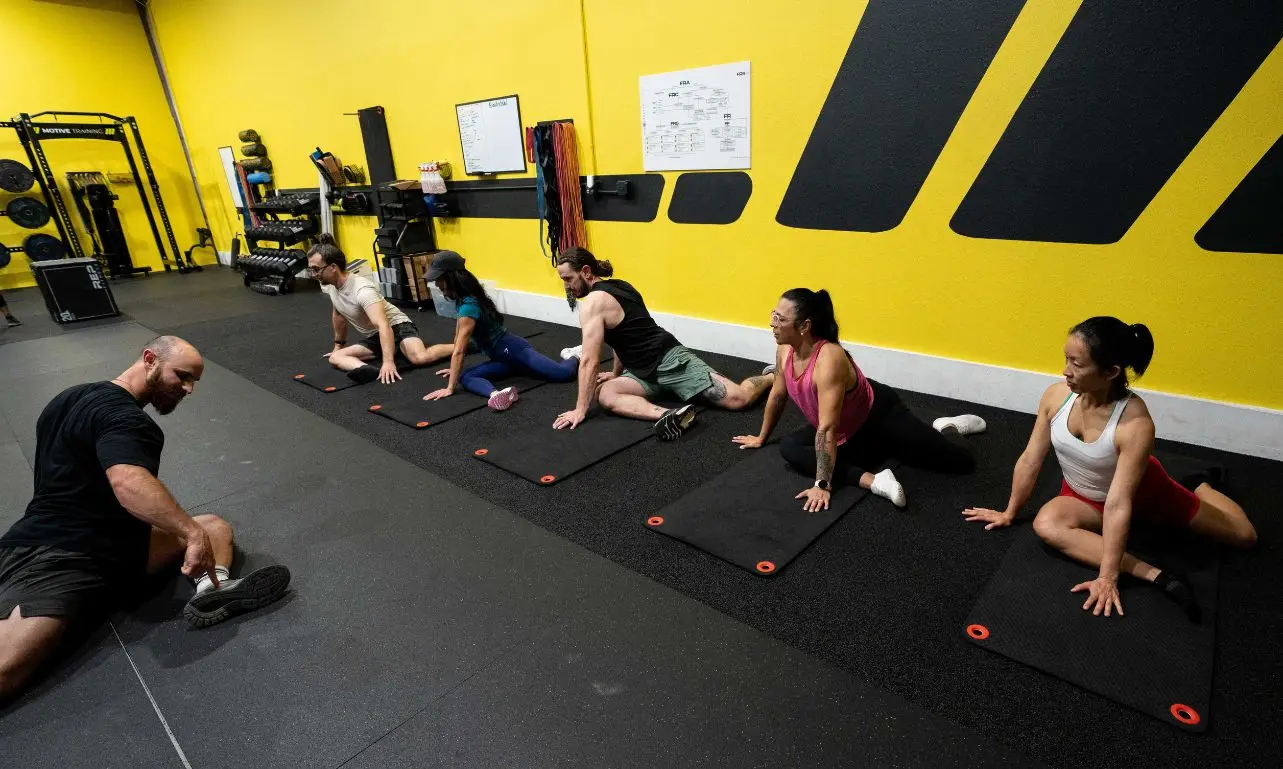
People show up having already done the internet’s homework. Doorway hamstring stretch, foam roller on the glute, figure-four on the floor before bed. Some of them have been at it for months. The line down the back of the leg is still there, and at some point they start to wonder if something’s actually wrong with them, since the stretch that’s supposed to fix this hasn’t fixed anything.
Here’s the thing nobody tells them going in: sciatica was never a muscle-length problem to begin with, so it makes sense that muscle-length solutions haven’t been doing much.
What “sciatica” actually describes
Sciatica isn’t a diagnosis. It’s a description, a pattern of pain, numbness, or that electric, radiating sensation that runs along the path of the sciatic nerve, usually starting somewhere in the low back or glute and traveling down the back of the leg (1). Lifetime prevalence sits somewhere between 13 and 40 percent depending on the population studied (1), which tells you it’s common and also that the label alone tells you almost nothing about what’s actually generating it.
The most frequent cause is a lumbar disc herniation putting pressure on a nerve root as it exits the spine (2). Piriformis syndrome, where the piriformis muscle in the glute compresses the nerve as it passes underneath or through it, gets blamed constantly but is a genuine driver in a much smaller slice of cases, something in the range of 6 percent by some estimates (3). A review looking specifically at piriformis syndrome’s role in sciatica concluded the diagnosis is probably over-applied, with a lot of cases that get labeled piriformis actually originating somewhere else in the pelvis or spine (4). Spinal stenosis, facet irritation, and sacroiliac joint dysfunction can all produce a version of the same symptom picture.
That range of possible sources is exactly why a generic YouTube stretch routine is a coin flip. You’re applying one intervention to a symptom that has several structurally different causes, and the causes require different things from the tissue.
Most disc-related sciatica is already headed toward getting better
This is worth saying plainly, because almost nobody in the stretch-and-suffer cycle hears it: the natural history of a herniated disc is a lot more forgiving than the MRI report makes it sound. A herniation isn’t a permanent structural failure sitting there for good. The body treats the extruded disc material as something to break down and clear, through a mix of dehydration, macrophage activity, and inflammatory signaling, and a 2017 meta-analysis put the rate of spontaneous regression at roughly two-thirds of cases (5). Separate reviews put the share of patients who improve with conservative management, meaning no surgery, somewhere between 60 and 90 percent, with only about 2 to 10 percent of cases ultimately needing an operation (6). Timelines vary; some reviews report meaningful resorption within 3 to 6 months, other case series have tracked it out closer to 8 or 9 months, and larger, more sequestrated herniations sometimes resorb faster than smaller ones because there’s simply more inflammatory material triggering the cleanup response (7).
I bring this up not to tell anyone to sit and wait it out, but because it changes what “helping” actually means during this window. The job isn’t to force a disc back into place with a stretch, since that was never how any of this worked mechanically. The job is managing the nerve’s irritability, keeping the surrounding joints and tissues moving well enough that compensations don’t stack on top of the original problem, and giving the body the conditions to do what it’s already positioned to do on its own timeline.
The target is a nerve, not a muscle
This is the part that actually changes how you should be thinking about it day to day. A hamstring responds to load and stretch by adapting length and tolerance over time; that’s a well-understood mechanism (8). A nerve doesn’t work that way. Nerve tissue responds to compression, inflammation, and restricted glide, not to being pulled longer (9). When a nerve root is irritated, it’s usually swollen and mechanically sensitive, and it needs room and movement along its own pathway, not tension applied to the muscle sitting next to it.
There’s actual research separating these two approaches out. A study using an experimental sciatica model in rats compared static stretching against neural mobilization, a gentler, oscillatory technique that moves the nerve through its available range rather than holding it at end range under tension. Neural mobilization outperformed static stretching for reducing the pain response (10). The proposed mechanism is that oscillatory movement helps disperse the swelling and pressure sitting on the nerve root, where static tension mostly doesn’t do that job, and can occasionally aggravate an already irritated nerve if it’s held too aggressively.
This tracks with something I see constantly on the gym floor. Someone with real nerve irritation cranks into a deep hamstring stretch chasing relief, holds it because that’s what they’ve always been told to do, and walks away feeling worse for the rest of the day. They’re not doing anything wrong technique-wise. They’re just applying a muscle-tissue solution to a nerve-tissue problem, and the nerve is telling them so.
Sliders, tensioners, and why the technique has to match the nerve’s mood
Neural mobilization itself isn’t one technique, and this is where a lot of generic advice falls apart even when it’s pointed in the right direction. Clinicians generally split the approach into two categories. Sliders move the nerve through its pathway without meaningfully increasing overall tension on it, lengthening at one end of the nerve’s path while slackening at the other simultaneously, so the nerve glides rather than stretches. Tensioners load both ends at once, which increases actual strain on the nerve and produces a stronger, more provocative effect.
The research comparing them is honest about not landing cleanly on one winner across every population, which is worth saying out loud instead of oversimplifying it. A systematic review of upper-body nerve irritation found sliders tended to work better in acute, more reactive presentations, while tensioners provided more benefit once the condition had settled into something more chronic (11). A separate randomized trial on cervical nerve root irritation found the opposite pattern, with the tensioner technique outperforming the slider for reducing pain and disability (12). What’s consistent across the literature isn’t a single “better” technique, it’s that both approaches measurably change how the nervous system is responding, including sympathetic nervous system activity (13), and that irritability level should be driving which one gets used, not habit or convenience.
Practically, that means someone in an acute, highly reactive flare-up generally has no business being pushed into an aggressive tensioning position, the exact thing a lot of stretch routines default to. Someone further along, with symptoms that have calmed down but plateaued, might actually need more of a tensioning stimulus to keep progressing. This is a judgment call that requires knowing where the nerve currently sits, not a script anyone can follow blind.
Where the actual restriction is matters more than the stretch itself
This is where assessment starts doing real work instead of being an extra step before the “real” training. The sciatic nerve’s symptom pattern can come from the lumbar spine, the sacroiliac joint, the deep hip rotators, or some combination, and each of those has a different relationship to what’s aggravating it. Stretching a piriformis that isn’t actually the site of compression doesn’t do much except waste time and occasionally increase pressure elsewhere in the chain. Loading a lumbar segment that’s already inflamed with the wrong movement can make things noticeably worse.
There’s a well-documented clinical concept in the spine literature called centralization, first described in detail by physical therapist Robin McKenzie and studied extensively since. It refers to what happens when a specific repeated movement or sustained position causes radiating leg symptoms to retreat back toward the spine, or disappear altogether, rather than spreading further down the leg. A movement that centralizes symptoms is generally a good sign and tends to predict a better outcome; a movement that pushes symptoms further down the leg, called peripheralization, is generally the opposite signal (14). This isn’t guesswork. It’s a testable, repeatable finding you get by having someone move through a direction, checking what the symptom does, and using that information instead of a generic stretch protocol picked off a search result.
CARs work here the way they work everywhere else in the FRC system: as a diagnostic tool as much as a training tool. Slow, controlled rotation through the hip capsule, done without forcing end range, gives real information about where a restriction sits and if a position reproduces or eases the symptom, which is functionally the same logic as checking for centralization, just applied through the joint rather than through repeated spinal flexion or extension. That information is what should be driving what comes next, not a generic stretch someone found online because it’s labeled “for sciatica.”
Stretching isn’t useless, it’s just not usually the mechanism
I want to be fair to stretching here, because the instinct to write it off entirely is its own kind of overcorrection. Muscle guarding is real. When a nerve is irritated, the surrounding musculature, especially the piriformis and deep hip rotators, tends to tighten up protectively, and reducing that guarding can genuinely ease pressure and improve how a person moves. Stretching can help with that layer. What it usually isn’t doing is treating the actual compression or inflammation at the nerve root, which is the layer most people are trying to fix when they keep stretching and keep not getting anywhere.
The nerve glide and neural mobilization work that shows better results in the research isn’t really a stretch at all, even though it looks similar from the outside. It’s controlled, low-amplitude movement through the nerve’s own pathway, closer in spirit to a CARs pattern than to a static hold. That distinction, moving the tissue through range under control instead of parking it at end range and waiting, is most of the difference between something that helps and something that doesn’t.
What actually determines the next step
Where the irritation is coming from changes everything about what should happen next, and that’s not something a symptom description alone can answer. Two people with the exact same radiating pain down the back of the leg can need completely different approaches depending on if the driver sits at a lumbar segment, the SI joint, or the deep hip rotators, and depending on how irritable that tissue currently is. This is the whole argument for why back pain isn’t always a back problem, and it applies just as directly here.
We start most cases like this with a Controlled Articular Rotations assessment through the hip and spine to see what’s actually restricted and what reproduces the symptom, rather than handing someone a stretch sheet and hoping. If hip rotation is part of the picture, this breaks down the frog position work we use for hip mobility and how it fits into that process. And if the pattern is coming more from the lumbar spine itself, here’s how we approach back pain through FRC.
If you’ve been stretching the same three spots for months with nothing to show for it, that’s not a discipline problem. It’s usually a sign the stretch was never aimed at the actual source, or was the wrong type of movement for how irritated the nerve currently is. Schedule a session and we’ll find out where yours actually is.
References
- Prevalence and general causes of sciatica, cited in: Prevalence of Piriformis Syndrome in Sciatica Patients. J Orthop Surg Res. PMC11452884. https://pmc.ncbi.nlm.nih.gov/articles/PMC11452884/
- A Severe Disc Herniation Mimics Spinal Tumor. Incidence and most prevalent cause of sciatica. PMC10033246. https://www.ncbi.nlm.nih.gov/pmc/articles/PMC10033246/
- Piriformis Syndrome & Herniated Disc: Similarities, Differences. Estimate of piriformis syndrome prevalence among sciatica cases. https://myacare.com/blog/piriformis-syndrome-herniated-disc-similarities-and-differences
- Looking Beyond Piriformis Syndrome: Is It Really the Piriformis? PMC10020728. https://pmc.ncbi.nlm.nih.gov/articles/PMC10020728/
- Spontaneous regression of lumbar disc herniation: four cases report and review of the literature, citing the 2017 meta-analysis on spontaneous regression rate. PMC11439616. https://pmc.ncbi.nlm.nih.gov/articles/PMC11439616/
- Prediction and Mechanisms of Spontaneous Resorption in Lumbar Disc Herniation: Narrative Review. Spine Surg Relat Res. PMC11165499. https://pmc.ncbi.nlm.nih.gov/articles/PMC11165499/
- Spontaneous Resorption of Herniated Lumbar Disk: Observational Retrospective Study in 9 Patients. Neurochirurgie. ScienceDirect. https://www.sciencedirect.com/science/article/abs/pii/S1878875018329383
- Blazevich AJ, et al. Range of motion adaptation mechanisms in response to stretch training. J Appl Physiol. 2014.
- The potential role of sciatic nerve stiffness in the limitation of maximal ankle range of motion. PMC6162234. https://www.ncbi.nlm.nih.gov/pmc/articles/PMC6162234/
- Bertolini GRF, Silva TS, Trindade DL, Ciena AP, Carvalho AR. Neural mobilization and static stretching in an experimental sciatica model: an experimental study. Rev Bras Fisioter. 2009;13(6):493-498. https://doi.org/10.1590/S1413-35552009005000062
- The effectiveness of slider and tensioner neural mobilization techniques in the management of upper quadrant pain: a systematic review of RCTs. Musculoskelet Sci Pract. ScienceDirect. https://www.sciencedirect.com/science/article/abs/pii/S1360859222000444
- Effects of Neural Tension Versus Neural Sliding Technique on Cervical Radiculopathy. ClinicalTrials.gov NCT05959330. https://clinicaltrials.gov/study/NCT05959330
- Papacharalambous C, et al. Comparative Effects of Neurodynamic Slider and Tensioner Mobilization Techniques on Sympathetic Nervous System Function: A Randomized Controlled Trial. J Clin Med. 2024;13:5098. PMC11396284. https://pmc.ncbi.nlm.nih.gov/articles/PMC11396284/
- Donelson R, Aprill C, Medcalf R, Grant W. A prospective study of centralization of lumbar and referred pain: a predictor of symptomatic discs and annular competence. Spine. 1997;22(10):1115-1122.
Written by

Brian Murray, FRA, FRSC
Founder of Motive Training
Motive Training is a coaching studio in South Austin built around assessment, joint health, and strength you can use. Train with us in the studio, come to a KINSTRETCH class, or work through the progressions in KINSTRETCH Online.