An Achilles that has been grumpy for three months behaves in a way that fools people. It hurts for the first ten minutes of a run and then quiets down. It is stiff in the morning and fine by lunch. It feels better after a week off and then feels exactly the same the moment you go back to training. That last part is the tell, and it is the reason rest keeps getting chosen and keeps not working.
Tendon is metabolically slow, poorly vascularized relative to muscle, and organized in a way that depends on mechanical signaling to stay organized. Take load away and collagen turnover drops. The pain settles because you removed the provocation, and the tissue capacity settles too, which means you return to the same running volume with less tendon than you had before. That is the loop most people are stuck in when they finally ask about it.
The eccentric era, and what the comparison trials found
For about two decades the answer to Achilles tendinopathy was the Alfredson protocol: heel drops off a step, three sets of fifteen, twice a day, seven days a week, for twelve weeks. It worked well enough to become the default across sports medicine, and the reasoning behind it emphasized the eccentric contraction specifically as the thing driving adaptation.
Then someone ran the head-to-head. In 2015 a Copenhagen group randomized 58 patients with chronic midportion Achilles tendinopathy to either eccentric training or heavy slow resistance for twelve weeks (1). Heavy slow resistance means loaded calf raises through the full range, both directions, three to four seconds up and three to four seconds down, three sessions a week rather than fourteen. Both groups improved significantly on the VISA-A score and on pain during activity, and both held those improvements at the 52-week follow-up. No meaningful difference in outcome between them.
Two things separated the groups. Compliance was 92 percent in the heavy slow resistance group and 78 percent in the eccentric group, which makes sense given one protocol asks for fourteen sessions a week and the other asks for three. Patient satisfaction at twelve weeks was 100 percent versus 80 percent, a difference that did not quite reach significance and did not persist at a year.
The interpretation I would draw is narrower than what usually gets drawn from this. It does not mean eccentric work was wrong; it produced the same clinical result. It means the eccentric contraction was probably never the mechanism people thought it was. What both protocols share is substantial mechanical load applied to the tendon repeatedly over months, and that shared feature is doing the work. The contraction type is a detail. The load and the duration are the thing.
What that means for how you program it
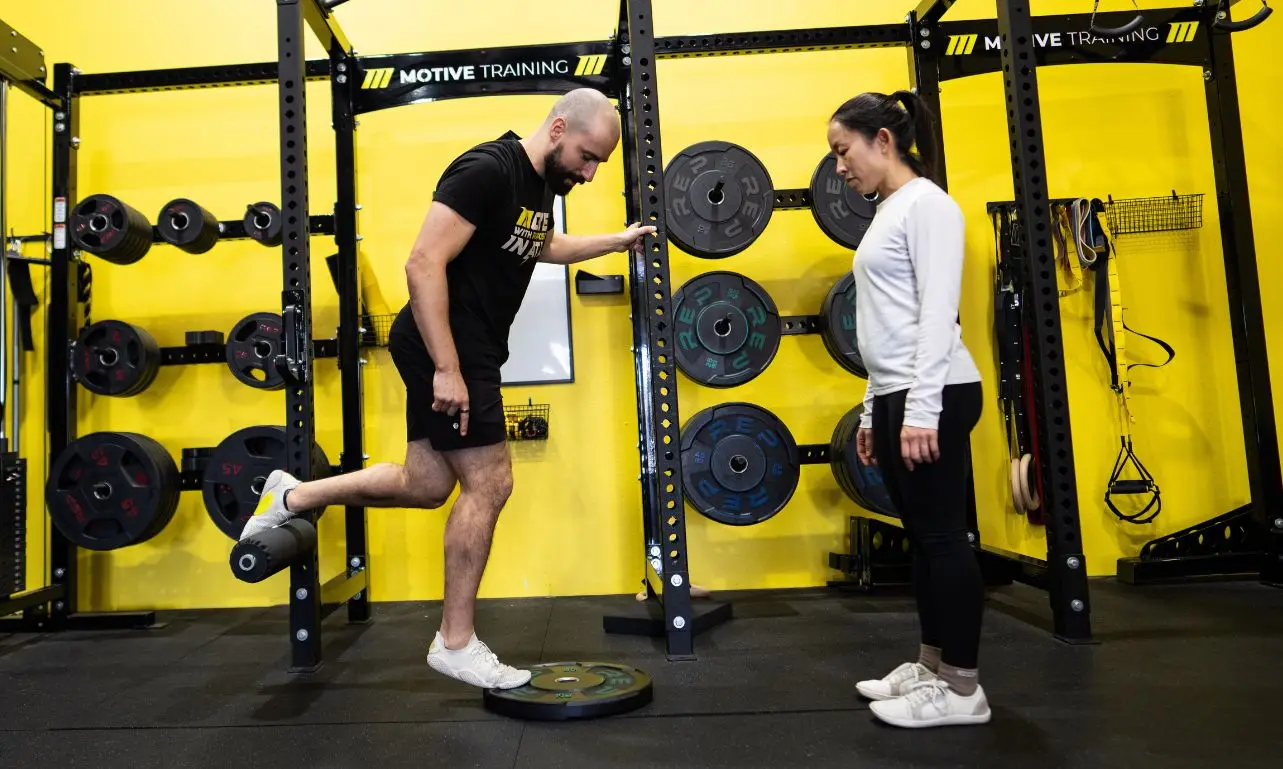
The practical version is unglamorous. Calf raises, loaded heavily enough that the last couple of reps are hard, taken through as much range as the ankle has available, three days a week. Work in the neighborhood of three or four sets of six to fifteen reps and add weight as tolerance improves, which for most people means a dumbbell, then a barbell or a loaded machine, over the course of a few months.
Slow is doing real work here, not just making the exercise harder to cheat. Tendon responds to the magnitude of strain and to how long the tissue spends under it, so a three-second lowering phase is worth more to the tissue than a fast rep at the same weight. Straight-knee and bent-knee variations both belong in the program because the gastrocnemius crosses the knee and the soleus does not, and the two load the tendon differently depending on knee angle. Most people only ever do the straight-knee version.
Pain during the work is allowed within limits. The general convention in tendon rehab is that discomfort up to roughly a 3 or 4 out of 10 during loading is acceptable provided it settles within 24 hours and the morning stiffness is not worse the next day. That next-morning check is the useful variable, and it is more informative than how the tendon felt during the session.
Twelve weeks is the number in both protocols. Not four, not six. I bring this up in every conversation about tendons because the single most common reason these programs fail is that the person stopped when the pain improved at week five, went back to full running volume, and landed back where they started by week nine.
The kinetic chain piece is worth naming without overclaiming. Ankle dorsiflexion range determines how the tendon gets loaded through stance, and a calf that reads as tight is sometimes an eversion problem rather than a length problem. Hip extension capacity determines how much propulsion comes from above. A joint-by-joint view of the lower limb is the right frame for deciding what else to look at, and for runners specifically the relationship between strength work and running is where most of the durability comes from. I would not tell anyone their Achilles pain originates at the hip, because nobody can know that without assessing the person.
Where end-range isometric work fits
Isometric holds have a place in this alongside the heavy slow work, particularly early when someone cannot tolerate full-range loading yet. The PAILs and RAILs programming framework applies here in the sense that isometric contraction at specific joint angles builds capacity at those angles, and a tendon that has been avoided for months usually has a narrow band of angles it trusts.
I want to be careful about how far I push that comparison. The trials above tested heavy slow resistance and eccentric heel drops. They did not test progressive angular isometric loading on an Achilles, and I am not going to imply an evidence base that does not exist. What I will say is that the underlying principle across all of it, that loaded work changes tissue in ways unloaded work does not, is the same principle, and it has held up across every tendon and fascia literature I have read.
If you want the ankle range and the calf capacity measured before you pick a starting load, that is what an assessment is for.
The Achilles is a structure built to store and return enormous force. It gets treated like something fragile when it hurts, and fragility is the one thing it responds to poorly.
References
- Beyer R, Kongsgaard M, Hougs Kjær B, Øhlenschlæger T, Kjær M, Magnusson SP. Heavy Slow Resistance Versus Eccentric Training as Treatment for Achilles Tendinopathy: A Randomized Controlled Trial. Am J Sports Med. 2015
Written by

Brian Murray, FRA, FRSC
Founder of Motive Training
Motive Training is a coaching studio in South Austin built around assessment, joint health, and strength you can use. Train with us in the studio, come to a KINSTRETCH class, or work through the progressions in KINSTRETCH Online.