There’s a specific conversation that comes up a few times a year at Motive. A runner walks in, usually somewhere in the 35–55 range, and they’ve been dealing with something: a knee that started bothering them at mile four, hip tightness that doesn’t resolve between runs, a hamstring that’s been “a little off” for six months. They’ve stretched. They’ve foam rolled. Some of them have done PT and been cleared. And the thing they haven’t done, almost universally, is train the body that’s doing the running.
Not their aerobic system. That part they know how to train. The joints, the connective tissue, the neuromuscular control at end range (the stuff that determines how much load their body can actually absorb and express over several thousand steps per run). That part is usually almost completely untrained.
This is a common enough pattern that it doesn’t surprise me anymore, but it still frustrates me a little. Austin is a city that takes running seriously. The marathon draws 30,000 people. Lady Bird Lake trails get millions of visits a year. There’s real commitment to the sport here. And the complement to that commitment, actual structured strength work designed around how runners move, is still being underserved.
Why Most Gym Strength Work Doesn’t Transfer
The standard gym answer to “I need to strength train for running” is usually a squat variation, some lunges, maybe a hip hinge, and a core circuit. That’s not wrong, exactly. But it’s also not a running-specific training program. It’s a general fitness program with the idea that being stronger will help somehow.
The problem is that running has a specific biomechanical profile. It demands single-leg stability at foot strike, hip extension through a full arc, rotational control through the trunk as each arm swings opposite a hip, and ankle dorsiflexion capacity to absorb impact. A bilateral squat trains some of that peripherally. A properly structured unilateral program with attention to those specific demands trains it directly.
There’s also the range-of-motion question. Running loads joints at positions that general strength training often skips entirely. If your hip extensors can produce force through the first 20 degrees of hip extension but lose access to motor control past that, you’re running with a meaningful deficit every single stride. The body compensates; it usually compensates through the lumbar spine, the contralateral hip, or the knee. That’s where the aches start.
From what I’ve seen, most runners who add strength work see improvement in general resilience, but they plateau or still get hurt because the strength work isn’t addressing the specific ranges and movement demands of the sport. The two things that close that gap are single-leg loading at the positions running actually requires, and mobility work that earns new range and then trains it with load.
What the Running Gait Actually Asks of the Hip
The hip is worth spending real time on because it’s the primary engine in running, and it’s also where the most compensation patterns originate.
In a full running stride, the hip moves through flexion at swing phase and extension at push-off, with internal and external rotation happening throughout the cycle. What limits runners is usually not flexion range; they tend to have plenty of that from sitting and from the hip flexor shortening that comes with high training volume. The deficit is almost always in hip extension and hip external rotation.
The hip flexor complex (primarily the iliopsoas and rectus femoris) adapts to sustained flexion. If you train or work in a seated position, run regularly, and don’t systematically address hip extension range and the tissue’s ability to produce force at end range, the hip flexors adaptively shorten. That shortening doesn’t just mean the muscle is “tight.” It means the nervous system has reduced the usable range, and the body now compensates during push-off by either truncating the extension arc or finding the extension somewhere else, typically the lumbar spine.
This is why lower back pain in runners is so common despite lower back being nowhere near the primary mover. The back is compensating for a hip that isn’t doing its job through the full range. Addressing the hip, not the back, is where that changes; we’ve covered the broader pattern of why hips stay chronically tight elsewhere, and runners are one of the clearest examples of it.
Single-Leg Loading and Why It Matters More Than Bilateral Work
Running is a single-leg sport. Every stride is a brief moment of single-leg stance and propulsion. The fact that most strength training for runners leads with bilateral movements (two legs on the floor, load distributed evenly) is a structural mismatch.
That doesn’t mean bilateral work is worthless. A Romanian deadlift builds posterior chain strength and hip hinge mechanics that carry over. A goblet squat builds positional awareness and knee tracking that matters. But they shouldn’t be the primary movements in a runner’s program, and they especially shouldn’t be treated as a proxy for single-leg capacity when the two things are measuring different things.
Single-leg work exposes deficits that bilateral work hides. When one leg can handle 70% of what both legs can handle together, that’s a problem for a running gait; it’s not even detectable in a bilateral squat. The asymmetries that develop over years of favoring one side, over compensating for an old injury, or simply from accumulated running volume without corrective work; those only become visible when you load one side at a time.
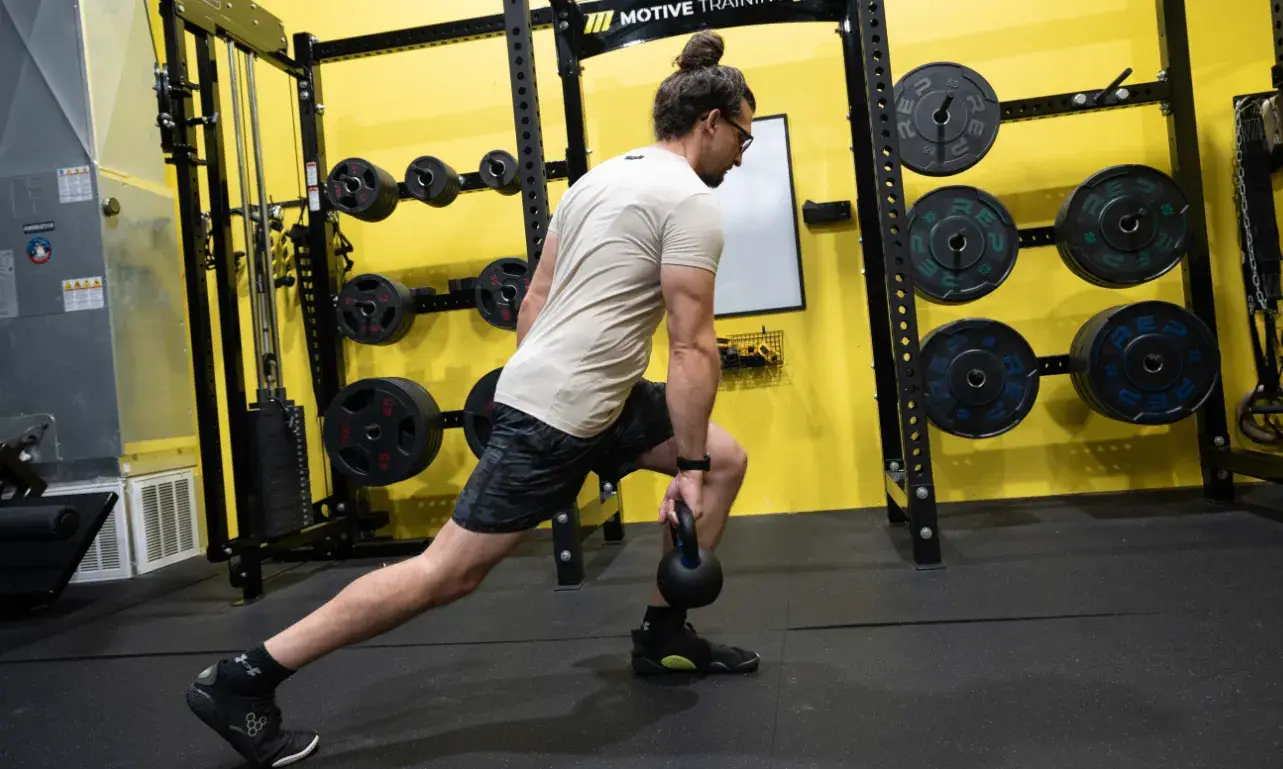
The movements that transfer most directly for runners are single-leg hip hinges (building posterior chain strength and stability at the positions running requires), split squats with attention to hip extension at the back leg, single-leg carries, and step-up variations with controlled descent. The eccentric on the descent matters. Runners are getting hit with eccentric load on every landing; training that pattern intentionally is more specific than any concentric-only movement.
The Mobility Work Runners Actually Need
I want to be clear about what I mean when I say mobility, because the word gets used loosely. We’ve written a full piece on mobility for runners that goes deeper on the joint-by-joint specifics; what follows is the framework. Flexibility is passive range, the range the tissue has when something external is moving it or holding it. Mobility is active range, what you can actually control and produce force through. Runners often have reasonable flexibility in their hips and hamstrings. What they lack is mobility, the ability to actually use those ranges under load.
The FRC framework we use at Motive is built around that distinction. Controlled Articular Rotations (CARs) take a joint through its full available range under active muscular control, which both maintains and assesses the joint. PAILs and RAILs build isometric strength at end range; the positions the joint can reach but can’t yet express force in. That’s the gap that matters for runners.
For most runners, the highest-priority joints are the hip and the ankle. Hip work focuses on extension range and the external rotation that running mechanics require. Ankle work focuses on dorsiflexion, which is frequently restricted in runners due to the repetitive plantar flexion of the push-off phase and the reduced dorsiflexion demand when running form breaks down. Ankle dorsiflexion restriction is one of the most consistent contributors to knee valgus on landing, which is the exact mechanism behind a lot of patellofemoral pain and IT band issues.
The thoracic spine is worth mentioning too. Arm swing in running is driven partly by thoracic rotation. Runners who have restricted T-spine rotation compensate by over-rotating at the lumbar spine or by reducing arm drive, which reduces running efficiency and places asymmetric load on the hips.
How to Structure the Combination
The practical question is how to fit strength training and mobility work into a schedule that already includes significant running volume. The answer depends on where someone is in their training cycle and what they’re managing, but a few principles hold pretty consistently.
Mobility work does best when it’s done with some regularity, even brief. Ten minutes of CARs and targeted end-range work before a run serves as both a joint assessment and a movement preparation. It’s not a warm-up in the traditional sense; it’s checking in on the system and waking up ranges that running doesn’t access. Done consistently, it also moves the needle on range over time.
Strength sessions work best on non-consecutive days with long runs. Two sessions per week is enough to see structural change. The sessions don’t need to be long; 45 to 60 minutes of focused single-leg work and posterior chain loading, with attention to the ranges that matter, is more specific and less fatiguing than a traditional gym session. The goal is not to build a powerlifter. The goal is to build a body that can absorb and produce force through the arc that running requires, without breaking down at mile four.
For runners who are managing an existing issue (a tendon that’s irritable, a hip that clicks, a knee that swells after long runs), the starting point is an assessment, not a program. The program has to match what the body actually needs, not what a template says it should need. That’s a different conversation, but the assessment is where it starts.
The Longer Argument
Austin runners tend to be smart, motivated, and already doing a lot of things right. The gap isn’t aerobic base; they’ve got that. The gap is that the body doing the running hasn’t been trained with the same seriousness as the engine driving it. And the version of strength training that closes that gap looks pretty different from a generic lifting program with a running label on it.
The pieces are single-leg loading at running-relevant positions, hip extension and external rotation work both in terms of mobility and strength, ankle dorsiflexion capacity, and T-spine rotation. None of that is exotic. It’s just specific, and specificity is what makes the difference between a strength program that translates to better running and one that just makes you better at the gym.
If you’re in Austin and looking to build that out, our assessment is where we’d start. It gives us a clear picture of what the body actually needs before any programming decisions get made. Or if you’re already curious and want to see what this looks like in a class setting, our KINSTRETCH classes are built on the same movement principles. And if you’ve come out of a period of injury or PT and you’re trying to get back to running with a more complete foundation, this piece on training after physical therapy covers that bridge specifically.
The training is available. The runners just have to decide the body is worth the same attention as the miles.
References
- Willy RW, Meardon SA, Schmidt A, et al. (2016). “Mechanics of running with altered footstrike patterns.” Journal of Orthopaedic & Sports Physical Therapy.
- Beattie K, Kenny IC, Lyons M, Carson BP. (2014). “The effect of strength training on performance in endurance athletes.” Sports Medicine.
- Dallinga JM, Benjaminse A, Lemmink KA. (2012). “Which screening tools can predict injury to the lower extremities in team sports?” Sports Medicine.
Written by

Brian Murray, FRA, FRSC
Founder of Motive Training
Motive Training is a coaching studio in South Austin built around assessment, joint health, and strength you can use. Train with us in the studio, come to a KINSTRETCH class, or work through the progressions in KINSTRETCH Online.