The couch stretch is great, until it isn’t. Dang near every one of our clients dealing with general knee pain cannot get through it, pad under the knee or not. That’s not a small handful of people walking through our doors. It’s most of them.
Why kneeling ends it before the hip gets there
The stretch itself isn’t the problem. Kneeling on a hard floor is. Bend the knee and load it against a surface and the kneecap gets compressed directly between the femur and whatever is underneath it, and that’s exactly the kind of load that patellofemoral pain, early arthritis, or a knee still working through something doesn’t handle well. There’s decent occupational data on this from an unrelated angle: a study comparing floor layers, who kneel for a living, against graphic designers, who don’t, found floor layers in their fifties had over three times the odds of radiographic tibiofemoral arthritis, with the risk climbing the longer they’d been in the trade (1). That’s years of repetitive occupational load, a different situation than a two minute stretch, but it’s the same compression mechanism showing up on a longer timeline. A folded towel under the knee doesn’t change that math. The load is still going straight down through the kneecap. It just feels marginally softer going in.
What the stretch is actually asking for
Worth fighting for, though, because this stretch is reaching a muscle almost nothing else gets to properly. The rectus femoris is the only one of the four quad muscles that crosses both the hip and the knee (2). Cross two joints and you inherit a specific problem. Shorten the muscle at one end and it goes slack at the other before it’s actually been stretched. Full hip extension with the knee straight barely touches it, because the knee end is still short. Full knee flexion with the hip neutral does the same thing in reverse. You need the hip extending and the knee bending at the same time, both ends lengthening together, or the muscle just goes along for the ride (2). That’s why this position feels like a real event compared to most other stretches, and why the half-hearted version, knee barely bent, hip barely behind the body, accomplishes next to nothing.
The bench fix
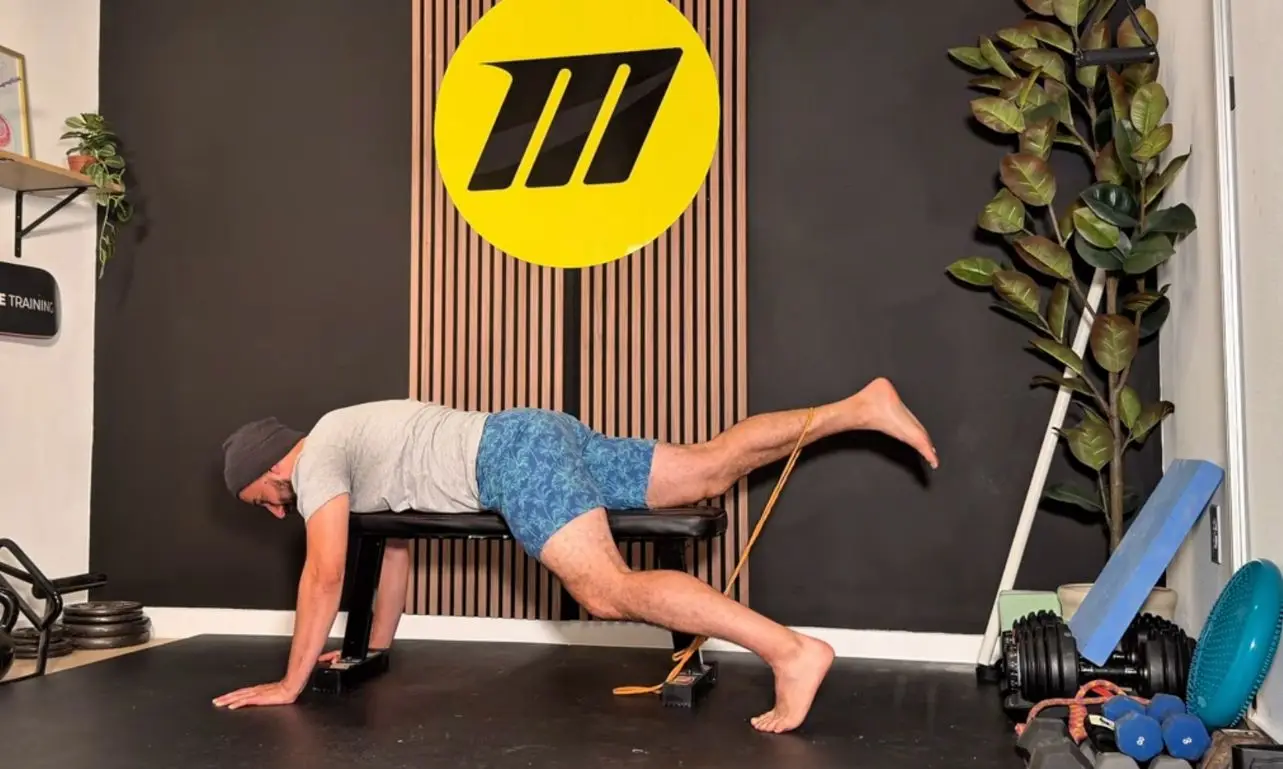
Andres has been setting clients up on a bench instead of the floor, and it solves the actual limiting factor instead of padding around it. Back leg goes up on a bench behind the body, shin resting on the surface instead of the ground, front knee bent in front like normal. Hip still extends. Knee still bends. Nothing about the stretch demand changes. What disappears is the weight driving straight down through the kneecap, because the knee is sitting on a padded bench at hip height instead of the floor.
For a lot of our clients that’s the difference between skipping this stretch entirely and actually getting something out of it. Two to five minutes, somewhere around a seven out of ten, once the position itself stops being the fight.
The hold alone doesn’t finish the job
Here’s the part that gets skipped even when someone does get the position right. Passive holding changes things, but maybe not the thing people assume. Research on static stretch training has found that most of the gain in end range motion comes from the nervous system tolerating the stretch better and from a change in how the tissue resists load at end range, not from the muscle actually growing longer. One frequently cited study on calf stretching found a 19.9 percent increase in ankle range and a 28 percent increase in how much resistance the tissue could take at end range after three weeks of daily stretch training, with no measurable change in muscle activation detected at end range (3). That’s a real adaptation. It’s also mostly a tolerance and stiffness adaptation, which means the position gets more available without anyone teaching the joint to actually use it.
That’s the real argument for pairing the passive hip extension with active work. It’s not an add-on. If a few minutes at a seven out of ten mostly teaches the nervous system to tolerate the position, something else has to teach it to produce force there.
Pairing the stretch with PAILs and RAILs
Drive the back knee down into the bench like you’re trying to straighten the leg against something that won’t move. Hold that. Then pull the heel back toward the glute and push the hip further into extension, actively, without help. That’s the PAILs and RAILs pairing, and it asks the nervous system to produce force at the exact range it just spent several minutes tolerating passively. Train the quad to stay long under its own control instead of just sitting through a stretch someone put it in, and the new range actually belongs to something. We go deeper on the mechanics of this pairing in our PAILs and RAILs guide.
Loading the range with a compound lift
From there, get some strength across a compound lift built on that same position, and you’ve got a solid baseline for getting that knee feeling better. A rear foot elevated split squat on the same bench loads the exact hip extension and knee flexion combination just opened up. Most people stretch a tight quad and then go squat a pattern that never asks the hip to extend past neutral, so none of the training carries over to what was just worked on.
There’s also a more immediate reason this matters for a knee that’s actually uncomfortable. Isometric loading of the knee extensor mechanism has a documented, same day analgesic effect, not just a training benefit that shows up weeks later. The study that got this conversation started measured pain during a loaded single leg squat in athletes with patellar tendinopathy before and after a set of heavy isometric holds, and found a substantial immediate drop in pain that outlasted the same protocol done with regular reps (4). Later attempts to reproduce that exact effect in larger groups have come back mixed, so this isn’t a guarantee and it isn’t evidence for every kind of knee pain. But it’s real enough that finishing this sequence on a loaded isometric hold, instead of stretching and walking away, has a legitimate shot at making the knee feel better that same session, not only over the following weeks.
Where this fits
This bench setup is one piece of what Andres builds into KINSTRETCH Online, where anterior chain and knee work gets sequenced this way on purpose. If knee pain has quietly become the reason you avoid quad and hip flexor training altogether, that’s worth addressing directly instead of working around it forever. We go deeper on the knee side of things in what your knee actually needs beyond flexion and extension.
Here’s Andres running through it:
Try that.
References
- Rytter S, Egund N, Kirkeskov Jensen L, Bonde JP. Occupational kneeling and radiographic tibiofemoral and patellofemoral osteoarthritis. J Occup Med Toxicol. 2009;4:19. https://www.ncbi.nlm.nih.gov/pmc/articles/PMC2726153/
- Murdock CJ, Mudreac A, Agyeman K. Anatomy, Abdomen and Pelvis, Rectus Femoris Muscle. StatPearls, NCBI Bookshelf. Updated November 13, 2023. https://www.ncbi.nlm.nih.gov/books/NBK539897/
- Blazevich AJ, Cannavan D, Waugh CM, Miller SC, Thorlund JB, Aagaard P, Kay AD. Range of motion, neuromechanical, and architectural adaptations to plantar flexor stretch training in humans. J Appl Physiol. 2014;117(5):452-462. https://pubmed.ncbi.nlm.nih.gov/24947023/
- Rio E, Kidgell D, Purdam C, Gaida J, Moseley GL, Pearce AJ, Cook J. Isometric exercise induces analgesia and reduces inhibition in patellar tendinopathy. Br J Sports Med. 2015;49(19):1277-1283. https://doi.org/10.1136/bjsports-2014-094386
Written by

Brian Murray, FRA, FRSC
Founder of Motive Training
Motive Training is a coaching studio in South Austin built around assessment, joint health, and strength you can use. Train with us in the studio, come to a KINSTRETCH class, or work through the progressions in KINSTRETCH Online.