Ask a serious BJJ or MMA athlete in Austin how they train mobility and most of them point at the mat. Rolling, drilling, hitting pads, that’s the answer. And it’s a reasonable thing to believe. A hard roll genuinely asks a lot of the hips and shoulders. Deep guard retention needs real hip internal rotation. A tight kimura or underhook fight needs real shoulder external rotation. The range is there, and it’s real.
Here’s the distinction that matters. The joint is getting pushed into that range by a training partner’s weight or a scramble you didn’t choose, not by anything you built yourself. The nervous system treats those two situations differently even when the position looks identical from the outside, and a joint that gets moved into range instead of building strength to control that range on its own tends to guard it. That guarding shows up as a pinch during a specific position, a hip that won’t quite clear guard the way it used to, a shoulder that starts complaining every time an armbar gets deep.
Why grapplers and strikers plateau on the same restrictions
A large 2025 survey of 881 BJJ practitioners worldwide found the knee and shoulder were the two most commonly affected regions, at 25 percent and 13 percent of all reported injuries (1). The shoulder finding lines up with what deep guard, butterfly retention, and berimbolo-style transitions demand: enormous internal and external rotation, frequently under someone else’s body weight, frequently at the outer edge of range. A hip or shoulder that’s fine through the middle and weak at the edges gets exposed here first.
The hip side of this has a specific mechanism behind it too. Positions that ask for deep hip flexion combined with internal rotation, exactly what guard retention and half guard demand, are the same positions associated with femoroacetabular impingement, a structural restriction at the joint capsule itself rather than simple muscle tightness (2). Tightness through the hip flexors compounds it, since a shortened, under-trained psoas limits how far the hip can extend before the lumbar spine starts compensating, which shows up as low back irritation during heavy rolling weeks that seems to have nothing to do with the hip at all.
Strikers get a version of the same problem through the shoulder and thoracic spine, and the biomechanics of where punching power actually comes from back this up directly. Kinematic analysis of the straight punch found that trunk rotation is the mechanism that transfers ground reaction force generated by the legs into force at the fist, with peak angular velocity of the trunk occurring right at impact (3). Power on a hook or a roundhouse runs through the exact same thoracic rotation. A stiff mid-back, one of the more common and least examined limitations in striking athletes, forces the shoulder to generate rotation it wasn’t built for, since the trunk isn’t supplying its share. That’s a common route to the shoulder pain strikers describe as only happening on their power side.
Why nobody catches this in a normal warm-up
Most warm-ups get the body ready for that day’s session: jogging, dynamic stretches, a few minutes of shrimping or technical stand-ups. That’s fine for raising tissue temperature and rehearsing a pattern. It asks nothing of the joint in isolation, at end range, under deliberate load, which is exactly the piece that’s missing.
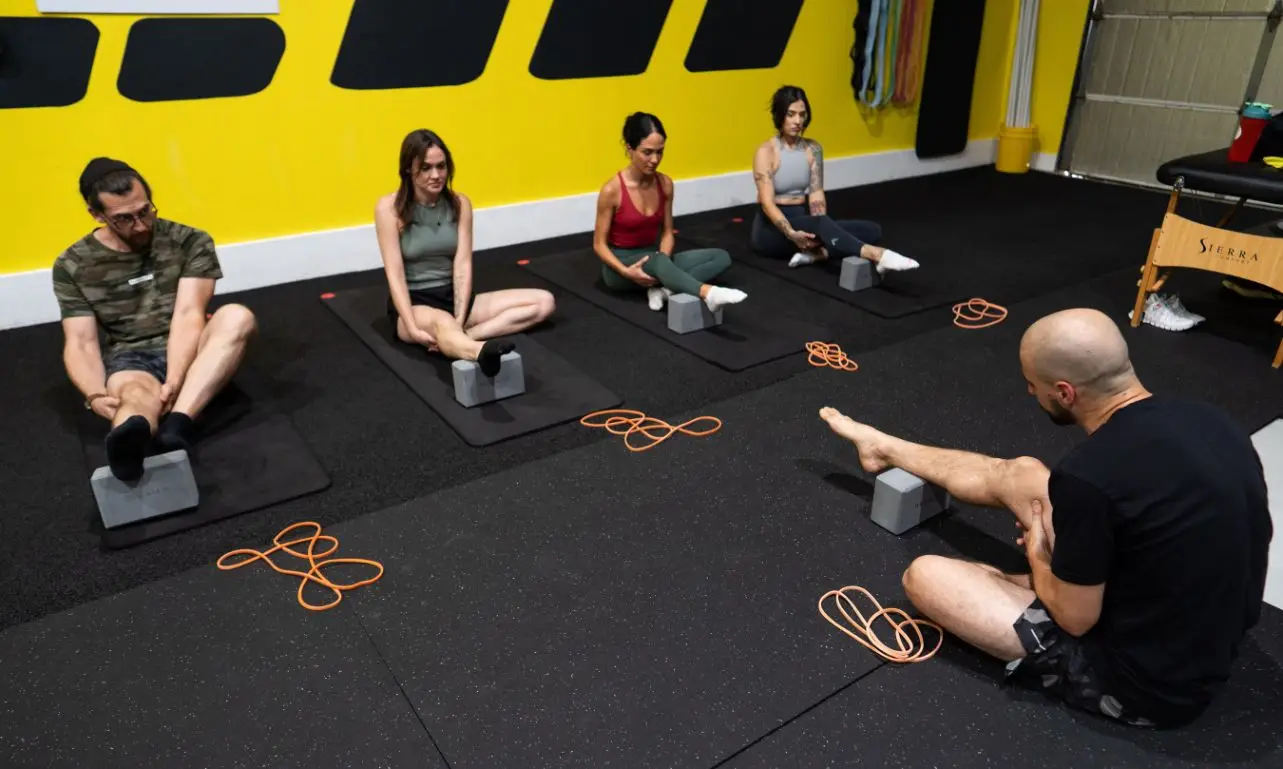
Controlled Articular Rotations done slowly and with real tension teach the nervous system where the joint’s actual capsule limits are, separate from what a training partner can force it into. End-range isometric loading, PAILs and RAILs, at hip internal rotation, the exact position that gives grapplers trouble in deep guard, builds strength precisely where live rolling never deliberately trains it. Same logic for shoulder external rotation if you’re doing regular armbar or kimura work, and for thoracic rotation if you’re generating power for strikes.
Training where I actually train
I train at Fox House Martial Arts in South Austin, and the gap this article is describing shows up on my side of the mat as much as anyone else’s. Rolling hard doesn’t exempt a coach from the same thing it doesn’t fix in a client, which is exactly the point. The martial artists who train joint work separately, for years, don’t usually describe it as feeling dramatically different day to day. What they notice is what stops happening. Fewer nagging hip pinches during a hard rolling week. Fewer shoulders that flare up out of nowhere after a heavy submission class. It’s a quiet kind of proof, but it’s the kind that holds up.
Finding out what’s actually restricted
If a hip or shoulder is already bothering you, a joint versus movement assessment is the first useful step, since it tells you if you’re dealing with a genuine capsule restriction or a strength deficit at end range that only feels like tightness. Guessing wrong means training the wrong thing for months.
KINSTRETCH for beginners is a reasonable starting point if you’ve never done joint-specific training before and want the hip and shoulder ranges your sport demands but never deliberately trains. Rotational power itself is worth training deliberately once the joint restrictions are addressed, and David Weck’s rotational movement philosophy covers why that transfer specifically matters for striking.
References
- Injury prevalence among Brazilian Jiu-Jitsu practitioners globally: a cross-sectional study in 881 participants, 2025
- Don’t Let Hip Pain Stop You From Climbing, Boulder Climbing Community, on femoroacetabular impingement and deep hip flexion/rotation positions
- Kinematic and Kinetic Analysis of Throwing a Straight Punch: The Role of Trunk Rotation in Delivering a Powerful Straight Punch
Written by

Brian Murray, FRA, FRSC
Founder of Motive Training
Motive Training is a coaching studio in South Austin built around assessment, joint health, and strength you can use. Train with us in the studio, come to a KINSTRETCH class, or work through the progressions in KINSTRETCH Online.