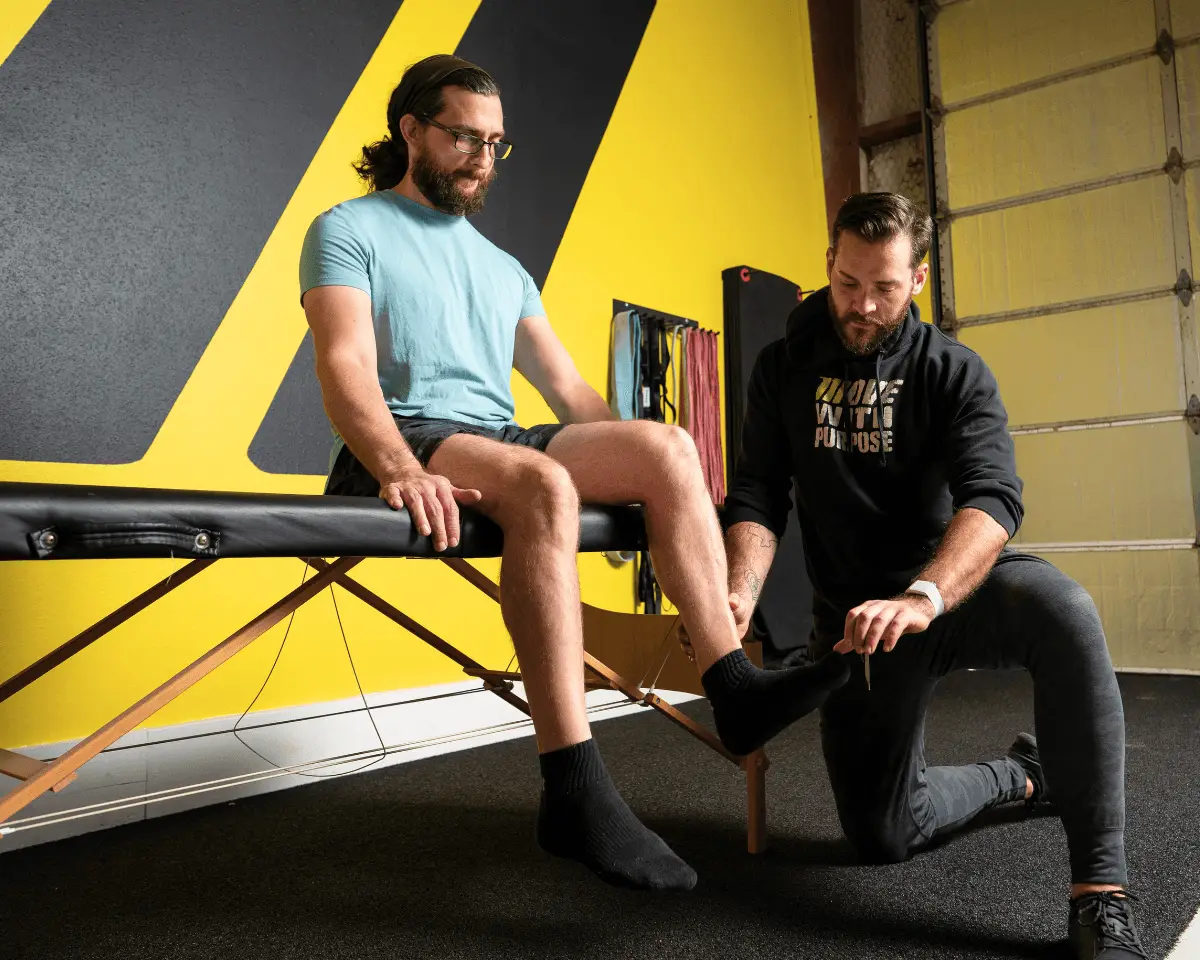
People who go looking for an FRC routine usually want a list. Ten exercises with a rep count next to each, something to print out and follow. I get the appeal, and plenty of those lists exist; some of them are decent. The trouble is that the list is the least important part of an FRC routine. Two people can run the identical sequence of CARs and isometrics for six weeks, and one of them builds hip rotation she can use under load while the other spends the whole block on a joint that was never holding him back.
What holds a routine together in Functional Range Conditioning is structure. Some work happens every day, some happens a few times a week, one joint gets most of the attention at a time, and that attention moves when the joint has earned it. Get those decisions right and the exercise selection mostly follows, because the joint in front of you tells you what it needs. What follows is how we set that structure up for people training on their own. It assumes pain isn’t driving the decision. If something hurts, the order changes, and so does who should be building the plan.
Two layers running on different clocks
An FRC routine has a daily layer and a targeted layer, and each one has its own job.
The daily layer is CARs, a full-body pass that takes each joint through the largest rotation it can make under active control. It takes ten to fifteen minutes and needs no equipment. The technique itself, including how much tension to bring and how slow to go, is covered in our guide to controlled articular rotations, so I won’t repeat it here. Its purpose in the routine is maintenance plus information. Every joint visits its current limit, and you get a daily read on where that limit sits.
The targeted layer is where range gets built. That means isometric loading at end range, followed by holds and eventually loaded movement through whatever range the isometrics opened up. It gets aimed at one or two joints, two to three times a week. It’s harder work, and it’s the part most people skip, because the daily layer feels productive enough on its own to pass for a complete routine.
Using the daily layer as a read
The daily pass maintains range almost regardless of how much attention you bring to it. Pay attention anyway, since it’s the cheapest assessment you’ll ever run. A hip that pinches at the same point in the rotation every morning, or a shoulder that won’t travel as far behind you on one side, is worth writing down. A few weeks of those notes usually point at the same one or two joints.
Leave the fixing for later. If a CAR hurts, shrink the circle to the range that doesn’t and keep moving. The daily layer exists to keep every joint visiting its limit; making the limit bigger belongs to the other layer.
Picking the joint that gets the work
The targeted layer only works when it’s aimed. Spread across every joint in the body, it gives none of them enough exposure to change.
Your daily notes are one input and your training is the other. Someone pressing overhead with shoulder flexion they can’t reach on their own has an obvious first target. For a runner, hip extension deserves a look, since a hip that won’t extend under its own control often shows up as extra extension through the lower back on every stride.
Then there’s what you can’t see from inside your own body. CARs show you where a joint stops. Measuring how far the range you can be placed into outruns the range you can reach yourself takes someone else moving the joint for you, and the size of that gap decides how hard the targeted work should push. That measurement is a large part of why most people here start with an assessment before anything gets programmed.
Pick one joint. Two if they sit at opposite ends of the body and you have the time. Then stay with them for several weeks. Stretch tolerance improves within days and fades about as quickly; control at end range builds slower, and switching joints every week guarantees you only ever collect the fast, temporary part.
What one targeted session looks like
Start with CARs for the target joint alone, slower and with more tension than the morning pass, so you know where it sits today. Then get into the end-range position and spend a couple of minutes there passively, letting the tissue settle.
The PAILs and RAILs come from that position. We’ve written the dosing out in detail in our piece on programming PAILs and RAILs; the short version is one to three rounds per position, with each contraction ramped gradually up to a hard effort. Once the contractions stop being hard, that joint is done for the day. Most people should do less of this than they expect.
Then test what the isometrics bought you. Come out of the stretch and hold the new end range using only your own muscle. That hold tells you how much of the range belongs to you yet, and it’ll feel far harder than the stretch did. Lift-offs and hovers sharpen it further once the hold is steady; the full set of tools and the order they go in are laid out in our piece on end-range mobility training.
Loaded movement through the new range comes last, and only after the hold stops shaking. Skip that gate and you’re loading range the nervous system hasn’t signed off on, which is the exact pattern this whole process is meant to prevent.
For one joint, the sequence usually fits in twenty to thirty minutes.
Fitting it into a training week
On days you lift, the targeted work goes first, while you still have enough output to contract hard at end range. Mobility tacked onto the end of a session is mobility done tired, and a tired contraction at end range does very little.
For someone lifting three or four days a week, a workable version looks like CARs every morning plus a targeted block for the priority joint at the start of two or three of those sessions. On a day off from lifting, the targeted block can stand alone as the session. The fixed point is two to three hard exposures per joint per week with a day of recovery between them. Everything else can flex around your schedule.
Scale the isometrics to the day. If the joint you’re targeting is one you’re about to load heavily, a lighter dose of PAILs and RAILs keeps it ready to train; we don’t take someone to max-effort contractions before a hard session on that same joint unless that’s specifically what they need.
Knowing when to move on
The measure that counts is the active range catching up to the passive range. Can you get closer to the deep position on your own than you could a month ago, and can you hold it longer without help. How the stretch feels will improve long before either of those does, so don’t grade the routine on it.
When the active range has mostly closed on the passive range, the joint graduates to maintenance. It stays in the daily pass, keeps showing up in your normal training, and the targeted layer moves to the next joint on your list. When a joint stalls for several weeks with honest effort behind it, get a second set of eyes on it. From what I’ve seen, stalls tend to come from working the wrong joint or the wrong direction of the right one, and both are hard to catch on your own.
The part a general routine can’t do
It’s common to see a routine built around one position, 90/90 being the usual example, sold as the thing that fixes hips. For some people it’s a fine choice. For the specific person reading, it might train a direction of the hip that was never limited while the direction that is limited gets ignored, and whoever wrote the routine has no way of knowing which. The structure above holds for almost anyone. What goes inside it depends on the joint in front of you, which is why the structure is the part worth learning first.
If you’d like the sequencing handled for you, KINSTRETCH Online runs this same structure in class form, joint by joint, from ten-minute warm-ups to full routines, with the progressions already built in. If you’re in Austin, start with the studio class, where a coach can watch what your hip is doing that day. That matters most in the first couple of months.
Written by

Brian Murray, FRA, FRSC
Founder of Motive Training
Motive Training is a coaching studio in South Austin built around assessment, joint health, and strength you can use. Train with us in the studio, come to a KINSTRETCH class, or work through the progressions in KINSTRETCH Online.