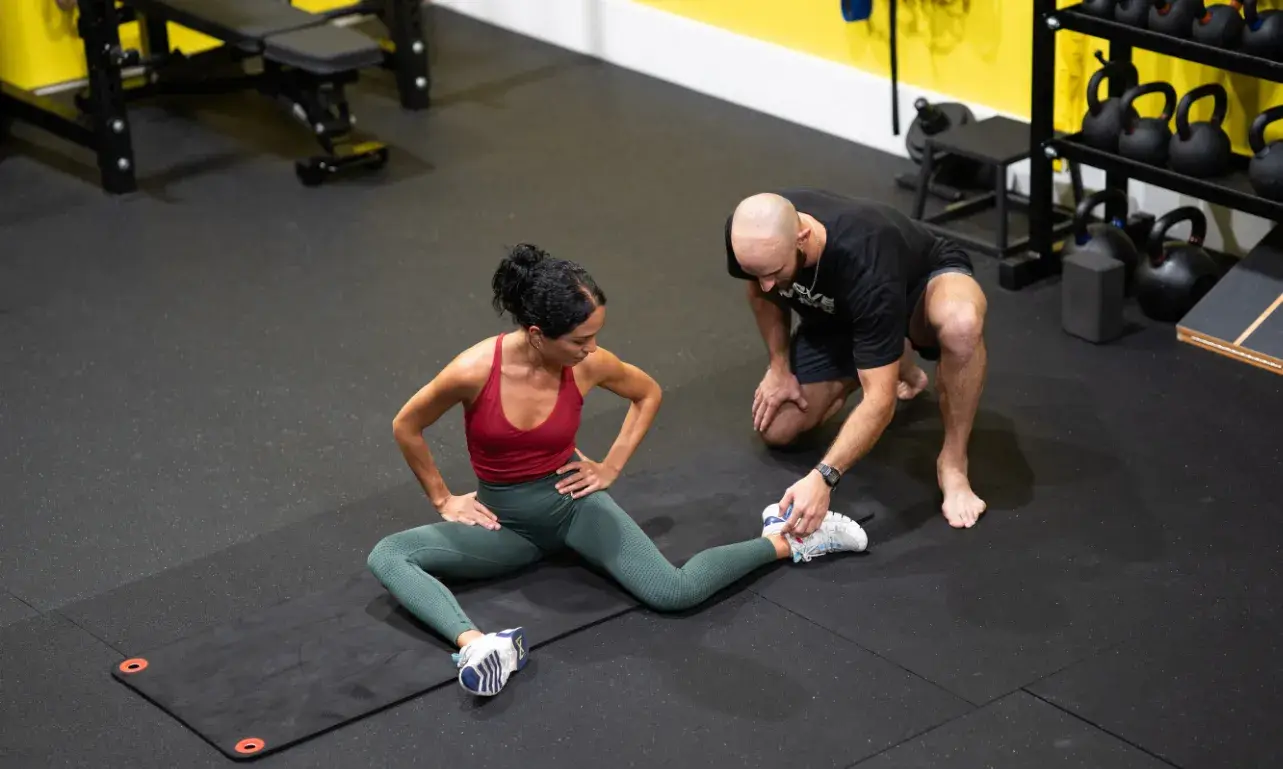
A client once told me foam rolling was the only thing that touched his tight hips, and he’d been doing it every day for two years. I asked him what his hips felt like the next morning, before he rolled. Same as always, he said. Tight. That exchange is the whole comparison in miniature. The roller was doing something real, just not the thing he thought it was doing, and definitely not the thing he wanted it to do. Two years of daily effort and his starting point hadn’t moved an inch.
Foam rolling and Functional Range Conditioning get filed under the same heading, mobility, which is how people end up treating them as two answers to one question. They’re not competing. They do different jobs on different timescales, and the confusion is what keeps people rolling for years while their actual range stays exactly where it started.
What foam rolling actually does
Worth being fair here, because the roller gets dismissed too hard by people in my corner of the field. Foam rolling does real things. The research is reasonably consistent that it produces short-term increases in range of motion, and unlike static stretching before activity, it does this without blunting strength or power. That makes it a legitimately useful warm-up tool. It also helps with delayed onset muscle soreness and with how recovered people feel, and those effects show up across enough studies to take seriously.
The catch is in the mechanism. The ROM you get from rolling is largely neural, not structural. You’re modulating pain sensitivity and stretch tolerance, getting the nervous system to briefly allow more range, rather than changing the tissue itself in any lasting way. Which is why the effect is measured in minutes to maybe an hour. The proposed mechanisms in the literature are things like altered tissue stiffness, increased blood flow, and pain-modulation through the nervous system, all of which are real and all of which are temporary by nature. Roll your hips, gain some range, lose it by tomorrow. That’s not a failure of foam rolling. That’s foam rolling working exactly as it works.
So the honest framing is that foam rolling is a transient input. It’s a good one. It opens a window. It does not build anything that stays.
What FRC does instead
Functional Range Conditioning is aimed at the opposite outcome: range that’s still there next week, and next month, because you built the strength and control to own it. The tools, controlled articular rotations, PAILs and RAILs, loaded end-range work, all share one feature that foam rolling lacks. They require you to produce force in the positions you’re trying to improve.
That’s the entire difference. Foam rolling has you receive pressure passively while the nervous system loosens its grip for a while. FRC has you generate tension at the edges of your range, which teaches the nervous system that those positions are controllable and therefore safe to access. The body limits range it doesn’t trust you to control, and you don’t earn that trust by lying on a cylinder. You earn it by demonstrating strength where you were weak. We’ve made the longer case that foam rolling isn’t mobility training elsewhere, and the reason comes down to this. One is passive and borrowed, the other is active and kept.
This is also why FRC is slower and harder, and why it doesn’t feel as immediately good. You’re not chasing the loosened sensation. You’re building capacity, which is a less satisfying process in the moment and a far more durable one over time.
How to actually decide between them
Put plainly, the question isn’t which is better. It’s what you’re trying to accomplish in the next hour versus the next season.
If you want to feel looser right now, before a session or a run, foam rolling is a reasonable choice and the evidence supports using it that way without worrying about killing your output. If your hamstrings are sore two days after a hard leg day and you want to take the edge off, roll them. Those are the jobs it’s genuinely good at. Use it for the transient window it opens and don’t expect it to do more.
If your actual problem is that a joint has been tight for years, that a range is missing rather than just temporarily stiff, or that you keep losing positions under load, foam rolling will not fix that no matter how long you do it. That’s the structural-and-neurological problem FRC is built for, and the difference between flexibility you have passively and range you can actually use is exactly the gap the active work closes. My two-year client wasn’t failing at foam rolling. He was using a recovery tool to try to solve a capacity problem, and those are different categories.
The cleanest way to think about it: foam rolling can be the thing you do before the work. FRC is the work.
Where they sit together
They’re not mutually exclusive, and the smarter move is usually to use both for their actual purposes rather than picking a side. Roll before training if it helps you feel ready. Then spend the session building control in the ranges that matter, because that’s the part that compounds. The roller opens the window. The training builds the room.
What I’d push back on is the belief my client had, that the roller was his mobility solution, when it was really his warm-up doing a warm-up’s job and nothing more. Two years of daily maintenance on a problem that needed training instead of maintenance. If you’re not sure which category your own tightness falls into, there are signs that point to an answer before you ever book anything, and past that, it’s most of what the movement assessment sorts out, whether you’ve got a range that’s missing or one you just can’t access yet, and the answer changes everything about how you should spend your time. If it turns out you need to build range rather than borrow it, that’s what we coach in person and through the system itself.
Written by

Brian Murray, FRA, FRSC
Founder of Motive Training
Motive Training is a coaching studio in South Austin built around assessment, joint health, and strength you can use. Train with us in the studio, come to a KINSTRETCH class, or work through the progressions in KINSTRETCH Online.