The most common person who walks into a group mobility class for the first time is not the brand new exerciser. It is someone who has already tried other things. They have done yoga for two years and feel about the same. They have been to StretchLab and noticed the tightness comes back by the end of the week. They got cleared from physical therapy six months ago and have been carefully avoiding what hurts ever since. They are forty-something, they sit too much, they want to keep playing pickleball or running or lifting, and they have figured out that the standard stretching options are not getting them where they want to go.
That is the audience this class format was built for. Group mobility is a working term we use for what is actually KINSTRETCH, a methodology built around training joints actively through their full available range. The class structure is different from yoga, Pilates, and passive stretching for reasons that are mechanical, not stylistic. The intent is to build capacity, not to relax into a position and hope something changes.
This piece walks through what the class actually is, who it serves in Austin specifically, and what it does that the other options on the local mobility landscape do not.
What “group mobility” means at Motive
The umbrella term is group mobility. The underlying methodology is KINSTRETCH, a system developed inside the Functional Range Systems family by Dr. Andreo Spina. The class structure is taught by certified instructors, follows a programmed format, and uses specific tools (CARs, PAILs and RAILs, end-range isometrics, joint capsule training) that share a logic with what we do in personal training.
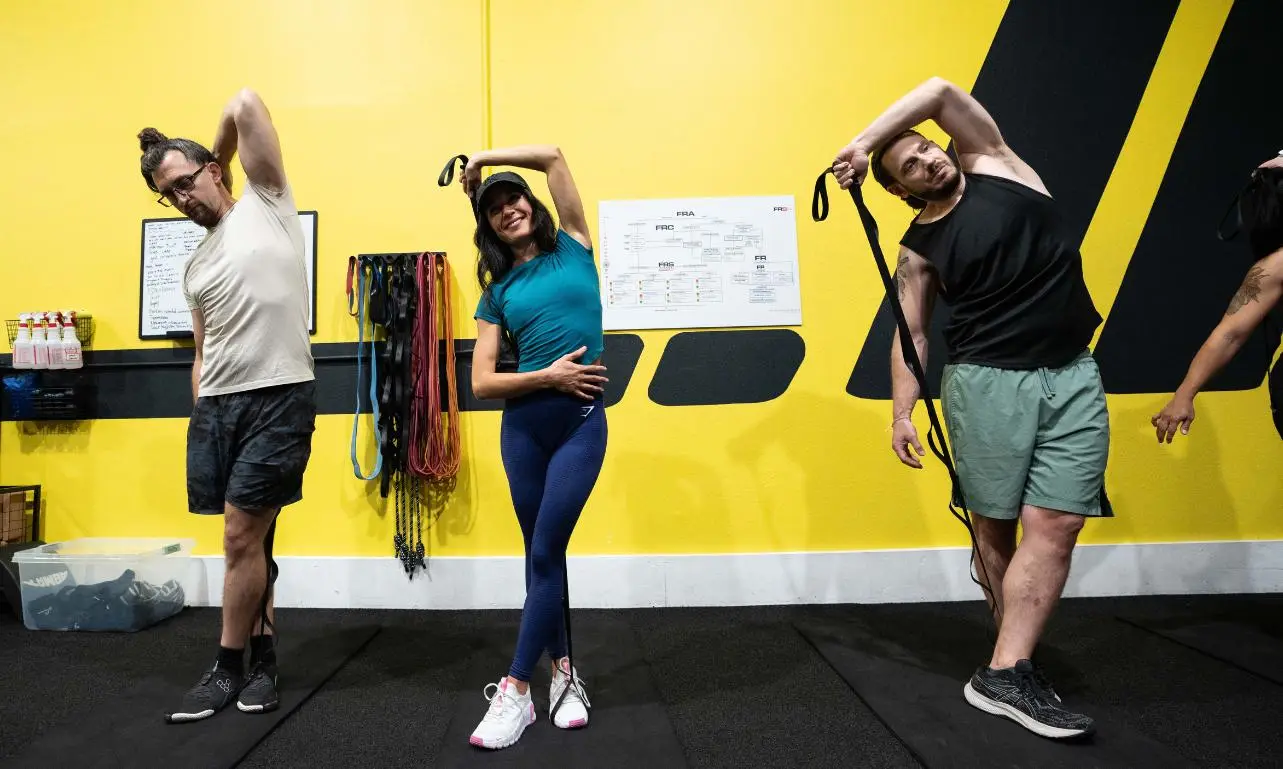
A class looks something like this. You arrive in workout clothes you can move in. The room has yoga mats, a few props, and not much else. The instructor takes the room through a warm-up that is really an assessment, looking at how the joints are responding that day. Then the body of class is forty to fifty minutes of work that targets specific joints or regions, depending on the class type. CARs at the top. Positional work to find the right shapes. Progressive isometric loading inside those shapes. Then a brief integration phase where the work gets connected to real movement patterns.
Five class formats run through the schedule. Restore is the low-intensity entry point and good for people coming back from injury or who are deconditioned. Hips and Lower Body focuses on the hip capsule, knee, and ankle. Foundations covers the basics of how the system trains the body and is the most appropriate first class for someone brand new. Posture Reset works the thoracic spine, scapula, and shoulder. Upper Body covers shoulder, elbow, and wrist. KINSTRETCH is the underlying methodology in all of them; the class names describe what you are training, which is more useful than just listing “KINSTRETCH” five times on the schedule.
What it does that other Austin classes do not
Austin has a strong group fitness landscape. Yoga everywhere. Pilates studios on most blocks of the city core. StretchLab in multiple locations. CorePower, Black Swan, the boutique strength studios. People assume group mobility is one more option in that landscape. It is doing something different.
Yoga is excellent for what yoga is for. It teaches breath, body awareness, and patient time in positions, and the better teachers cue subtle alignment in ways that produce real changes over years. The piece it is not built to do is train the body to actively own ranges it does not already use. Most of what happens in yoga is passive (you sink into a position and breathe) or it is dynamic flow (you move between positions). Neither of those is the same as isometric end-range loading, which is what builds active control of a new range.
Pilates is excellent at what it is for too. Core integration, postural awareness, controlled movement against light resistance. The piece it is not built to do is target specific joint capsules with progressive load through end ranges. The Reformer is a great tool. It is not a CAR or a PAIL.
StretchLab is passive assisted stretching. Someone moves your limbs through ranges, applies stretch, holds you in positions. The literature is fairly clear about what passive stretching can do, which is increase stretch tolerance, and what it does not do, which is build muscular capacity inside the new range. If you stop going, the changes do not stick, because nothing about the protocol teaches your nervous system to use what was opened up.
Group mobility class at Motive does the opposite. The work is active. The instructor is teaching you how to use your own muscle to find and hold the positions. The whole point is that what gets trained in class is something you can carry out of class because your own body learned to do it. The reason clients keep coming back is not addiction to the experience; it is that the work is compounding.
Who this serves in Austin
A few patterns I see consistently in the people who land in group mobility class:
The Austin tech worker who sits for nine or ten hours a day. Hip flexors that have not been at full length in years. Thoracic spine that has lost rotation. Shoulders that round forward by default. They lift on weekends, they run sometimes, they hike the Greenbelt. The body is not catastrophically deconditioned, just systematically restricted in places that compound over time. Group mobility addresses the input side, not just the workout side. (For people who want a deeper individual look at what is going on, the personal training side covers the same methodology with a focused one-on-one structure.)
The active 40-plus adult who is hitting the wall. Pickleball is hard on the body in ways most people do not anticipate. Marathon training breaks people. Cycling is great cardiovascularly and rough on hip flexion and thoracic posture. The 40+ crowd in Austin is active, often very active, and the body is starting to push back on whatever they have been doing. Group mobility gives this crowd a place to train the inputs that recreational sport degrades.
The post-physical-therapy graduate. Someone finished a course of PT, they got most of the way back, and now they are on their own. The gap between “discharged from PT” and “training like an athlete again” is wide and most people fall through it. Group mobility is a way to keep the work going in a structured environment.
The person who has done everything else. Yoga for years. Pilates for a stretch. Tried StretchLab. Bought a foam roller. They are not getting worse, but they are not getting where they thought they would. The methodology shift is what changes things.
What to expect in your first class
You do not need to be flexible to come. Most people who walk in are not. The class is structured so that the first six weeks are a learning curve, the next several months are when the patterns start to shift, and the durable changes show up sometime around the one-year mark for a body that has been doing this work consistently.
You will need to be able to get to the floor and back up. You will need to be able to follow cues. The work is harder than it looks. People often describe their first KINSTRETCH class as “harder than I thought” because what looks like sitting in a position is actually maximal active engagement at a specific joint angle. You will feel it the next day in places you did not realize had muscle.
Wear something you can move in. Bare feet preferred. Hydrate. Eat something but not too much. Bring water.
If you have a specific issue (recent injury, surgery, pregnancy, persistent pain), the right starting point is not class. It is the Motive Movement and Mobility Assessment, which exists specifically to figure out what you need before you commit to a format that may or may not fit.
How it fits with the rest of the system
Group mobility class is the entry point most clients use to get into the work. It is also a complement to one-on-one training rather than a replacement for it. The methodology that runs through class is the same methodology that runs through personal training at Motive. KINSTRETCH is the group format. Functional Range Conditioning is the broader system. The personal training side applies the same principles individually, with assessment, programming, and load that match what your specific body needs.
A lot of clients run class plus training together. Class twice a week, personal training once or twice a week, and the inputs start compounding in ways that are visible inside three months. Other clients just do class for years and get exactly what they need from that format alone. There is no one right way to use the system. There is a right way for the body you have.
Where to start
If you have never taken a class before, Foundations is the right entry point. If you have a specific problem area (back, hip, shoulder), the body-region classes are useful but you will get more out of them once you understand the underlying movement patterns. If you are dealing with persistent pain or coming back from an injury, talk to us first instead of just showing up to class. Some bodies need a slightly different starting point than the class format provides.
Group mobility is not a niche option in the Austin fitness landscape. It is a different category of work than most of what is on offer. The people who keep coming back are the ones who needed something the other formats were not built to provide.
Written by

Brian Murray, FRA, FRSC
Founder of Motive Training
We’ll teach you how to move with purpose so you can lead a healthy, strong, and pain-free life. Our headquarters are in Austin, TX, but you can work with us online by signing up for KINSTRETCH Online or digging deep into one of our Motive Mobility Blueprints.