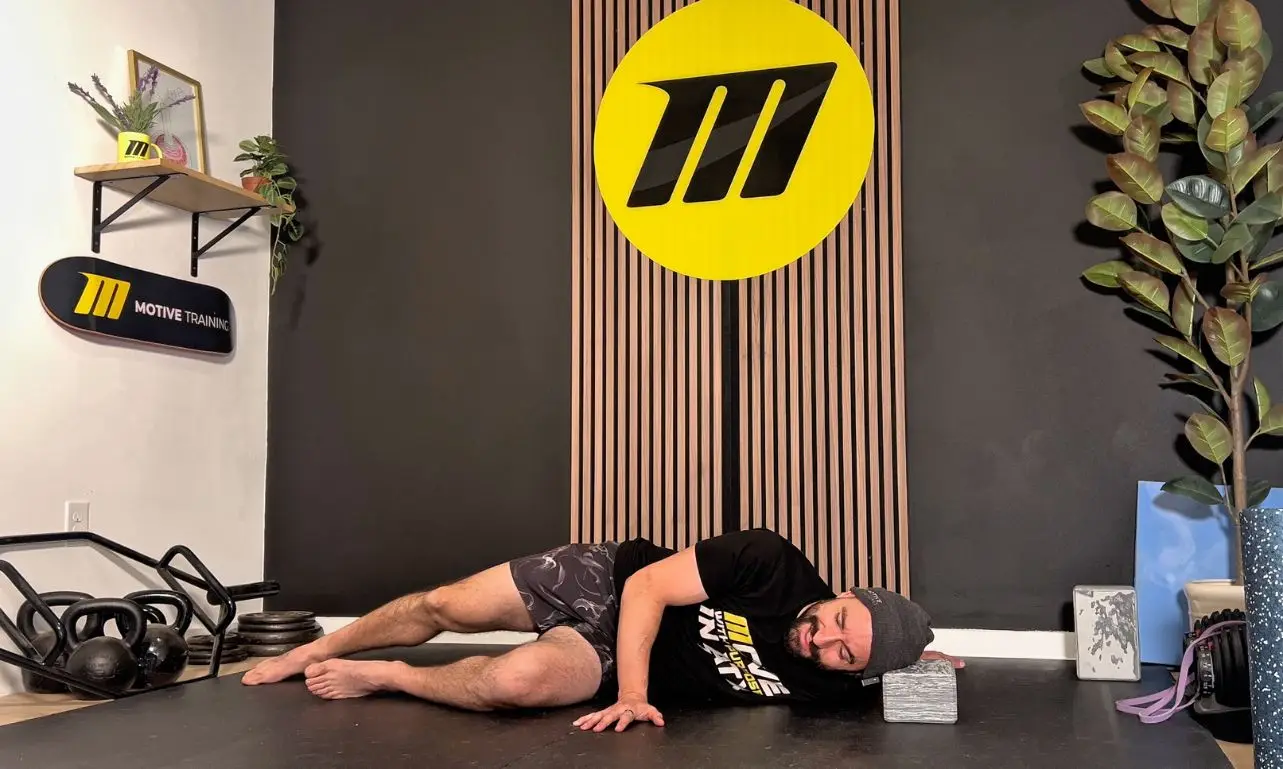
The first half of the posture problem is the thoracic spine, and we made that case in detail in part one of this series. The t-spine gives up its extension, the rest of the chain compensates, and every joint around it pays the bill. That part is real. It is also incomplete.
Open the t-spine in a session, walk out feeling tall, and within a few hours the shoulders are creeping back forward. The chin starts drifting. The upper traps re-engage. The reason is that the t-spine is the platform, but the platform is not what holds your shoulders in place. That is the shoulder blade’s job. And in most adults with a posture problem, the shoulder blades have been trained out of doing it.
That is the second half. So let’s start there.
The scapula is supposed to move. The problem is when it stops
The shoulder blade is a freely floating bone. It is not bolted onto the rib cage. It rides across the back of the rib cage on a sheet of muscles that are supposed to slide it in six directions. Up and down, forward and back, and rotating in both planes. The position your shoulder blade sits in at rest is the product of all those muscles pulling on it in some kind of balance. When the balance is normal, the scapula sits flat against the rib cage, slightly back, with the bottom corner tucked in. When the balance is off, the scapula gets pulled to a default position that does not represent rest. It represents whichever muscles have been doing the most work.
For most desk-life adults, the default is a scapula that has been pulled up and forward. The upper traps and pecs win the balance. The lower traps, rhomboids, and serratus anterior lose. The shoulder blade settles into a slightly shrugged, slightly protracted position that the body has come to treat as neutral. The body adapts to where you spend your time, which is a feature, not a bug. It is just inconvenient when the position your body has adapted to is also the position that compromises everything connected to the shoulder.
The piece most posture content gets wrong is treating the shoulder blade as a passive object. Pull the shoulders back. Squeeze the blades together. Hold for the photo. The shoulder blade does not respond to those cues the way most people seem to think it does. It needs to be retrained, and the retraining sits across several tissues at once, which is most of why one stretch does not fix it.
What actually gets stuck
The pec is the part everyone has heard about and almost nobody addresses correctly. The chest muscles, particularly pec minor, attach onto the front of the shoulder blade and pull it forward when they shorten. Years of arms-in-front-of-the-body posture (typing, driving, scrolling) leaves the pec minor short and the scapula pulled forward at rest. The first thing most people try is to stretch the chest. That works as far as it goes, but stretching alone does not change anything durable. The pec opens, the day continues with the arms in front of the body, and by evening the scapula is back where it started.
The upper trap dominance is the next layer. The upper traps elevate the shoulder blade. They are supposed to be one of three forces controlling the scapula, alongside the middle and lower traps. In a chronic posture pattern, the upper trap takes over and the middle and lower traps stop firing well enough to balance it. The result is shoulders that sit up by the ears and a scapula that cannot get down where it belongs, even when the t-spine is open.
The lower trap and rhomboid weakness is the part almost no general fitness conversation addresses, and the piece that determines if posture work actually holds. These are the muscles that pull the shoulder blade down and back. They are also the muscles that have been doing the least work in your life for years. You cannot fix a posture pattern without giving them a job, and giving them a job means specific, low-load, high-attention training of scapular depression and retraction. This is the slow piece. It is also the piece without which nothing else lasts.
Serratus anterior sits in the same conversation. It anchors the scapula against the rib cage. When it stops firing well, the bottom edge of the shoulder blade lifts off (what’s called winging), and the rest of the scapular musculature loses its base of operations. People with winged scapulas tend to find pressing painful and overhead work frustrating without ever knowing why.
So the restriction is multi-tissue. Pecs short and tight, upper trap overworking, middle and lower trap inhibited, serratus quiet. A single drill addresses one of those at a time. That is why the work has to be sequenced. Release the pec, then teach the scapula to come down and back, then load that range under control, then layer it into actual posture. Skip any of those steps and the scapula reverts.
The bill a stuck shoulder blade keeps charging
A scapula that cannot depress and retract creates a cascade that overlaps with, and amplifies, the cost we covered in part one.
The shoulder pays first and loudest. Getting your arms overhead requires the scapula to upwardly rotate. If the scapula is stuck in protraction, that upward rotation is mechanically compromised. The space the rotator cuff tendons pass through under the acromion gets smaller. That is the mechanical setup for impingement, and it is why so many shoulder issues in desk workers do not resolve until the scapula starts moving cleanly. We have written about this in our piece on scapula training and shoulder health, and the principle applies just as much to posture as it does to lifting.
The t-spine does not stay where you put it, either. This is the part most posture programs miss. You can mobilize the t-spine into extension, but if the scapula keeps pulling forward, it tilts the upper rib cage downward and the chest closes again from the front. The t-spine wins the morning and loses the afternoon. The shoulder blade is what holds the work the t-spine did.
The neck takes a version of the same hit. When the upper trap is dominant, it pulls the head down toward the shoulder and elevates the shoulder up toward the ear. Both of those compress the cervical spine on whichever side is doing the most work. People with chronic neck stiffness frequently have a shoulder blade problem they have never been told about. The neck cannot rest down on a relaxed shoulder if the shoulder will not relax.
And then there is the gym side of it. Pressing and pulling depend on the scapula doing its share of the work. If the scapula is locked, the shoulder has to do all of it, and the shoulder is not built to absorb that load by itself. Bench press shoulders, overhead press impingements, lat pulldowns that pinch under the collarbone, these are all scapular control problems wearing shoulder-joint costumes.
How to know if this is you
You don’t need an assessment to get a useful read on your own shoulder blades. A few simple checks tell you most of what you need to know.
Stand in front of a mirror with your arms relaxed at your sides and look at where your hands land. If the backs of your hands are facing the mirror, the scapulae are protracted, which means the front of the shoulder is internally rotated and the shoulder blade is being pulled forward. The thumbs should face forward in true neutral. Most people who have not specifically trained this find their hands a quarter to half turn away from neutral, which means the scapulae have been parked forward long enough that the body now treats it as resting position.
Or try this one. Sit or kneel tall with your fists out in front of you at shoulder height, elbows straight. Without letting the fists move up or down at all, try to shrug your shoulders up to your ears and then pull them all the way down and back. Most people cannot do it cleanly. The fists float up when the scapula shrugs, the fists drop when the scapula depresses, because the joint between the shoulder blade and the arm has been moving as a single unit for so long that the brain cannot separate them. That separation is the foundation of scapular control, and very few adults walk in with it.
The last one is the most diagnostic for chronic desk posture. Lie face down on the floor with your forehead resting on a towel or block and your arms out in a W shape, elbows slightly below the shoulders. Now try to lift the forearms just barely off the floor by pulling the shoulder blades together and down toward the back pockets. If your arms can barely clear the ground, your retraction is probably reasonable. If the arms shoot up high without much effort, that is a control problem, not a strength one. If you cannot lift them at all without arching your low back, the lower and middle traps have gone silent enough that even gravity is winning.
Two of those three, and the scapula is part of your posture story. All three, and it is not really a question.
Opening the chest is the easy part. Teaching the scapula to do its job is where the work happens
Most shoulder mobility content stops at “stretch your pecs.” Lay over a foam roller, get in a doorway, sigh deeply, repeat tomorrow. That opens the front of the body, which is necessary, and on its own does almost nothing for posture. We have written about why open range without control is not durable in our breakdown of PAILs and RAILs. The principle that applied to the t-spine applies just as much here. Open the range, then train inside it under your own muscle, or the range you opened in the morning is gone by afternoon.
The scapula has its own version of that sequence. First, the pec gets released, either with a foam roller or, for tighter people, with a lacrosse ball into the front of the armpit. That opens the front so the scapula has somewhere to move. Then scapular CARs take the shoulder blade through its full range under active control, which teaches the brain that all six degrees of freedom are available and addressable. Then isometric retraction work, with the arm trapped under the body, builds strength specifically in the position the scapula has been avoiding. Then depression lift-offs, sitting up tall on blocks and pressing down through the hands so the scapulae have to pull down to lift the body, train the lower trap to take its job back. And finally, the all-fours variation with a band pulling the scapula up, where you have to actively pull it down against resistance, which is the piece that turns the work into something you can access under load.
The order matters. The sequence matters. Release, then mobilize, then load, then integrate.
That is the structure of part two of the Posture Problem series in KINSTRETCH Online. It follows directly from the t-spine work in part one, which is by design. Part one creates the platform. Part two teaches the scapula to use the platform. Done together, the work holds. Done in isolation, it usually does not.
What this means for what you should do
If you have done some t-spine work and noticed the gains do not last past lunchtime, the t-spine is probably not the limiter anymore. The piece that has gone unaddressed sits above it. The scapula has been refusing to come down and back, and that is where attention needs to go next.
If your shoulders, neck, or upper back keep flaring up despite consistent stretching and posture cues, the same answer probably applies. The chain runs from the t-spine to the scapula to the shoulder to the neck, and any of those links can be the reason the others won’t settle. We see this play out the same way across the range of people who come through our studio, from the runners and pickleball players and cyclists who deal with it as an upper-body version of their lower-body compensation patterns, to the Austin tech workers whose desk lives have built it in over years.
There is a way to chase this on your own with a foam roller and good intentions, and we have seen it work for the rare person with a high baseline. More commonly we see the t-spine work happening without the scapular layer, and the gains evaporating. The version that holds up is when both layers are trained, in order, with someone watching for the shoulder blade sneaking back into its old default the second your attention drifts. That is what the Posture Problem track is built around, and it is why part two does not stand alone. It builds on part one.
If you are not sure where to start, the movement assessment tells us. From there, we can point you to part one, part two, or somewhere else entirely.
Written by

Brian Murray, FRA, FRSC
Founder of Motive Training
Motive Training is a coaching studio in South Austin built around assessment, joint health, and strength you can use. Train with us in the studio, come to a KINSTRETCH class, or work through the progressions in KINSTRETCH Online.