The most common question I get from people starting mobility work is some version of “how long until this feels different.” The honest answer is longer than most people want to hear, and shorter than they think once they understand what they’re actually waiting for.
Mobility isn’t one thing. It’s a stack of qualities: passive range, active control, tissue tolerance, nervous system permission. Each one moves on its own schedule. The mistake most people make is treating them as a single timeline, expecting a six-week transformation, and quitting at week ten when the real work has just started.
The First Month Is Mostly Your Nervous System
When someone starts a real mobility practice, the first changes show up fast. Within a few sessions, people report feeling looser, more aware, less stiff getting out of bed. Some of this is real. Most of it is the nervous system updating, not your tissue lengthening.
Your brain is constantly negotiating how much range it’s willing to let you use, based on your history of using the joint and how safe it feels giving you access. When you start doing controlled work in ranges the joint hasn’t seen in a while, the system updates. It isn’t giving you more length. It’s giving you more access to length you already had. That feels like progress because it is, but it has a ceiling, and people who don’t know that hit the ceiling and assume the practice stopped working.
The nervous system gains are real and they happen quickly. The structural and capacity gains take longer. The plateau between them is where most people get frustrated and walk away.
The Next Three Months Are Where the Gap Closes
The more meaningful work, and the work most adults actually need, is closing the gap between passive and active range. Passive range is how far the joint can be moved when you’re not doing anything. Active range is how far you can move it under your own control. Most adults have a substantial gap between the two. That gap is where the feeling of tightness lives, where injury risk concentrates, and where carryover into actual movement gets lost.
Closing the gap is a strength problem. The system doesn’t give you access to ranges it doesn’t trust you with, and trust is built by demonstrating you can produce force in the range. PAILs and RAILs are the most direct tool for this. The broader point is that active range catches up to passive range only when the muscles around the joint have been asked to work at end ranges consistently. Eight to twelve weeks is roughly what it takes to see noticeable change at a specific joint, assuming the intensity is real and the work is consistent.
In practice, the change usually shows up in something specific. A position that used to feel impossible becomes accessible. A lift that used to grind starts feeling smooth. A morning stiffness that had been part of life for years quietly disappears. People rarely notice it the day it changes. They notice weeks later, when something they used to do uncomfortably they haven’t been doing uncomfortably for a while.
Six Months Is Where the Body Starts to Feel Different
The deeper changes, the ones that move someone from managing tightness to actually feeling at home in their body, take six to twelve months. This is the part most people quit before reaching.
What happens in that window is harder to describe in a single number. The system starts organizing itself differently. Movement patterns that had been compensating around limited joints start to shift back toward how the body was supposed to organize itself. The thoracic spine starts contributing to motion the lumbar had been doing. The hips start participating in load the low back had been absorbing. None of this is one big visible change. It’s a long string of small ones, and the cumulative effect is that the body starts feeling like something you live in instead of something you manage.
The reason this takes six months or more is that the adaptations aren’t just to the tissue. They’re to the way the nervous system organizes movement across joints, which is a slower process than just changing strength at a specific position. The brain has spent years learning the compensations. It needs time to learn the new versions.
What Has to Be True for the Timeline to Work
The timelines above assume real work, done consistently. The most common reason mobility timelines fail is not that the body can’t change. It’s that the practice wasn’t intense enough or consistent enough to produce change.
Intensity matters in mobility work in a way most people don’t appreciate. Sinking into a stretch and waiting is not the same as actively contracting at end range. Functional Range Conditioning recommends two to fifteen minutes holding a “passive” stretch (passive in quotes, because it’s not really passive when you’re being cued and moving through these positions). Most people don’t approach that intensity, and most people don’t get the change they’re after.
Consistency is the other variable. Ten or fifteen minutes a day of controlled articular rotations produces more than an hour once a week. The joint adapts to repeated stimulus over time. Sporadic stimulus, sporadic adaptation.
The last variable is what you’re actually working on. Most people address what feels tight. What feels tight is often not what’s producing the limitation. A real assessment is how you find out where the actual gaps are. It’s also the difference between two years of work that produced moderate results and two years of work that produced real change.
Why Most People Quit Before the Work Starts Working
The honest version of why mobility fails for a lot of people isn’t that the work doesn’t work. It’s the mismatch between expectation and reality. People come in expecting six weeks. The first three weeks feel great because the nervous system is updating. Weeks four through eight feel like a plateau because the next phase is slower. By week ten, the person has decided the practice isn’t working and goes back to what they were doing before, which also wasn’t working.
The frame that helps is to think of mobility the way you’d think of training for endurance or strength. Nobody expects a couch-to-marathon plan in six weeks. Nobody expects to add a hundred pounds to their squat in a month. Physical adaptation takes time. The same principles apply to mobility, and somehow with mobility we expect it to be faster. It isn’t.
People who stay with a consistent practice for six months end up in a meaningfully different relationship with their body than they were in before. The shift is real. The reason most people don’t get there is that they walked away during the slow part.
A Realistic Frame to Start From
If you’re starting from scratch, here’s the version I tell clients in their first session. The first month is about building the habit and letting the nervous system update. You’ll feel better and you shouldn’t read too much into it.
The second and third months are where you start doing the harder work: loaded isometrics at end range, progressive PAILs and RAILs blocks, real intensity. This is where the gains slow down and where most people get bored. Push through.
The fourth through sixth months are where structural change starts showing up, and where the practice begins to feel like part of how you live instead of something you have to schedule. After that it stops feeling like a project and starts being a baseline.
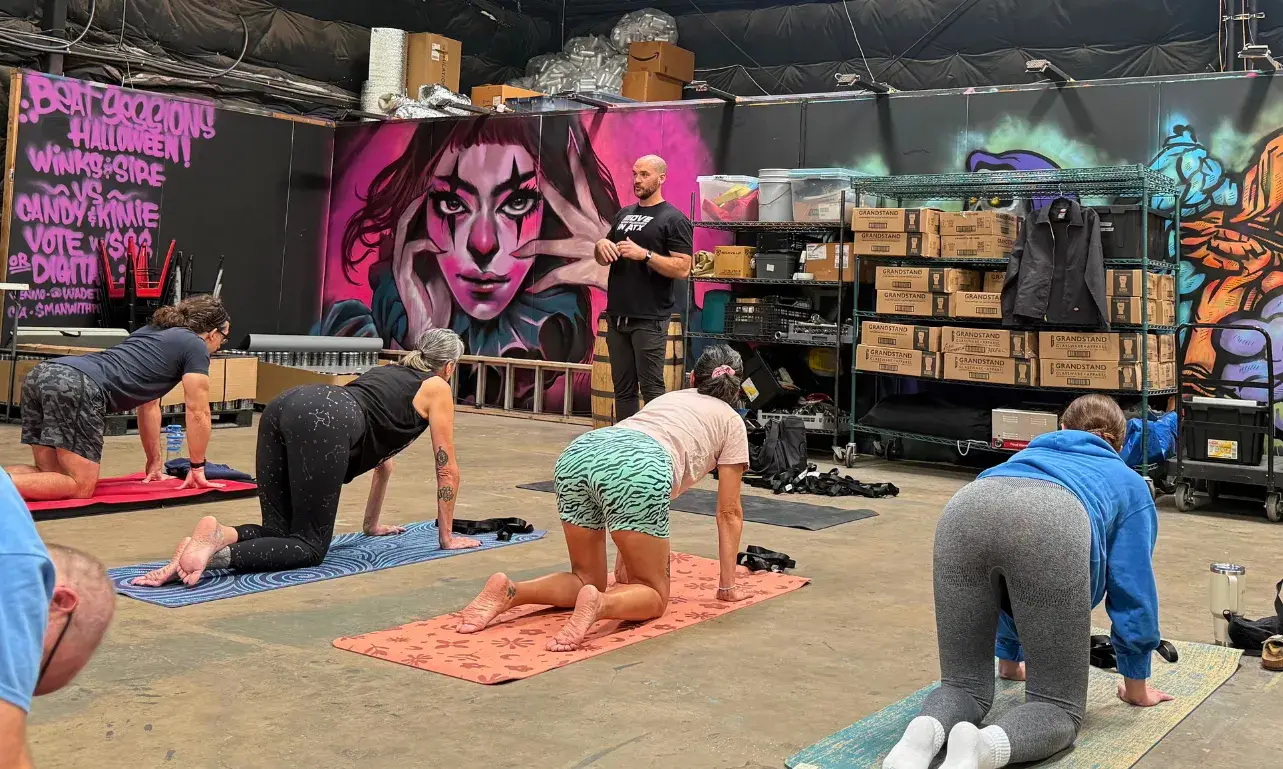
A class once or twice a week, like KINSTRETCH, accelerates the timeline because it gives you exposure to harder positions and a coach watching what you’re doing. Daily home practice for the easier work. An assessment in the first month so you’re working on what actually matters.
Mobility isn’t a quick fix and it was never going to be. The upside is that once you’ve built the foundation, it doesn’t disappear quickly. You can step back from intense daily practice and the body will hold most of the gains. But the foundation is six months, not six weeks. The people who internalize that early are the ones who actually get somewhere.
Written by

Brian Murray, FRA, FRSC
Founder of Motive Training
Motive Training is a coaching studio in South Austin built around assessment, joint health, and strength you can use. Train with us in the studio, come to a KINSTRETCH class, or work through the progressions in KINSTRETCH Online.