Why Tech Workers in Austin Are Dealing With More Pain Than Ever
Austin has grown into one of the largest technology hubs in the United States. Thousands of professionals spend their days coding, designing products, managing teams, and sitting through long meetings. Most of that work happens in front of a computer.
The environment is productive, but it also creates predictable physical patterns.
Neck stiffness. Shoulder tightness. Restricted hips. Persistent low back discomfort.
These issues rarely appear overnight. They develop gradually as the body adapts to spending long periods in the same positions.
Many tech workers try to offset the problem with occasional workouts, stretching routines, massage therapy, or ergonomic adjustments. Those strategies can provide short-term relief, but they often fail to solve the underlying issue.
The real problem is not simply tight muscles. It is the gradual loss of usable movement capacity inside the joints.
Mobility coaching focuses on restoring that capacity. At Motive Training, the goal is to rebuild how the joints move first, then layer strength on top of that foundation. Systems like Functional Range Conditioning help improve joint function so movement becomes stronger, more controlled, and less likely to trigger discomfort.
The Physical Cost of Desk Work
A typical desk setup encourages the body to remain in similar positions for hours at a time.
The hips stay flexed in a seated position. The spine gradually rounds forward. The shoulders drift toward the keyboard. The head moves closer to the screen.
The body adapts to the positions it experiences most frequently. When certain movements disappear from daily life, the joints begin to lose access to them.
Hip extension becomes harder to access. Spinal movement decreases. Shoulder rotation becomes limited.
Over time the body organizes itself around fewer movement options. When someone eventually tries to train harder in the gym, their body may struggle to tolerate the load because the joints no longer move the way they should.
This is one reason many desk workers feel worse when they jump into intense workouts.
Mobility coaching approaches the problem differently. Instead of forcing more intensity, it restores the joint movement that allows training to work in the first place.
What Mobility Coaching Actually Involves
Mobility coaching is often misunderstood as stretching or light warm-up exercises. In reality, it is a structured process designed to improve joint health, control, and usable range of motion.
At Motive Training, the process begins with a detailed evaluation called a Functional Range Assessment.
This assessment looks at how individual joints actually move. It helps identify the areas where motion has been lost and where strength inside those positions is missing.
The evaluation examines factors such as:
Joint rotation capacity Differences between active and passive range of motion Movement asymmetries Strength inside specific joint positions
For many tech workers, the results reveal familiar patterns. The hips may lack rotation and extension. The thoracic spine may have very limited movement. Shoulder rotation may be restricted from years of keyboard use. The neck often becomes stiff from constant screen exposure.
Once these limitations are identified, training can focus directly on restoring those specific movement capacities.
Instead of guessing which exercises might help, mobility coaching targets the exact joints that need attention.
Why Strength Must Follow Mobility
Improving mobility without strengthening it rarely leads to lasting change.
The body tends to keep positions it can control. If a joint gains range of motion but lacks strength within that position, the nervous system will often avoid using it.
That is why mobility work at Motive Training is paired with strength development.
When hip rotation improves, strength training teaches the body how to use that motion under load. When shoulder movement increases, strength exercises reinforce control and stability through those positions.
The result is not simply greater flexibility. It is a body that can move through a wider range of positions while remaining strong and resilient.
Many clients pair mobility work with structured personal training so strength development supports the movement improvements happening in the joints.
How KINSTRETCH Helps Maintain Progress
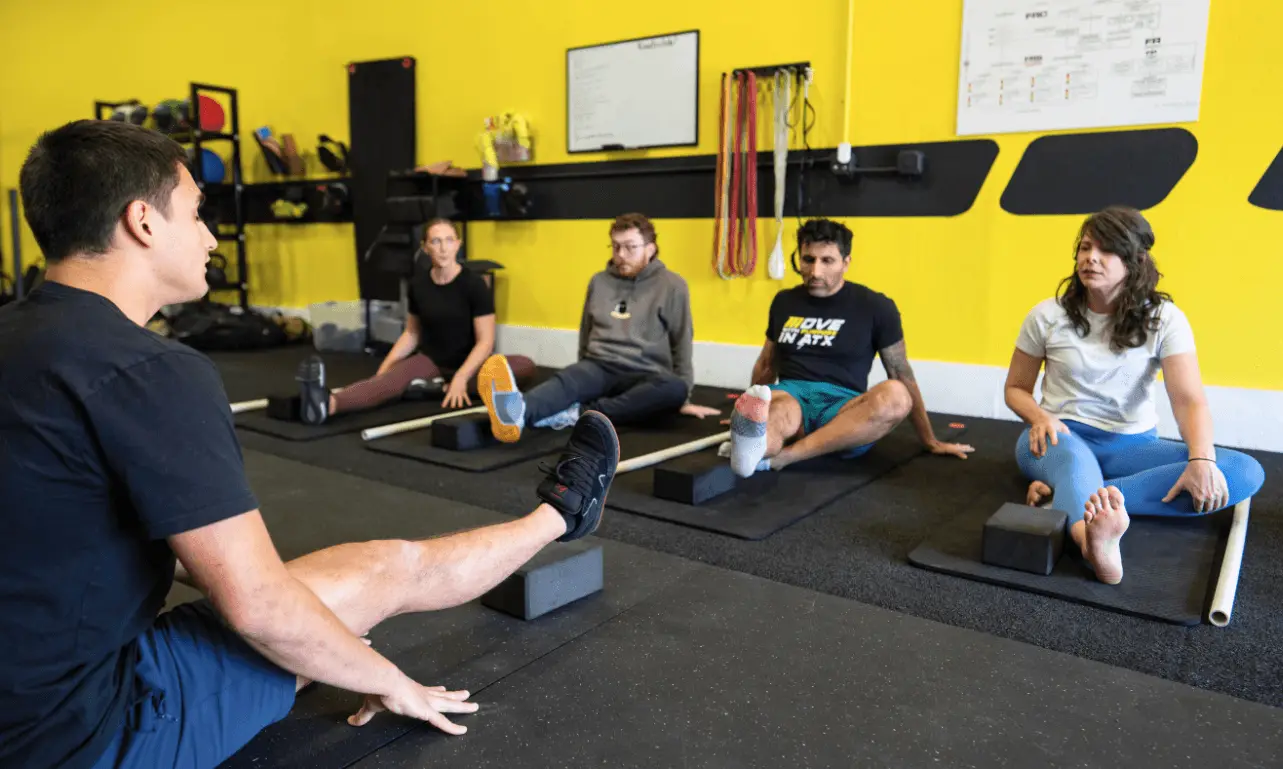
Some clients also use KINSTRETCH classes to reinforce their mobility work between training sessions.
KINSTRETCH is a joint-focused training system designed to improve control, strength, and movement capacity. The classes guide participants through controlled joint movements that progressively improve how the body moves.
For desk workers, this consistent exposure to joint movement is valuable. It helps counteract the effects of long hours spent sitting and keeps mobility improvements from fading between training sessions.
Group classes also make it easier to stay consistent with mobility work, which is one of the most important factors in maintaining joint health over time.
When Tech Workers Should Consider Mobility Coaching
Mobility coaching is often helpful for professionals who spend most of their day sitting and notice their body beginning to resist movement.
Common signs include stiffness after standing up from a desk, persistent tightness in the neck or shoulders, or discomfort during normal workouts. Some people notice that exercises which used to feel easy now aggravate their joints.
These patterns are extremely common among people working in technology and other desk-heavy professions.
Mobility coaching provides a structured way to restore movement capacity and gradually rebuild strength in the positions the body has lost.
Start With a Movement Assessment
The most effective place to begin is understanding how your body currently moves.
A detailed Functional Range Assessment identifies the joints that have lost movement capacity and reveals where training should begin.
For tech workers in Austin dealing with stiffness, recurring discomfort, or limited movement, mobility coaching provides a clear path forward. By restoring joint function first and strengthening those positions over time, training becomes more productive and everyday movement becomes easier.
Written by

Brian Murray, FRA, FRSC
Founder of Motive Training
We’ll teach you how to move with purpose so you can lead a healthy, strong, and pain-free life. Our headquarters are in Austin, TX, but you can work with us online by signing up for KINSTRETCH Online or digging deep into one of our Motive Mobility Blueprints.