There is a quietly common belief that has settled into the wellness conversation in the last decade, which is that walking is enough. Hit your ten thousand steps. Maybe seven thousand if you have read the more recent research. Get outside. Keep moving. The rest will sort itself out.
Walking is one of the best things you can do for general health. The research on it is enormous and durable. Cardiovascular benefit, blood sugar regulation, stress reduction, cognitive function, longevity, sleep quality, basic mood maintenance. Almost no one regrets walking more. The studies on step counts and all-cause mortality are not subtle.
It is also, on its own, not enough to maintain a body. That is the part the wellness conversation tends to gloss over. Walking is necessary for most adults. It is not sufficient. The two ideas can both be true at the same time, and treating “walking is great” as the whole answer leaves a lot of capacity on the table that gets quietly lost as people age.
This piece is about what walking actually does, what it does not do, and what to add if you want a body that still works in twenty or thirty years.
What walking does
Walking moves the cardiovascular system at a low, sustainable intensity. It drives the heart and lungs at a level that, accumulated across a day, produces real metabolic benefit. It uses the lower body in a coordinated, repetitive cycle that maintains a baseline of leg function. It puts the body outside, when you walk outside, which is its own form of input. It gives the nervous system rhythm, the kind of patterned movement that humans have done for the entire history of the species. It accumulates step volume that has been shown to correlate with longer, healthier lives.
For someone who is not currently active, starting to walk is the single highest-leverage move available. It costs nothing, it requires no skill, and the data on it is strong enough that you can recommend it without caveat. The first three thousand steps a day a sedentary person adds matters more than the last three thousand of an active person’s day.
What walking is, biomechanically, is locomotion at a low intensity through a narrow range of motion. Your hip flexes and extends inside a small arc. Your knee does the same. Your ankle does its small amount of dorsiflexion and plantar flexion. Your trunk rotates slightly. Your arms swing in counter-rotation. The whole cycle stays inside a window of maybe twenty to forty percent of the joint range available to a healthy adult.
That is the trade. Walking is sustainable because it is low intensity in a small range. That is also why it cannot do everything.
What walking does not do
Walking does not build or maintain strength. The load on each leg during a walk is roughly bodyweight, repeated many times. That is enough stimulus to keep the leg from atrophying in a sedentary person. It is not enough stimulus to maintain muscle mass past forty, when sarcopenia (age-related muscle loss) starts to outpace what walking alone can offset. The data on this is consistent. Adults who walk and do not strength train continue to lose muscle. Adults who walk and lift weights maintain or build it. Strength training is not optional past forty, and walking, on its own, does not cover the strength side.
Walking does not maintain joint range. The repeated motion of walking trains the joints to do exactly what walking asks of them, which is a narrow slice of what those joints are built to do. The hip in walking flexes maybe sixty degrees of the hundred-plus it should have. The hip in walking does almost no internal rotation, no external rotation, and very little abduction. The shoulder in walking barely moves. Over years and decades, joints that only get used in their walking range stop having the rest of the range available. This is one of the major drivers of the stiffness most adults blame on aging. It is not aging. It is a body that has been trained to do only what walking asks of it. Pickleball, hiking, getting off the floor, reaching overhead, all of those require ranges walking does not maintain.
Walking does not load the upper body in any meaningful way. Your arms swing. That is it. The shoulder girdle, the thoracic spine, the upper back, the chest, the neck, none of these get any real stimulus from a walk. Adults who walk consistently and do nothing else have lower bodies that work and upper bodies that quietly fall apart over decades.
Walking does not maintain power. Power is force over time, and walking is force over a lot of time, which is the opposite of power production. Power is what allows the body to react quickly, catch itself, jump, throw, sprint. It declines faster with age than strength does, and walking does not protect against the decline. The drop in power output is one of the strongest predictors of fall risk and loss of independence in older adults. Walking helps in other ways and does not address this directly.
Walking does not address the structural restrictions that build up over a life of sitting. The hip flexors get short. The thoracic spine loses extension. The shoulders round forward. Walking does not push back against any of those patterns, because walking happens inside the same patterns. To undo what sitting does, you have to do work that goes the other direction, and walking does not. Mobility work is a different category of input than walking is, and it does things walking cannot.
The aging research, more carefully read
The headlines on walking and longevity are real. Adults who walk more live longer. Adults who walk more retain cognitive function. Adults who hit their step counts have better cardiovascular outcomes.
What does not show up as cleanly in the headlines is what those longer-living adults are also doing. The strongest predictors of healthy aging in the research are walking plus resistance training, walking plus grip strength, walking plus muscle mass, walking plus the ability to get up off the floor without using your hands. Walking is one input in a stack of inputs. The studies that controlled for resistance training found that the walking signal weakens substantially when you account for strength.
This is the part the wellness conversation tends to leave out. Walk-only protocols do not show up in the literature on durable aging the same way walking-plus-strength-plus-mobility protocols do. The lifestyle that produces the eighty-year-old who can still ski, hike, garden, and pick up grandkids is not a walking lifestyle. It is a moving lifestyle, of which walking is one piece.
What to add
The honest answer is that walking should be the floor, not the ceiling. Below this, the body is not getting enough input. Above it, the marginal value of more walking declines, and the next inputs do more work than additional walking would.
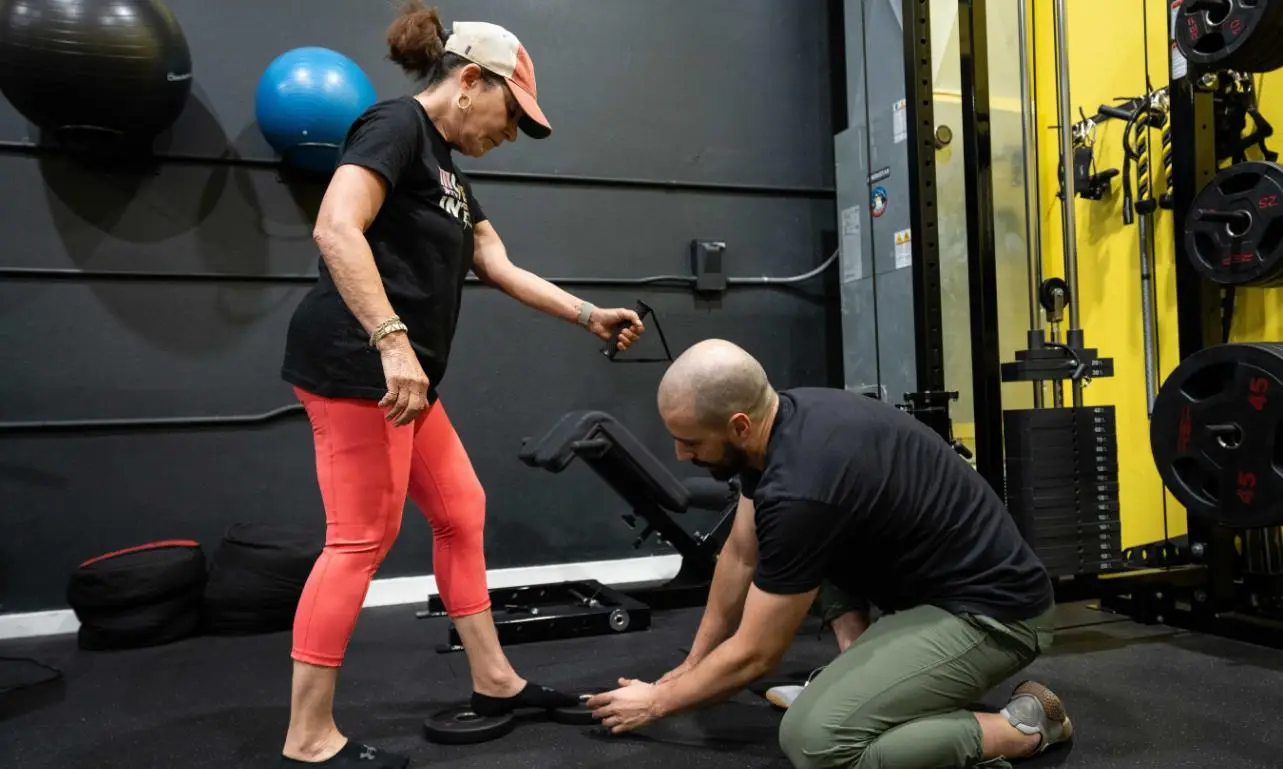
Resistance training is the next addition, and the one with the most leverage past forty. Two to three sessions a week of progressive resistance work, covering the major movement patterns, addresses everything walking does not. Strength, muscle mass, bone density, power, postural support, joint loading capacity. Adults who walk and lift age very differently from adults who walk and do not.
Active mobility training is the third piece. Stretching is not the same as training. Static stretches held for thirty seconds do not produce durable change. What does produce change is end-range work, controlled articular rotations, and isometric loading inside the ranges that get lost over time. PAILs and RAILs are the most direct version of this. The work is harder than people expect and the timeline is longer than people want, but the body responds. There is a meaningful difference between mobility and flexibility, and walking maintains neither one.
Some form of varied locomotion helps too. Running, hiking on uneven ground, biking, swimming, dancing, the racket sports, climbing. Anything that asks the body to move outside the narrow walking pattern. Even short doses of these per week add input that walking alone cannot.
The honest take
Walk. Walk a lot. Get the steps. Get outside. Hit the trail. Get up from your desk every hour. Do not skip the basic move that has been built into being human for a million years.
Then do the other work too. The body past forty needs strength, joint capacity, and varied movement on top of the walking. Without those pieces, the walking is keeping you alive without keeping you capable, and there is a difference. The body that is going to work at seventy is not the body that walked seven thousand steps a day for thirty years and did nothing else. It is the body that walked, lifted, moved through full ranges, and stayed athletic in small doses across decades.
Walking is the easiest input. It is also the most overrated when it stands alone. Both can be true. The lifestyle that holds up is the one that treats walking as a baseline and builds the rest on top of it.
Written by

Brian Murray, FRA, FRSC
Founder of Motive Training
Motive Training is a coaching studio in South Austin built around assessment, joint health, and strength you can use. Train with us in the studio, come to a KINSTRETCH class, or work through the progressions in KINSTRETCH Online.