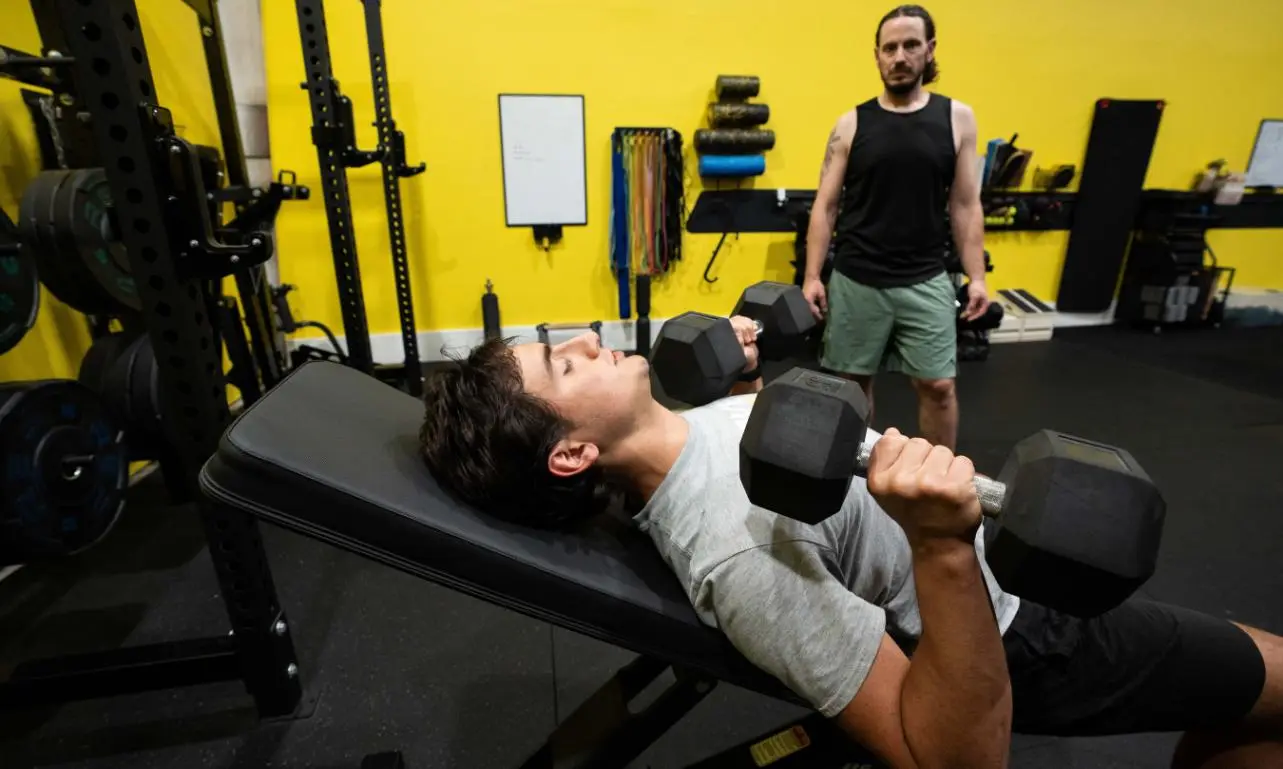
The most common version of the 40-something who walks into a training studio is someone trying to train the way they used to train. They were strong at thirty. They lifted hard at thirty-five. Now they are forty-two, they are still in decent shape, and they want a coach who will push them. So they go in expecting to be programmed like an athlete in their twenties with the weight scaled down a little for sense.
It does not work. Or it works for six weeks and then something flares up. Back, hip, shoulder, knee. The training stops, the comeback feels harder than the start, and they slowly conclude that this is just what aging is. They were not exactly wrong. The body changes. They were missing the part where the training has to change too.
Personal training after forty is not personal training with less weight. It is a different model. The pieces that should change are mechanical, physiological, and contextual. The pieces that should stay the same are the ones most people assume drop away. This piece walks through both sides.
What actually changes in the body
Tissue responds slower. Connective tissue takes longer to remodel under load past forty than it did at twenty-five. That does not mean it cannot remodel. It means that when you load a tendon, ligament, or joint capsule, the adaptation timeline stretches out. The training has to respect that timeline. You can still drive the adaptation. You cannot rush it.
Recovery takes longer. Sleep gets thinner, sometimes much thinner. Stress recovery slows down. Hormonal recovery slows down, particularly for men past forty-five and women through perimenopause and menopause. A heavy lifting session that took 48 hours to bounce back from at thirty might take 72 to 96 hours at forty-five. If the next session is loaded the same way and timed the same way, the body is being asked to perform inside a deficit. That deficit accumulates as fatigue, joint irritation, and eventually injury.
Joint capacity becomes the limiter. In your twenties, the limiter on most training is strength. Your joints have more range than your muscles can use, your tissues recover fast, and the bottleneck is how much your muscles can produce. After forty, the limiter shifts. Your strength capacity may still be there or even improving. Your usable joint range is what starts to shrink, and once it starts shrinking, the loads you put through the system start showing up at the wrong joints. The hip stops contributing, the lumbar spine picks up the slack, and the back goes. This is the most common injury pattern I see in the 40+ training population, and it is almost always upstream of strength.
Load tolerance changes by exercise, not by the person. A 45-year-old can often still squat heavy if the hip mechanics are intact. The same person might have to give up overhead pressing as a primary lift because the shoulder will not tolerate the volume anymore. Generic “lift heavy after 40” advice misses the point. Some lifts will tolerate load just fine for the next thirty years. Others will quietly become irritation engines if you treat them as forever exercises. Which ones depends on the body in front of you, not on a chart.
What stays the same
Strength training is still the right answer. The research on resistance training for adults past forty, past fifty, past seventy is unambiguous. Strength is downstream of survival, independence, bone density, cognitive function, and metabolic health. The 40+ adult who quits lifting because they assume it is dangerous is making a worse decision than the 40+ adult who keeps lifting and adjusts the protocol.
Intensity is still important. The mistake in a lot of “training for older adults” content is the assumption that intensity has to drop. It does not. The 40+ body still needs to be pushed. Without intensity, strength does not develop, tendons do not adapt, and the metabolic stimulus is too small to matter. The intensity has to be applied differently. The volume around it has to be calibrated. The frequency has to match what the body is recovering from. But the intensity itself stays.
The progression principle still holds. The body still adapts to what it is asked to do. Progressive overload still works. The timeline is longer and the variables that get progressed are sometimes different (range of motion, control, load, density), but the underlying logic of “give the body a stimulus that it has to adapt to, then give it the next one when it has” still drives every training program that actually changes a person.
The mental game stays the same too. The 40-year-old still has to do the work consistently. They still have to show up when they do not want to. They still have to be honest about what they are doing outside the gym. None of that gets easier with age, but none of it changes either.
What should actually shift in the program
A few specific places where good 40+ training looks different from generic gym programming:
Assessment matters more, not less. In your twenties, you can get away with a generic program because the system is forgiving. In your forties, the program has to fit the body, because the body is no longer covering for the program. This means knowing where the joints are, where the asymmetries are, what has been injured, what is currently irritated, and what the actual range of motion available for loading is. Without that, you are programming for a body you do not actually have.
Mobility work goes from optional to upstream. Through your twenties and into your thirties, mobility work is something you do if you have time. After forty, it goes ahead of the strength work because the strength work loads what the mobility work has prepared. Generic stretching is not enough. The work has to actually build active control in the ranges that matter, which is what end-range training is for. The honest expectation is that mobility changes take longer than most people want them to, measured in months of consistent work, not weeks.
Volume gets thoughtful. This is where most 40+ training fails. The person who used to do five working sets at thirty tries to do five working sets at forty-five and ends up with a problem. The 40+ body usually responds better to fewer working sets with more attention to each one, longer recovery between hard sessions, and more frequency at lower intensities. The trainer who programs the same volume the client did fifteen years ago is not coaching, they are guessing.
Recovery becomes part of the program. Sleep, stress, and nutrition matter at every age. After forty, they become limiters. The training program has to account for what is happening on the other side of the session. A coach who treats recovery as the client’s problem is not coaching the whole picture.
The lifts that show up most often need a hard look. Squats, deadlifts, pressing variations, pulling variations are not problems by default. The question is if the body in front of you, with the joint history and capacity it actually has, should be doing those lifts at that volume and that load. Sometimes yes, sometimes no, sometimes with significant modification. This is where competent assessment and individualized programming matter, and where templated “everyone deadlifts” programming starts to fail.
Heavy lifting is not the only stimulus. Throwing, jumping (carefully programmed), rotational power, locomotion under load, sprinting (again, carefully programmed) all keep more of the body’s adaptive systems alive than just strength work. The 40+ adult who only lifts often gets very strong and very stiff. The 40+ adult who lifts plus throws plus does some plyometric work plus moves stays athletic, which is a different outcome.
What about training after physical therapy
A real pattern in the 40+ population is the post-PT bridge. Something happened. Knee, shoulder, hip, back. They got through PT. They are cleared. Now they need to get back to training and there is a gap nobody is helping them cross.
This is one of the most underserved situations in the personal training industry, and it is one of the places where the assessment-first model genuinely matters. Training after physical therapy is not the same as starting fresh. The body has been through something. It has been protected for weeks or months. It has lost capacity in specific areas. A good coach has to know what the body is coming back from, what the current limits are, and how to progress without re-injuring the person.
The most common failure mode is jumping back into a pre-injury program because that is what feels familiar. The body is not the same body. The program should not be the same program, at least not at first.
What this looks like at Motive
The model at Motive starts with assessment for almost every 40+ client. That assessment names what each joint can do, what the patterns look like, and where the priorities should be for the first phase of training. From there, the programming is built around what the body in front of us can actually use, not what a template says someone of that age should be doing.
Personal training is one-on-one. The program updates as the body responds. Mobility work runs alongside strength work, not as a stretch tacked onto the end of a session, but as actual training that builds the ranges the strength work will eventually load.
Adults past forty who train consistently inside a model that matches the body they have do not look like adults aging out of fitness. They look like adults who got into better shape than they were in their thirties, with fewer injuries, more durable capacity, and a clearer sense of what their body is for. That outcome is available. It does not happen through training as if nothing has changed. It happens through training that respects what has changed and acts accordingly. Start with an assessment and we will tell you what your body actually needs.
Written by

Brian Murray, FRA, FRSC
Founder of Motive Training
Motive Training is a coaching studio in South Austin built around assessment, joint health, and strength you can use. Train with us in the studio, come to a KINSTRETCH class, or work through the progressions in KINSTRETCH Online.