Every personal training website in this city promises the same four things. Customized programs. Experienced coaches. Real results. A supportive environment. I have written versions of those lines myself, which is part of why I know how little they narrow the field for someone trying to spend money well. They describe an intention. They tell you nothing about what happens in the room.
The part you can evaluate is the process. Specifically, what a coach does in the first hour, before they have written a single set or rep for you, and how much of what they find in that hour shows up in the program they hand back.
The first hour decides the next six months
A trainer who starts you on day one with a warm-up and a workout has made a decision about your body without having any information about it. They are working from population averages and from what worked for the last person who walked in with a similar goal. Sometimes that lands. For a 27-year-old who has trained before and has no history of pain, it often lands fine.
For everyone else, the average is doing a lot of quiet work in the background. Adults in their thirties, forties, and fifties arrive carrying a decade of specific adaptations: an ankle that never got its range back after a sprain in college, a hip that rotates well in one direction and poorly in the other, a shoulder that finds its last twenty degrees of overhead reach by leaning into the low back. None of that is visible from a goal conversation. You have to test for it.
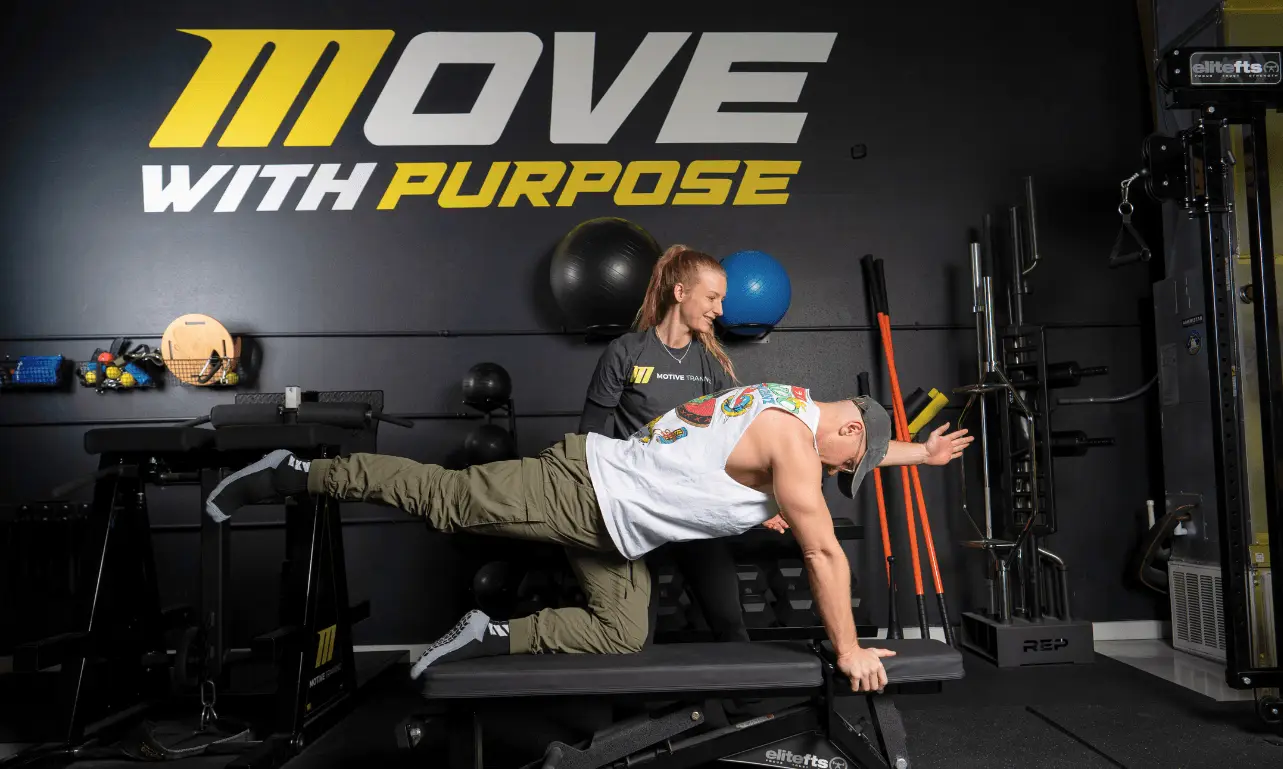
Our movement and mobility assessment is a joint-by-joint measurement of what you can do under your own control. We look at each articulation on its own, in isolation from the sling of muscle and momentum that usually covers for it, and we compare left to right and passive to active. That last comparison is the one most people have never had made for them.
Passive range and active range are two different numbers
If I move your hip into rotation while you relax, you have some amount of available range. That is your passive range. If you produce that same rotation yourself, without my hands and without a swing to help you, you have a smaller number. The distance between those two numbers is space your body can be put into but cannot control.
That gap is where a lot of unpleasant things happen. Speed, load, and fatigue will all push a joint toward the outer edge of its passive range, and when it arrives there without any capacity to produce or resist force, the tissue takes the hit. Stretching alone tends to widen the gap, since it raises the ceiling without building anything underneath it. The nervous system also has a say. It restricts what it will let you access actively when it has no evidence you can handle the position, so range you have never loaded stays locked whatever the tissue is capable of.
Closing that gap is most of what Functional Range Conditioning does. Controlled Articular Rotations map the outline of a joint and give you a daily read on what changed. PAILs and RAILs load the end of that range isometrically so the range becomes yours instead of something you visit. This is slow work. Progress shows up in a few degrees at a time, and a coach who tells you otherwise is selling something.
What the assessment cannot tell you
It does not tell you why your back hurts. Nobody can hand you that answer from a chart of joint measurements, and a trainer who says your back pain comes from your hips is guessing in a voice that sounds like knowledge. Pain has too many inputs. What an assessment gives us is a map of what your joints can and cannot do, along with the asymmetries and restrictions worth addressing, which is enough to build a plan without pretending we have diagnosed you.
There is also a scope line, and it is a real one. Some people need a physical therapist or a physician before they need me, and the ones who need both at the same time get better results when the two of us are talking. I have written more on where the trainer role ends and the clinical role starts, because the handoff between rehab and training is where a lot of people fall through. Coming out of eight weeks of PT cleared to lift, then walking into a program built for someone who never got hurt, is how the same injury comes back in six weeks.
What findings change in the program
Say the assessment shows limited hip internal rotation on the right, and a right ankle that gets about half the dorsiflexion of the left. Both are common. Neither is an emergency. Both change how a squat is going to be organized, since that missing range has to come from somewhere, and the somewhere is usually the low back or the arch of the foot.
The uninformed version of that program squats anyway, cues harder, and hopes the pattern cleans up on its own. The version I want has the squat in it, at a depth and a stance that matches the range currently under control, with dedicated rotational work for the hip and loaded end-range work for the ankle sitting alongside it. Six weeks later we re-measure. If the numbers moved, the squat changes with them. If they did not, the plan was wrong and we say so.
That loop is the actual product. Assessment, program, reassessment, revision. Everything else is logistics.
Rotation belongs in the plan
Squats, deadlifts, presses, and rows all earn their place. They load a lot of tissue at once, they are easy to measure, and they carry over. My argument is with treating them as the full description of what a body is for.
Look at how humans move outside a gym and rotation shows up everywhere. Walking is a rotational event before it is anything else; the pelvis and ribcage counter-rotate, the spine stores and returns energy, and the legs cycle through what that produces. Throwing, swinging a club, changing direction on a court, picking a kid up off the floor at an angle you did not plan for. Trunk stiffness has its uses and it is not the only skill the trunk needs. The lumbar spine offers only around thirteen degrees of rotation in total, which is why the thoracic spine and the hips have to supply the rest, and why they lose that job so quietly when nothing asks for it.
So we train rotation on purpose. Hips and thoracic spine get direct rotational work. Coiling and rope work show up for people who need the trunk and hips to talk to each other under speed. KINSTRETCH classes cover the joint-level side of the same problem in a group setting, which is a cheaper and more repeatable way to keep the maintenance work happening between sessions.
If your goal has nothing to do with pain
Plenty of people come in wanting to lose fat, get stronger, or look better with their shirt off, and none of what I have described competes with that. Progressive overload still runs the engine. You still have to lift heavier over time, eat in a way that supports the goal, and show up long enough for the adaptation to happen. Adherence beats sophistication every time, so a program you will do for two years outperforms a better one you quit in March.
Where the assessment earns its keep for those goals is in what it protects. A lifter with fifteen degrees of shoulder external rotation missing on one side can press overhead for a while. The compensation is small and the low back absorbs it, until the volume goes up or the bar gets heavy enough that the small thing stops being small. Then six weeks come off the calendar. Nothing kills a strength or body composition goal faster than repeated interruption, and most interruptions trace back to loading a position the joint could not hold.
So the mobility work is not a separate program running beside your training. It sits inside it, mostly in warm-ups and between sets, taking up ten or fifteen minutes of the hour, aimed at whatever the last assessment said was limiting. The rest of the session looks like training, because it is training.
Credentials, and what they are worth
Mine are FRCms, FRSC, FRA, and KINSTRETCH Level II, on top of seventeen years of coaching. I am also working toward Functional Release certification and Texas massage licensure, which will change what I am able to offer in a session down the line.
Here is the honest read on certifications. They tell you a coach has studied a system and passed its standard. They do not tell you the coach can apply it to the person in front of them, and the failure mode in this industry is a trainer who learned one system and now sees every client as a candidate for it. PRI as the answer. FRC as the answer. McGill as the answer. The methodology is rarely the problem. Treating it as the whole answer is.
What credentials should buy you is a reason for every choice in your program. If you ask why an exercise is in there and the answer is a shrug, the certification on the wall did not do its job.
What training here looks like
The studio is on Shelby Lane in St. Elmo, in South Austin. It is small on purpose. Sessions are one-on-one, and the coach running your session is the one who assessed you.
KINSTRETCH runs as a class, twenty-five dollars to drop in or a hundred twenty-nine a month unlimited, with the first class free for anyone new. A full hour sometimes goes to a single joint. People find that strange for about ten minutes and then stop finding it strange when they see how much control they do not have over a shoulder they have owned their entire life.
Sessions are also HSA and FSA eligible through Truemed, which for a lot of people changes the math on what training costs.
What clients have said
These are real reviews from people who train here.
“I recently signed up with Motive Training and started working with Brian Murray, and my experience has been outstanding. My initial goals ranged from reducing pain from training to supporting my calisthenic goals. Right off the bat, Brian worked with me to understand these goals and the limitations I had been experiencing so he could personalize my workout plan.”
Jeff T.
“I play soccer 3-5 times a week and was dealing with terrible pain in my ankle, knee, hips, and lower back. Needless to say, I was struggling in the mobility and flexibility department. I started working with Brian and the Motive Training team in March earlier this year. It is now June, and I have made significant progress not only with the pain but my performance has improved as well! Brian customizes my sessions and understands what my specific needs are.”
Fernando A.
“I have been training at Motive since September, and the experience has been phenomenal! I have neck, shoulder, back, and hip pain, so the ‘typical’ personal trainer wasn’t going to cut it. My brother, a chiropractor, recommended Motive based on their focus on movement, flexibility, and overall health, not just losing weight and gaining muscle. I have lost weight and gained muscle, BUT most importantly, my neck, shoulders, back, and hips are mostly pain-free. I can work, live, and keep up with my four-year-old daughter significantly better than before training.”
Thomas P.
Three people, three different reasons for walking in. What they have in common is that the plan came after the measuring.
How to shop for this
Ask any trainer you are considering, here or anywhere in town, what happens in the first session and what they will measure. Ask what they would do if the thing they measured did not improve. Ask when they refer out. The answers will sort the field faster than any list of qualities on a website, including this one.
If you want the measuring done first, that is what an assessment is for. Bring the results wherever you decide to train.
Written by

Brian Murray, FRA, FRSC
Founder of Motive Training
Motive Training is a coaching studio in South Austin built around assessment, joint health, and strength you can use. Train with us in the studio, come to a KINSTRETCH class, or work through the progressions in KINSTRETCH Online.