The question comes up in almost every first session. Someone rotates a shoulder slowly through its range, hears a grinding sound somewhere under the scapula, stops, and looks at me. They want to know if they just did something bad. Usually they have been avoiding that range for a while because of the noise, and by the time we talk about it the shoulder has started feeling stuck for reasons that have nothing to do with the sound.
So here is what is happening, and then here is the part that people skip.
The classic knuckle crack was explained for about sixty years as a gas bubble collapsing inside the joint. That turned out to be backwards. In 2015 a group at the University of Alberta put a finger in an MRI, applied traction with a cable, and filmed the joint at 3.2 frames per second until it popped (1). What the imaging showed was a cavity forming at the moment of the sound, not collapsing. The cavity then stayed visible afterward, which is why you cannot immediately re-crack the same joint; the gas has to redissolve first. The process has a name, tribonucleation, and it describes what happens when two surfaces resisting separation finally come apart fast inside a fluid holding dissolved gas.
That is one kind of joint noise. It is a pressure event in the synovial fluid, and it tells you almost nothing about the state of the tissue. The other kind is crepitus, the grinding or crunching that shows up through a range rather than as a single pop, and that one is where the interesting conversation lives.
What the crepitus research says, including the part nobody quotes
A 2025 systematic review in the British Journal of Sports Medicine pooled 103 studies covering roughly 42,800 knees (2). Crepitus was present in 41 percent of the general population and in 36 percent of people with no knee pain at all. So more than a third of pain-free people have noisy knees, which should lower the temperature on this considerably.
But the same review found something that gets left out of most reassurance content. Knee crepitus was associated with roughly 3.8 times the odds of a radiographic osteoarthritis diagnosis, along with associations to osteophytes and cartilage changes on MRI. That is a real statistical association and I am not going to pretend otherwise. The authors rated the certainty of that evidence as low to very low, and crepitus showed no association with muscle strength or with self-reported pain and function. So the sound is a weak statistical flag for structural findings and a poor predictor of how the knee will feel or perform.
Both things are true at once, and holding both is the whole point. The sound functions as a low-quality signal in either direction, which is exactly why it should not be the thing driving your training decisions.
Knuckle cracking specifically has been chased down harder than most people realize. A case-control study of 215 people aged 50 to 89 compared hand osteoarthritis rates against decades of self-reported cracking history, measured in what the authors called crack-years (3). No significant association at any joint. The mean exposure in the group was around 70 to 75 crack-years. If the habit caused arthritis, that sample should have found it.
The variable that matters more than the sound
What I pay attention to in a session is what the noise travels with.
A joint that grinds through a range and feels fine, produces normal force at end range, and does not swell or ache afterward is a joint making noise. A joint that grinds and also catches, or gives way, or hurts in a specific reproducible arc, or feels different the next morning, is telling you something separate from the sound. The sound is not the information. The symptom pattern next to it is.
This matters because of what people do with joint noise when nobody explains it. They stop using the range. A shoulder that clunks at 90 degrees of abduction becomes a shoulder that lives below 90 degrees, and six months later the restriction is real and the person is convinced it was the clicking all along. Avoidance is the risk here, and it compounds quietly.
What this changes about how you train
Not much, which is the useful part.
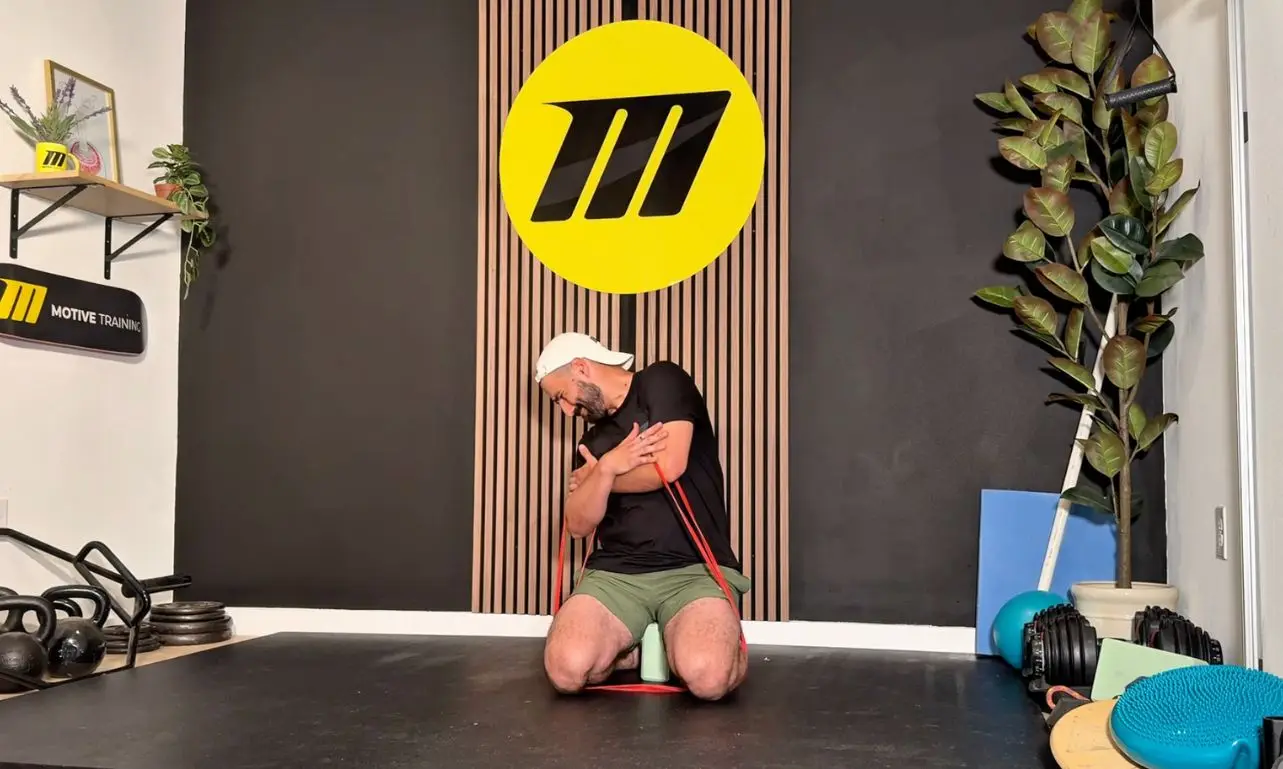
If a joint makes noise and nothing else is going on, train the range. Controlled Articular Rotations done slowly are a good tool here specifically because they are slow; moving deliberately through a full circumference gives you information about where in the arc the sound occurs and mechanical feedback about what the joint is doing there. Rotational work at the joint is worth doing on its own terms regardless of what it sounds like, which is the argument in the piece on joint rotation and joint health. Over a few weeks, a lot of noise quiets down on its own as tissue tolerance improves, though I would not promise that to anyone as a guarantee because I have also seen it stay exactly the same while everything else improves.
If the noise comes with pain, swelling, catching, or a sense of the joint slipping, that is a different conversation and it belongs in an assessment rather than in a blog post. Joint irritability is a real and trainable variable, and it is worth understanding on its own terms before deciding what a given joint can handle. Certain noises during CARs also have identifiable causes worth working through systematically, which we get into in the troubleshooting piece.
The thing I would want someone to take from all this is that a joint is a living structure that responds to what you ask of it, not a machine wearing down toward failure. Understanding what training does inside the joint reframes the noise question entirely. A quiet joint you never use is in worse shape than a noisy one you train well.
References
- Kawchuk GN, Fryer J, Jaremko JL, Zeng H, Rowe L, Thompson R. Real-Time Visualization of Joint Cavitation. PLoS One. 2015
- Couch JL, King MG, De Oliveira Silva D, et al. Noisy knees: knee crepitus prevalence and association with structural pathology: a systematic review and meta-analysis. Br J Sports Med. 2025
- deWeber K, Olszewski M, Ortolano R. Knuckle Cracking and Hand Osteoarthritis. J Am Board Fam Med. 2011
Written by

Brian Murray, FRA, FRSC
Founder of Motive Training
Motive Training is a coaching studio in South Austin built around assessment, joint health, and strength you can use. Train with us in the studio, come to a KINSTRETCH class, or work through the progressions in KINSTRETCH Online.