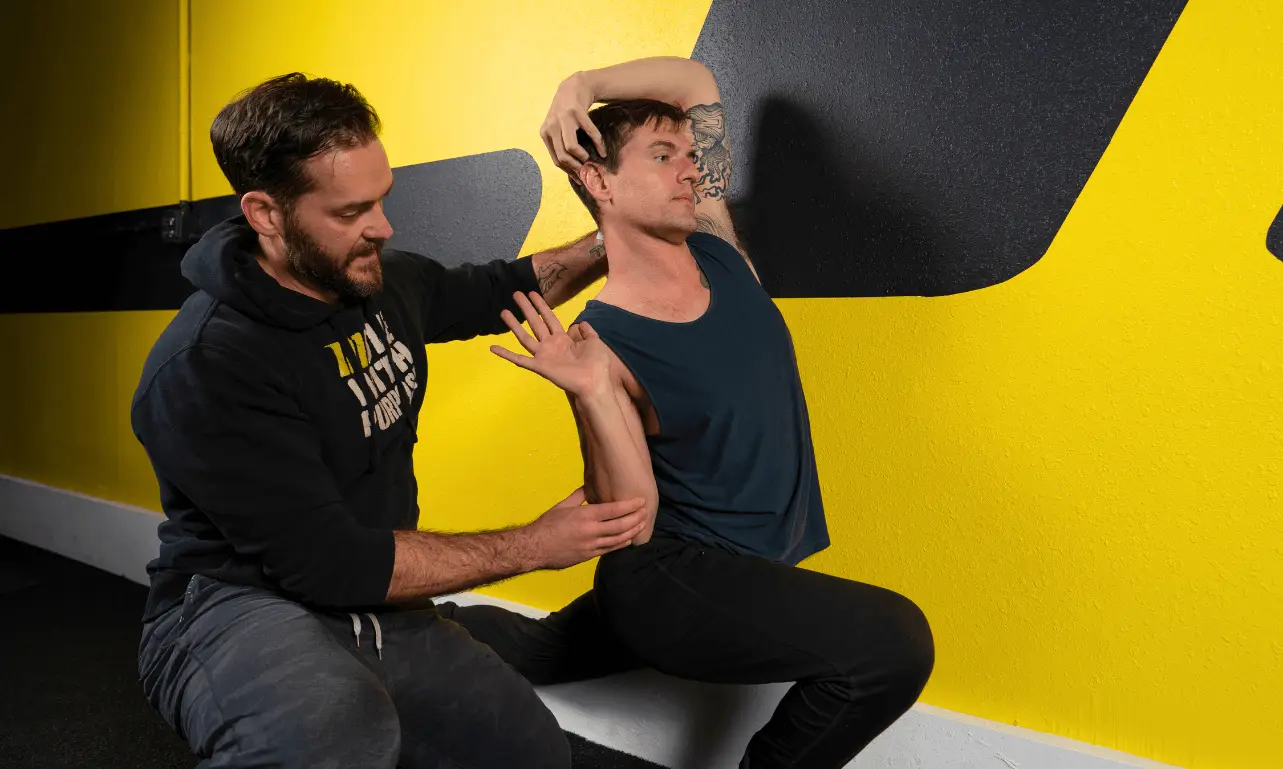
I get asked about Functional Patterns maybe twice a month, almost always by someone who found it on Instagram and cannot tell if they are looking at something real or a very good edit.
The honest answer is that it is both, and separating the two takes longer than a comment reply. So here is the long version.
We do not practice Functional Patterns at Motive. I have no financial reason to promote it and no professional reason to bury it. What I do have is a stake in the same argument it is making, which is why I find it worth taking seriously instead of dismissing.
What Functional Patterns is
Naudi Aguilar founded the system in 2006. Its organizing claim is that the movements worth training are the ones humans evolved to do: standing, walking, running, and throwing. Everything else in a program is judged by how it serves those.
The training itself leans on gait mechanics, standing and rotational work, cable and band exercises loaded through the trunk, and soft tissue work aimed at the connective tissue between muscles rather than at individual muscles. Sessions look nothing like a conventional gym floor, which is a large part of the appeal and a large part of the skepticism.
The system also takes a hard position on conventional training. Squats, deadlifts, bench pressing, and bodybuilding-style isolation are framed as building patterns that work against human structure. That position is the reason Functional Patterns generates the reaction it does, in both directions.
The part I agree with
The premise is closer to right than what most of the fitness industry operates on, and I do not say that as a courtesy.
The standard model treats function as a list of gym movements. Squat, hinge, push, pull, carry. That list is useful and I use it, but calling it functional is a category error that has been repeated so many times it stopped sounding like a claim. Being able to pick something up off the ground is different from a barbell deadlift. The body was built to throw. It was built to walk and run and jump. We took the movements that are easy to load and measure and quietly redefined function to mean those.
Functional Patterns noticed that, and it noticed loudly enough that a lot of people heard it. Naming gait as the organizing movement of a human being is a defensible position, and it is one we take from a different direction through spinal engine theory and rotational work. The trunk and the hips organizing against each other to produce locomotion is the closest thing to a fundamental human pattern that exists.
So the question Functional Patterns is asking is a better question than the one most gyms are asking.
Where it overreaches
The trouble is not the methodology. It is how completely the methodology gets sold.
Functional Patterns positions itself as the correction to everything else, which means it inherits the burden of being right about everything else. That is a very large burden and the evidence underneath parts of it is thinner than the confidence attached to them.
Take myofascial force transmission, which is load traveling between muscles through the connective tissue that links them rather than only through the tendon of the working muscle. It is real, and it is interesting. A systematic scoping review of in-vivo human studies concluded that the evidence supports its existence, and did so cautiously, noting that the trials were heterogeneous and generally of lower methodological quality (1). That is where the science sits. Force transmission through fascia happens. Being able to selectively train it, isolate it, or reorganize it through a particular exercise sequence is a much bigger claim, and the honest position is that we do not have the evidence to make it. I have not dug deeply enough into the newer work to say nobody ever will. I can say the certainty is running ahead of the data.
Same with posture. Correcting standing alignment as a route out of chronic pain assumes a relationship between posture and pain that is a lot messier in the literature than it is on social media. People with textbook alignment have pain. People whose posture looks alarming do not. That does not mean position never matters; it means position alone is a weak explanation for a specific person’s symptoms.
And the framing that conventional lifting damages you is where I get off entirely. Squatting and deadlifting are not the pinnacle of human function, and they are also not a disease. They are one expression of movement, useful for what they are useful for, limited in the ways all specific things are limited.
The error is not any particular exercise Functional Patterns prescribes. It is the exclusivity. This is the same thing I would say about PRI as the answer, or McGill as the answer, or 90/90 as the answer, and it is the thing I have to keep checking in my own work with FRC. A method that explains everything has stopped being a method and started being a belief.
What we do instead, and why
At Motive we start from the same place: the movements that matter are the ones that keep a person doing what they want to keep doing. Where we diverge is what we do before prescribing anything.
We measure. The Functional Range Assessment goes joint by joint and compares what each one can be moved through passively against what the person can produce actively. That gap is specific to the individual, it is a number rather than a visual impression, and it is the thing we work on.
That distinction matters more than it sounds. A gait analysis or a postural read tells you what a person looks like while moving. It does not tell you which joint lacks the range to do otherwise, and which one has the range but cannot produce it under load. Those two problems look identical from the outside and need opposite interventions. One needs range acquired. The other needs control built in range that already exists.
From there the work is joint-specific and progressive. CARs to maintain and map what each joint can do. PAILs and RAILs to build strength at the end of a range so it becomes range the person owns rather than range a coach can put them in. Then rotational and locomotor work, the WeckMethod side of what we do, where trunk and hips organize against each other and gait gets trained rather than analyzed.
The coiling core work sits in that last category, and it is worth naming because it overlaps with what Functional Patterns is after. Rotation through the spine and hips as the engine of locomotion. Same target, different route in, and a route that started from measurement rather than from a model of what a human should look like.
If you are trying to decide
Functional Patterns will help some people, and the people it helps are usually people who were doing nothing resembling coordinated whole-body movement before. That is a real improvement and it should be counted.
What I would want you to keep is the question it asks. Function is not a list of lifts. It is rotation, trunk and hip organization, locomotion, and the capacity to keep producing those for another few decades.
What I would want you to hold loosely is any answer, including mine, that arrives already certain about your specific body. Nobody knows what your hip can do until somebody measures it. That is the entire reason an assessment exists, and it is why I am suspicious of any system, mine included, that can tell you what is wrong with you from across a room.
References
- Ajimsha MS, Shenoy PD, Surendran PJ, et al. Evidence of in-vivo myofascial force transfer in humans: a systematic scoping review. Journal of Bodywork and Movement Therapies. 2022.
Written by

Brian Murray, FRA, FRSC
Founder of Motive Training
Motive Training is a coaching studio in South Austin built around assessment, joint health, and strength you can use. Train with us in the studio, come to a KINSTRETCH class, or work through the progressions in KINSTRETCH Online.