People usually arrive at mobility training sideways. A hip feels stuck at the bottom of a squat, a shoulder grumbles every time they reach for the top shelf, or the low back stiffens after an afternoon of meetings, and somebody (a friend, a physical therapist, an account they follow) tells them they need to work on their mobility. Fair enough. The trouble is that the word has been stretched to cover almost anything, from a hamstring stretch before a run to ten minutes on a foam roller in front of the TV, so figuring out if you need it starts with knowing what it is.
What mobility training is built to do
Mobility is the range of motion you can produce and control with your own muscles. Flexibility is the range a joint can be moved into by something else: gravity, a strap, a partner, your own hand pulling on your shin. Those two numbers are almost never the same, and the space between them is where mobility training does its work (there’s a longer breakdown of the difference between mobility and flexibility if you want the full picture).
Your nervous system keeps a close eye on that space. Range you can get into but can’t control under your own effort is range the body treats as a liability, so it guards it. Muscle tone climbs near the end of the motion, the movement gets cut short, and a neighboring joint quietly picks up whatever the stuck one won’t give. Static stretching mostly raises your tolerance for the sensation at the end of a stretch, which is part of why the looseness tends to be gone by the next morning. Mobility training goes after the control itself, with hard contractions at the edge of the range and slow rotations through all of it, so the nervous system has a reason to let you keep what you find.
That’s the lens for everything below. Each of these signs is some version of the same problem: range that exists on paper and goes missing when you need it.
Six signs mobility training is the missing piece
These are patterns that show up over and over in the gym, and you can check several of them on your own in a couple of minutes.
Stretching feels good and changes nothing
If you’ve stretched the same hip flexor or hamstring most days for a year and it feels exactly as tight as it did last spring, the stretching is doing what stretching does. It buys a temporary window of comfort. What it can’t do on its own is teach the joint to work in the range it opens up, so the nervous system closes the window again. What’s missing is load at the end of the range.
You can get into a position with help and lose it the moment you let go
Here’s a quick check. Stand next to a wall for balance, grab one knee with both hands, and pull it as high toward your chest as it will go. Note the height. Now let go of the knee and try to hold it there with your hip alone. Most people watch it drop several inches before it settles. That drop is your passive-active gap, made visible. Then try lifting the knee as high as you can from the floor without hands and compare it to where your hands could take it. The bigger the difference, the more range you own on paper and can’t use.
Your lifts stall or pinch at the same spot every time
A squat that feels fine until a certain depth and then pinches at the front of the hip. An overhead press that’s smooth until the last few inches, where the ribs flare and the low back takes over. When the same position gives out the same way week after week, and adding weight or reps hasn’t moved it, a joint is usually running out of controllable range right there. Strength work tends to build around a limit like that, so the limit itself needs its own attention.
One side moves differently than the other
Some asymmetry is normal; nobody is built like a mirror. What’s worth noticing is a difference you can feel without trying. One hip rotates easily and the other feels blocked, or one shoulder clears your ear and the other stops at your cheek. Side-to-side differences in control show up clearly in rotational sports like golf and pickleball, where one side of the body gets asked to do far more than the other for years at a time.
Stiffness comes back on a schedule
If the stiffness shows up every morning, or every time you stand up after a few hours at a desk, and fades once you’ve been moving for a while, your joints are doing a good job of adapting to the positions you spend the most time in. Eight hours in a chair asks very little from the hips in extension or the upper back in rotation, and the body stops maintaining range it doesn’t get asked for. Moving through those ranges deliberately every day is how you keep them in the rotation.
Your joint rotations don’t look much like circles
Stand tall, brace your trunk lightly, and slowly take one arm through the biggest circle it can make, forward, up, back, and around. Go slow enough that it takes ten or fifteen seconds. Watch for the moments where the ribs flare, the torso twists, or the path suddenly speeds up or cuts a corner. Those are the spots where the shoulder ran out of control and borrowed motion from somewhere else. This drill is a controlled articular rotation (CAR), and our complete guide to CARs walks through how to run them for every major joint.
When something else comes first
Mobility training sits inside a bigger picture, and a few situations call for a different starting point.
Sharp pain, numbness or tingling, pain that wakes you up at night, or swelling after a specific injury all belong in front of a clinician first. Someone needs to rule things out before anyone starts loading the area.
If you’ve recently been discharged from physical therapy or cleared after surgery, mobility work belongs in the plan, and it works best as one part of a progression that rebuilds load tolerance. We wrote about that stretch of time specifically in training after physical therapy.
And sometimes the range checks out fine. If your joints pass every self-check above but you get winded on a flight of stairs or can’t carry groceries without your grip giving out, strength and conditioning are where the needle moves. Mobility can ride along in the warm-up while you go after the bigger gap.
What good mobility training looks like
The tools are well known. CARs every day to map and maintain each joint. PAILs and RAILs, which are progressive isometric contractions at the end of a stretch followed by actively pulling yourself deeper into the new range. Loaded end-range work that teaches the joint to produce force in positions it used to avoid.
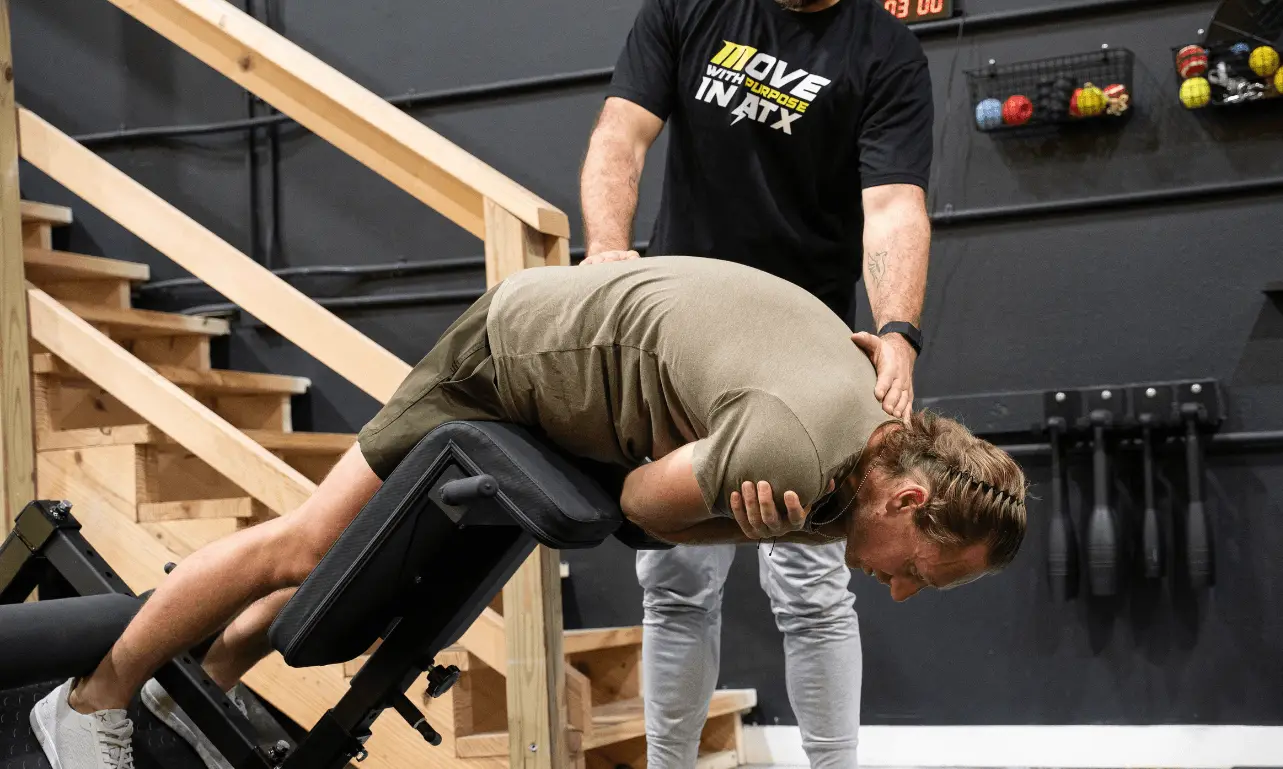
What separates the version that changes things from the version that doesn’t is mostly dose and follow-through. Functional Range Conditioning programming calls for holding a position anywhere from two to fifteen minutes before the contractions start, and almost nobody stays that long. Fewer still load the range afterward. From what I’ve seen, the people who get lasting change are the ones willing to sit in an uncomfortable position longer than feels reasonable and then go to work in it, a few times a week, for months. A KINSTRETCH class is built around exactly that sequence, with someone watching for the compensations you can’t see on yourself.
Measuring instead of guessing
The self-checks above give you a rough read, and a rough read is useful. If your knee dropped when you let go of it, or your arm circle turned into a full-body wobble somewhere behind your head, you now know where to start paying attention. What they won’t tell you is how much range each joint has compared to what it should have, which side is the real limiter, or why a restriction in one place keeps showing up as a complaint somewhere else. That takes measurement, joint by joint, active and passive, which is what an assessment at Motive is for. Once you have those numbers, the training stops being a list of stretches you hope are working and turns into a plan you can retest every few months to see if they moved.
Written by

Brian Murray, FRA, FRSC
Founder of Motive Training
Motive Training is a coaching studio in South Austin built around assessment, joint health, and strength you can use. Train with us in the studio, come to a KINSTRETCH class, or work through the progressions in KINSTRETCH Online.