Most of the people who walk into the studio with chronic neck pain have already tried the obvious things. Chair stretches off YouTube. A foam roller from Amazon. A massage when the stiffness gets bad enough to make turning the head to check a blind spot uncomfortable. Sometimes a chiropractor or a few rounds of PT. The relief is real for a day or two, and then the neck tightens back up.
The reason that loop keeps repeating is that the neck is usually not the problem. It is the place where the problem shows up.
Cervical pain in adults who spend most of their day at a desk is almost always the downstream effect of a few joints further south refusing to do their job. The thoracic spine stops rotating and extending. The scapula gets glued to the rib cage. The deep neck flexors check out. The neck then has to make up for all of it, and after enough hours of compensation, the tissue is irritated, the joint feels restricted, and the nervous system starts protecting the area by making it stiffer. Stretching the neck at that point feels good for ninety seconds and then changes nothing, because the load that created the problem is still loading the joint every time the person sits down.
This is the gap KINSTRETCH was built for.
Where neck pain actually comes from
Neck pain is the fourth leading cause of disability globally, and roughly one in three adults experiences it in any given year. For people in sedentary jobs the numbers are worse. The basic mechanism is well understood at this point. The average human head weighs ten to twelve pounds when it sits over the shoulders. At a forty-five degree forward tilt, the kind of posture most of us drift into when we are reading a phone or leaning toward a monitor, the cervical spine has to manage an effective load closer to sixty pounds. Hours per day, weeks per year.
The body adapts to that load the way it adapts to any repeated demand. The tissues on the front of the neck and chest shorten. The tissues across the upper back lengthen and lose tone. The first ribs ride high. The shoulder blades anchor themselves forward. The older clinical literature gives this pattern a name; what matters is the picture. A neck that should be carrying its load over a stable thoracic base is now carrying that load over a thoracic spine that has lost its capacity to extend and rotate. Even people who exercise regularly tend to end up here, because most strength training does not put meaningful demand on thoracic rotation or extension.
The research keeps pointing in the same direction. A 2024 cross-sectional study of 179 white-collar workers with neck pain found that thoracic range of motion mediated the effect of cervical range of motion on disability scores. Reduced thoracic mobility predicted higher pain severity. A 2022 randomized controlled trial in office workers with chronic neck pain compared thoracic spine mobility exercise against thoracic spine manipulation, and both groups improved cervical range of motion and pain measures, with the exercise group matching the hands-on group for outcomes. The signal across this literature is consistent. If you want the neck to feel better, the thoracic spine has to participate.
Why stretching the neck does not fix the neck
Neck stretches are not the villain. They are not dangerous, they sometimes feel pleasant, and they offer brief relief. The reason they fail to produce lasting change is that they do not address the layered nature of the problem. The general factors that make modern necks unhappy, including posture, screen time, stress, and sleep position, are covered elsewhere on the blog. The question here is different. Why does the stretching itself not stick?
A passive stretch increases tolerance to a sensation. The tissue is not really lengthening in any meaningful structural way over a ninety-second hold; the nervous system is just deciding that the position is acceptable for the moment. That is fine when the goal is short-term comfort. It is not fine when the goal is to keep the neck from going back into the same compensation pattern an hour later.
There are three issues a single neck stretch cannot solve.
The first is that the thoracic spine, not the neck, is the segment that has lost the most usable range. The cervical spine is often hypermobile by the time someone shows up in pain, moving more than it should because the segments below it have stopped moving at all. Stretching a joint that is already moving too much is not the answer.
The second is that the deep neck flexors, the small muscles along the front of the cervical spine that are supposed to stabilize the head, have usually disengaged. These muscles do not respond to stretching. They respond to specific, low-load training that asks them to hold positions the body has forgotten how to organize.
The third is that the scapula is part of the system. The shoulder blade rides on the thoracic cage, and the upper trapezius, levator scapulae, and rhomboids all share neural and mechanical territory with the cervical region. If the scapula is locked in a forward, protracted position, it will keep pulling on the same set of tissues no matter how much you stretch the neck itself.
So the neck does not just need to be stretched. The system around the neck needs to be reorganized.
What KINSTRETCH does that other approaches do not
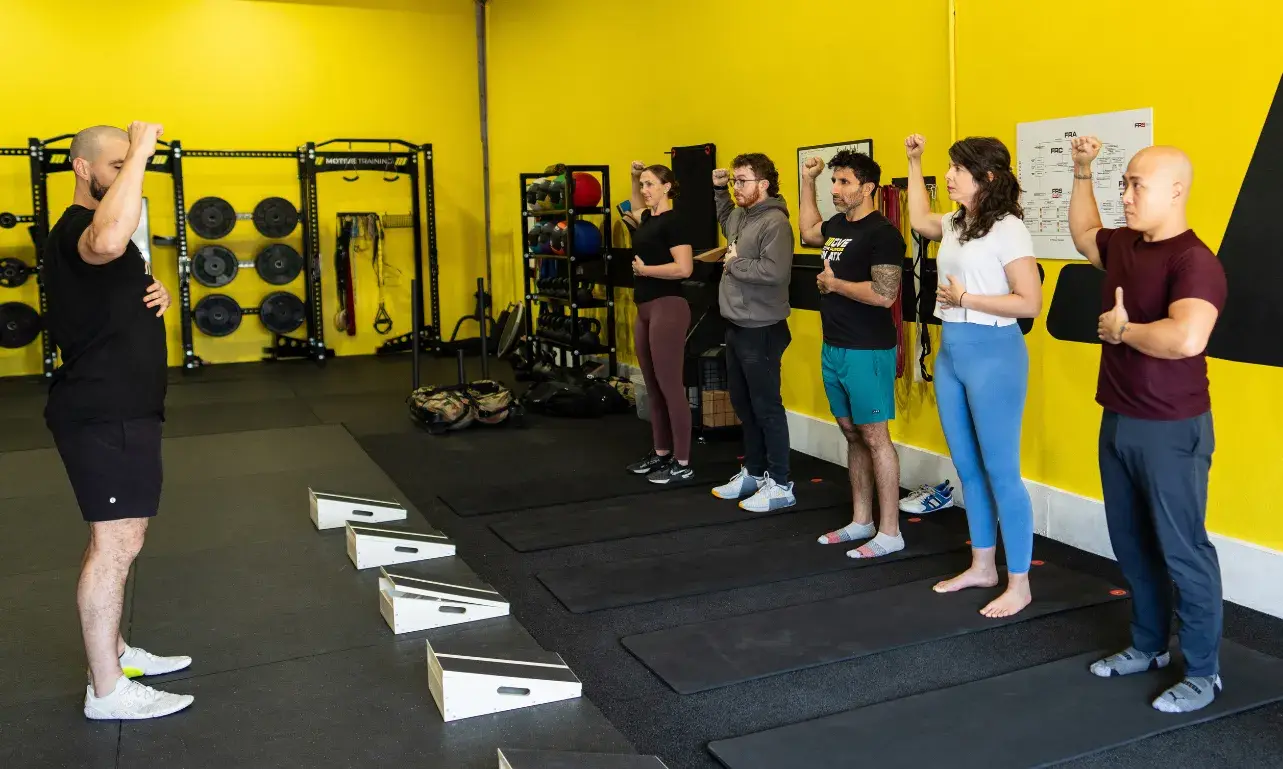
KINSTRETCH is a structured group class built on the principles of Functional Range Conditioning. The work is repeatable. You can train it consistently in a class, on your own, or through online classes, and the joints respond the way joints respond to any well-applied stimulus: with adaptation.
For someone dealing with desk-driven neck pain, three things matter about how a KINSTRETCH class is built.
It trains the thoracic spine and the cervical spine in the same session. Thoracic CARs and segmental rotation work directly improve the ability of the upper back to extend, rotate, and side-bend. When that capacity returns, the neck is no longer the only segment available to produce motion. This is the mechanism that the 2022 RCT was essentially demonstrating in a clinical setting.
It includes controlled articular rotations for the cervical spine itself. Not stretches. Active, controlled motion through the available range, with intent, against a small amount of internal tension. The goal is to keep the joint moving through its full workspace and to give the nervous system regular evidence that the area is safe to use. Joints that lose access to their full range without pain tend to lose that range permanently. CARs keep the door open.
It trains end-range strength through PAILs and RAILs at the cervical and scapular joints. This is the part most general stretching content skips entirely. After expanding a passive range, the body needs to learn to produce force inside that new range. A neck that can rotate further but cannot produce torque at the new end position is a neck that the nervous system will still defend by stiffening up. Isometric loading at end range tells the brain that this position is owned, not borrowed.
It treats the scapula as part of the neck. Scapular CARs, isometric scapular work, and direct training of the muscles that should be anchoring the shoulder blade to the rib cage all show up in the spine-focused classes. The scapula is not an optional consideration for someone with desk-induced neck pain. It is half the problem.
The cumulative effect is that the person leaves a session with a neck that has more range, more strength inside that range, and a thoracic spine that is finally doing its share of the work. Repeat that two or three times a week for a few months and the compensation pattern starts to dissolve.
What a session looks like in practice
People considering their first KINSTRETCH class tend to want to know what actually happens in the room. The structure is consistent across classes and is built to take the body through a full sequence rather than a collection of isolated stretches.
We open with CARs, usually starting at the spine and working out to the limbs, sometimes the reverse depending on the focus of the day. For a spine-focused class, this means cervical CARs in multiple positions, thoracic segmental work, and scapular CARs. The goal at this stage is assessment as much as training; you find out what is moving and what is not.
The middle of the class is where the real strength work happens. Long stretch holds, PAILs and RAILs at chosen joint positions, and isometric work at positions the body would otherwise avoid. For someone with neck involvement, this often includes loaded cervical positions and a significant amount of thoracic extension and rotation under tension.
The end of the class is integration. Closed-chain shapes that ask the body to organize the gains it just made into something usable. This is the part most home stretching programs leave out, and it is the part that makes the change carry over into how someone sits, stands, and trains the rest of the week.
Where this fits with the rest of training
KINSTRETCH is not a replacement for strength training, and it is not a substitute for medical care if the pain is severe, sharp, or radiating into the arm. Anyone with neurological symptoms or a recent injury should see a clinician first. For the much more common situation, the adult who sits at a desk and whose neck has gotten progressively stiffer over years, KINSTRETCH is the structured solution that addresses the actual problem instead of repeatedly chasing the symptom.
Many of our clients in Austin pair the classes with regular personal training, which lets us address the postural and strength issues that show up specifically at their job and in their other training. For people outside Austin, or for people who cannot make the in-person classes work with their schedule, KINSTRETCH Online covers the same material in a format you can train from your living room or hotel room.
The pattern we see most often is this: clients come in expecting a more thorough version of stretching. They leave understanding that mobility is something they own, not something they borrow for ninety seconds and lose by lunch. The neck improves not because they stretched it harder, but because the structures around it finally started doing their job.
That is the difference between content marketing about neck pain and actual coaching for it. The neck is the symptom. The thoracic spine, the scapula, and the nervous system are where the work happens.
Frequently asked questions
How fast can I expect my neck to feel better
Most people notice some change after a few sessions, particularly in the morning stiffness and the depth of rotation. Real structural change in the thoracic spine and lasting reduction in neck symptoms typically take eight to twelve weeks of consistent work. Joints adapt on the same timeline as muscles do. Three weeks is rarely enough; three months almost always is.
Do I need to be flexible to start
No. KINSTRETCH is built around training your current range and slowly expanding it. People who arrive with severe restriction often see the most dramatic early gains, because the gap between what they can do passively and what they can do actively is wide. There is a lot of room to recover.
Will this fix tech neck if I keep working at a desk all day
It addresses the parts of the problem your body can adapt. You will still have to manage your workstation, take breaks, and not look at your phone for nine hours an evening. But the structural foundation underneath all of that, the thoracic mobility and the cervical strength, can be trained well enough that the desk is no longer accumulating damage at the same rate.
Is this the same as physical therapy
No. KINSTRETCH is a training class taught by certified instructors, not a medical treatment. If you have a diagnosis or you are working through a specific injury, your physical therapist should be your first stop. KINSTRETCH is often what comes after PT, or what runs alongside it, to maintain and progress the gains.
Written by

Brian Murray, FRA, FRSC
Founder of Motive Training
Motive Training is a coaching studio in South Austin built around assessment, joint health, and strength you can use. Train with us in the studio, come to a KINSTRETCH class, or work through the progressions in KINSTRETCH Online.