The x-ray language does most of the damage. Bone on bone. Degenerative changes. Wear and tear. Someone in their fifties hears those phrases in a seven-minute appointment, and what they take home is that their knee has a finite number of steps left in it and they should spend them carefully.
Then they stop squatting, stop hiking, take the elevator, and eighteen months later the knee is worse. What gets lost in that stretch is movement options, which is a harder loss to notice than the arrival of pain. The interpretation is that the arthritis progressed. Some of it did. A meaningful portion of what changed was that a joint got asked to do less and adapted downward, which is what tissue does.
Why the car tire model is wrong
The wear and tear framing treats cartilage as a passive material with a fixed service life, like a brake pad. That model has been retired in the research literature for a while now, and the replacement is that osteoarthritis is a whole-joint condition involving synovial fluid, subchondral bone, ligaments, surrounding musculature, and the nervous system supplying all of it, driven by a dynamic imbalance between tissue breakdown and tissue repair rather than by accumulated mileage (1).
That distinction changes the prescription entirely. If the joint is a wearing part, every step spends a little more of it, and rest is protective. If the joint is a living system in a breakdown-and-repair balance, load is one of the primary inputs regulating repair, and removing it tips the balance the wrong way.
People ask directly if exercise wears the cartilage down faster. That has been examined specifically. A 2025 clinical commentary in JOSPT reviewed the systematic review evidence on exactly this and concluded that exercise therapy does not appear to harm cartilage structure or quality in people at risk of, or living with, knee osteoarthritis (2). The authors framed the belief itself as a clinical problem worth addressing directly with patients, since the fear does more to limit people than the pathology does.
Muscle weakness is also one of the earliest findings in knee osteoarthritis and predicts both onset and progression, which puts resistance training in the strange position of addressing something upstream of the joint surface rather than merely coping with it.
What this looks like in practice
The reframe I use is that an arthritic joint has a working envelope, and the envelope is trainable. It is smaller than it used to be, sometimes considerably. It is also not fixed, and the way it grows is by working near its edges consistently without repeatedly blowing past them.
Finding those edges takes measurement rather than guessing, which is the same reason assessment comes before programming with anyone else. What can this hip flex to today. Where does rotation stop. What load does the knee tolerate at 60 degrees versus 90. Those are answerable questions, and answering them turns a scary diagnosis into a set of numbers that move.
Daily walking gets prescribed as the answer here and it is a floor rather than a ceiling, for reasons worth understanding. Frequency matters more than intensity here. A joint with reduced tolerance does better with smaller doses applied more often than with two heroic sessions a week, and the general logic of how often to train mobility applies with extra force in this population. Controlled rotational work is worth doing daily and costs almost nothing in recovery.
Some soreness during and after is expected and is not evidence of harm. The variable to watch is the same one used across tendon and joint rehab: is it settled within 24 hours, and is the joint the same or better the next morning. A flare that lasts three days means the dose was wrong, and the correct response is a smaller dose rather than no dose.
Symptoms come and go somewhat independently of what is happening structurally, which is why a good week does not mean it healed and a bad week does not mean it progressed. People make big training decisions off single bad weeks, and the pattern behind pain returning after treatment is often a capacity problem rather than a structural one.
The line I will not cross
Arthritis is a medical diagnosis and I am not a physician. Inflammatory arthritis, rheumatoid and psoriatic and the rest, is a systemic disease with medication decisions attached to it, and it is a different situation from osteoarthritis even though the word overlaps. Anyone with hot swollen joints, morning stiffness lasting more than an hour, or systemic symptoms belongs with a rheumatologist, and nothing here substitutes for that.
What training does is address the part of the picture that is trainable: capacity, control, and the working range of the joint. The clinical guidance across bodies has converged on exercise as core treatment for osteoarthritis rather than as an optional adjunct, which is worth knowing when deciding where a trainer fits alongside clinical care.
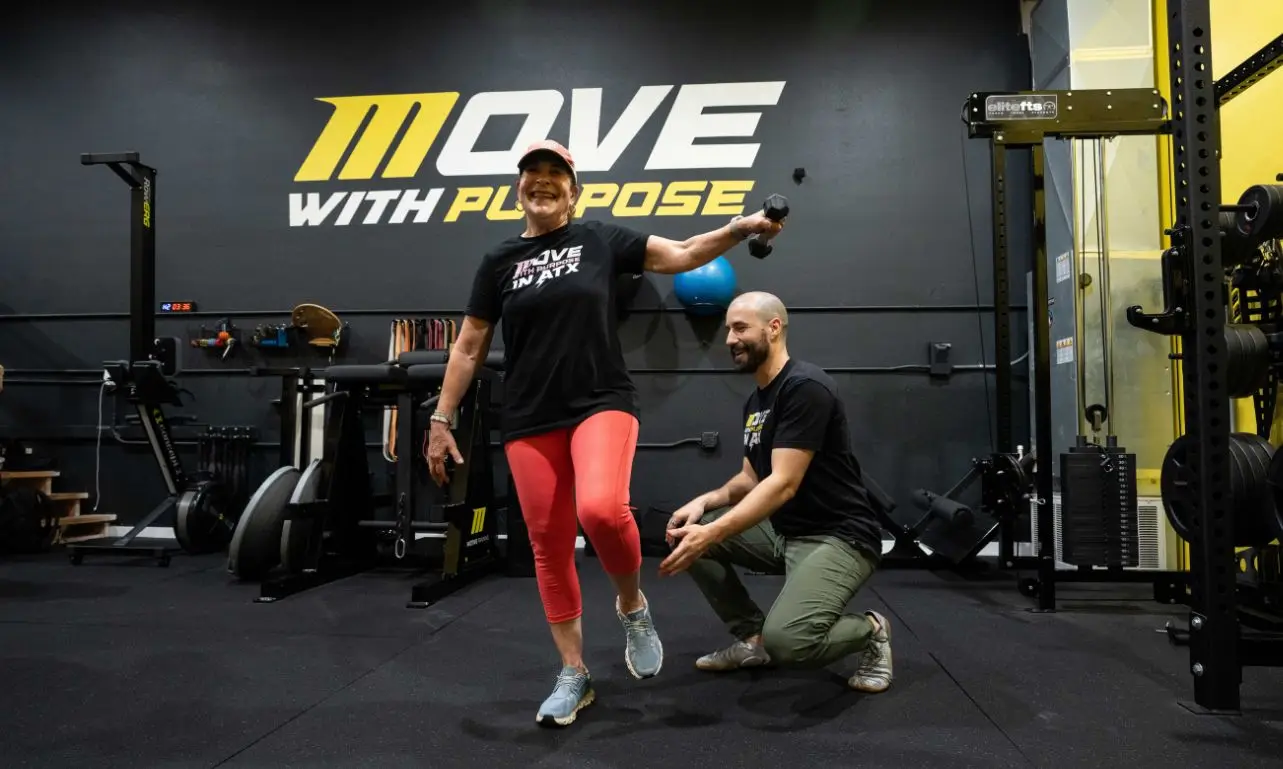
The clients I have worked with in their sixties and seventies who move well are not the ones with the cleanest imaging. They are the ones who kept using their joints through the decade when everyone told them to be careful. Training after 60 is mostly a story about who stopped and who did not.
References
- Marriott KA, Birmingham TB. Fundamentals of osteoarthritis. Rehabilitation: exercise, diet, biomechanics, and physical therapist-delivered interventions. Osteoarthritis Cartilage. 2023
- Exercise Therapy “Wears Down” My Knee Joint: Myth or Reality? J Orthop Sports Phys Ther. 2025
Written by

Brian Murray, FRA, FRSC
Founder of Motive Training
Motive Training is a coaching studio in South Austin built around assessment, joint health, and strength you can use. Train with us in the studio, come to a KINSTRETCH class, or work through the progressions in KINSTRETCH Online.