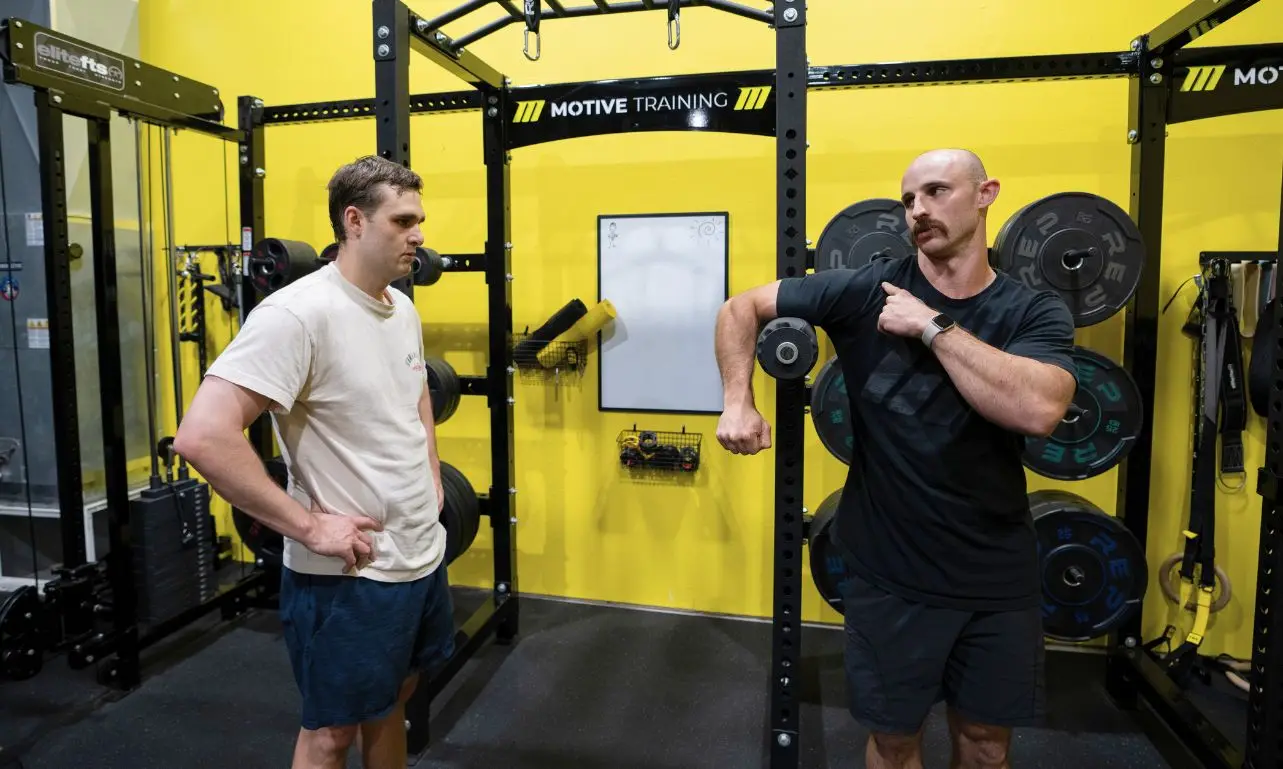
Shoulder internal rotation is the upper arm turning inward in the socket. With your elbow bent at your side, it’s the forearm swinging across your stomach. With the arm out to the side at shoulder height, it’s the hand rotating down toward the floor. You use it to reach behind your back, tuck in a shirt, fasten something at the small of your back, and finish a throw. And in my experience it’s the rotation people lose first, usually without noticing until they try to scratch between their shoulder blades and find their hand stops at the belt line.
How you measure it shapes what you think is wrong, so start there.
Two ways to measure it, and why they disagree
The common version is functional: reach one hand up behind your back and see how high the thumb gets along the spine, then compare sides. It’s useful because it’s a real task. It also mixes several things together. Reaching behind your back takes shoulder extension, internal rotation, elbow bend, and a lot of shoulder blade movement, so a person can score well by tipping the shoulder blade forward and a person can score poorly because of an elbow or a shoulder blade problem, with internal rotation itself fine.
The more specific version isolates the joint. Lie on your back with your upper arm out to the side at shoulder height, resting on the floor, and the elbow bent to 90 degrees so the forearm points at the ceiling. Put your other hand on the front of the shoulder you’re testing. Now let the forearm rotate forward toward the floor, palm heading down, and stop the moment you feel the front of the shoulder start to lift into your hand. That lift is the shoulder blade tipping forward to give you more range. Where the forearm is when the lift starts is your internal rotation at the joint.
Do the same for external rotation (forearm rotating back toward the floor behind you) on both sides. Clinicians measuring throwing athletes use essentially this setup, with the shoulder blade held down at the front (1).
When the behind-the-back reach looks fine and the floor test is limited, the shoulder blade is covering for the joint. When both are limited, there’s less covering going on. Either way you’ve learned something the reach alone couldn’t tell you.
Why the total arc matters more than one number
Internal rotation rarely means much on its own. The useful number is the total arc, internal plus external rotation, compared side to side.
Throwers show why. A pitcher’s throwing shoulder usually has more external rotation and less internal rotation than the other side. Part of that is bone; years of throwing while young change the twist of the upper arm bone itself (humeral retroversion), which shifts the whole arc toward external rotation without shrinking it. In one CT study of professional pitchers, the throwing side showed that bony shift, more external rotation, and less internal rotation, while total rotation matched between sides (2). That loss of internal rotation is an adaptation, and trying to “fix” it with stretching misses what’s happening.
The arc shrinking is a different story. In a three-season study of professional pitchers, those whose total rotation on the throwing side was more than 5 degrees short of the other side had a higher injury rate; pitchers with a large internal rotation deficit were nearly twice as likely to be injured, though that comparison didn’t reach statistical significance (1). That’s an association in elite pitchers, so I wouldn’t map it straight onto a recreational lifter. What carries over is the habit of looking at both rotations together, and comparing sides, before deciding internal rotation is the problem. The throwing side of this is covered in more depth in mobility training for throwing athletes.
What limits shoulder internal rotation
Bony anatomy sets the outer limit, as above. Inside that limit, the usual suspects sit at the back of the shoulder: the posterior capsule, the posterior rotator cuff (infraspinatus and teres minor), and the back of the deltoid. All of them lengthen as the arm turns in, and all of them adapt to the positions the arm spends time in.
The shoulder blade matters too. When it sits tipped forward and wrapped around the ribcage, the socket faces a slightly different direction and the arm runs out of room sooner. That’s part of why shoulder blade control belongs in this conversation; scapula training covers that side.
And then there’s the gap between what the shoulder can be pushed into and what you can produce on your own. Everyone has some gap; that’s how the nervous system works. The FRC standard is active range within about 85 percent of passive, and a shoulder well short of that in internal rotation is a shoulder worth training, because the active number is what shows up when you reach, throw, or catch yourself.
The sleeper stretch
The sleeper stretch is the best internal rotation stretch I know of, and it’s how we stretch the shoulder capsule at Motive. You lie on the side you’re stretching, upper arm out in front of you at shoulder height with the elbow bent to 90 degrees, and use the other hand to ease the forearm down toward the floor. Lying on the shoulder holds the shoulder blade in place, so the rotation has to come from the joint itself, which is exactly where the posterior capsule lives.
Setup decides how well it works. Roll back slightly so you aren’t lying squarely on top of the shoulder blade, keep the elbow at shoulder height, and let the stretch land at the back of the shoulder. If you feel a pinch at the front of the joint, adjust the roll or ease off; that’s the shoulder telling you the position needs work, and forcing through it won’t help.
The research comparing the sleeper stretch to other posterior shoulder stretches is small and split, with some trials favoring the cross-body stretch and others finding the two about equal. In practice, nothing else gets at the capsule as directly. I walk through the setup in more detail in this piece for EliteFTS, which comes at internal rotation from the bench press.
A stretch on its own only gets you so far. It opens the range; loading the range is what lets you keep it and use it.
How to train internal rotation at end range
Start with shoulder CARs. Slow, full circles of the arm with the ribcage held still, paying attention to the part of the circle where the arm turns inward behind you. That’s usually where the circle flattens or the trunk starts helping.
Then load the sleeper position with isometrics. Set up as above and ease into your limit, spending a couple of minutes there. Then press the forearm back up toward the ceiling against your other hand, building effort gradually, so the tissue at the back of the shoulder works at its longest. Then try to rotate further toward the floor using your own muscle, with the hand only following. The mechanism and the progression are in the PAILs and RAILs breakdown, and the video below shows the setup in the sleeper position.
The same sequence works lying on your back with the shoulder blade held down, which is a good option if lying on the shoulder bothers you.Then build active range behind the back. Stand with the back of your hand resting on your low back, elbow bent. Lift the hand a few inches off your back without moving the elbow or the shoulder blade, and hold it there. Most people can barely clear the shirt. That small lift is internal rotation produced at end range, and it’s the version the behind-the-back reach depends on.
Then put it to work. A band or cable anchored at elbow height lets you train internal rotation through the full range with the elbow at your side, and later with the arm out at shoulder height. Go slow at the inward end, where the range is new. From there it has to show up in the movements you train, pressing included.
External rotation deserves the same attention, since the arc is what matters. The free class on shoulder external rotation works that side, and internal rotation work inside KINSTRETCH Online follows the progression above.
If it hurts to turn your arm in
A lot of people searching this topic aren’t curious about range; it hurts when they turn the arm inward. Pain into internal rotation has several possible sources, and the range numbers above can’t tell you which one is yours. If turning in hurts, especially with a pinch at the front or top of the shoulder, night pain, weakness, or a recent injury, get it evaluated before training into it.
Frozen shoulder is its own condition, with a capsule that tightens in every direction and a long, staged course; it calls for a different plan, which we laid out in the frozen shoulder piece. The work in this article is for a shoulder that has lost internal rotation and is otherwise ready to train.
References
- Wilk KE, Macrina LC, Fleisig GS, et al. Correlation of glenohumeral internal rotation deficit and total rotational motion to shoulder injuries in professional baseball pitchers. Am J Sports Med. 2011;39(2):329-335. https://doi.org/10.1177/0363546510384223
- Crockett HC, Gross LB, Wilk KE, et al. Osseous adaptation and range of motion at the glenohumeral joint in professional baseball pitchers. Am J Sports Med. 2002;30(1):20-26. https://doi.org/10.1177/03635465020300011701
Written by

Brian Murray, FRA, FRSC
Founder of Motive Training
Motive Training is a coaching studio in South Austin built around assessment, joint health, and strength you can use. Most clients start with the Movement & Mobility Assessment. From there, train with us in the studio, come to a stretching class, or work through the progressions in KINSTRETCH Online.