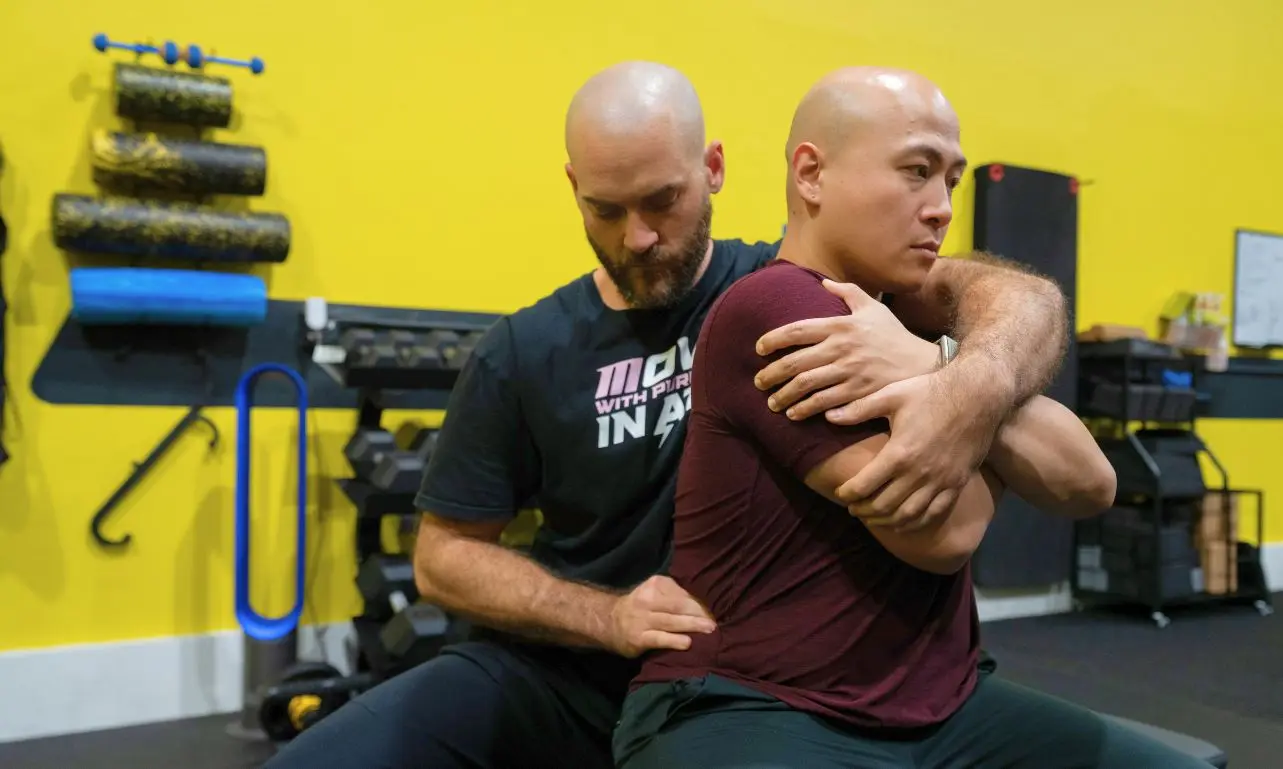
Ask most people what they do for their upper back and you’ll hear about a foam roller. They lie across it, arch back over it, and work up and down the spine. That’s extension, and it’s worth training. It’s also a different job from rotation, and plenty of people with a decent arch over the roller can barely turn their ribcage without their hips coming along.
Rotation deserves its own attention, and it also sits on top of the other motions of the spine. If the spine can’t flex and extend well, segment by segment, it can’t rotate well either. That’s how the spine works. So the path to better rotation starts somewhere most people don’t expect, and it ends with training the turn itself.
Where trunk rotation comes from
When you twist to look behind you, the motion is spread across a lot of joints at once: the hips, the lumbar spine, the thoracic spine, the neck, and the shoulder blades sliding around the ribcage. Each contributes, and they don’t contribute equally.
The thoracic spine does most of the spinal part. In one study that used CT scans to track each vertebra during maximal trunk rotation, the thoracic spine from top to bottom rotated about 25 degrees to each side, with the largest amounts per segment in the middle and lower thoracic levels, roughly T6 through T11 (1). Each segment only contributed a couple of degrees. The total comes from a dozen small joints adding up.
The lumbar spine has much less to give. A similar in vivo study found lumbar segments rotating somewhere between about half a degree and two degrees each (2). The orientation of the lumbar facet joints favors bending forward and back, and they limit twisting fairly early. So when the thoracic spine runs short on rotation, the low back is a poor place for the rest of the turn to come from, and the hips usually end up doing more of it.
That’s the useful takeaway from the anatomy. Thoracic rotation is a distributed range, built out of many small segmental motions, and it can quietly go missing without any single segment feeling stuck. Restrictions in the upper back often show up as complaints somewhere else, in the neck, the shoulder, or the low back, which is one reason I want to measure the thoracic spine directly before guessing.
How to test it without the hips cheating
The trick to testing thoracic rotation is taking the pelvis and lumbar spine out of it. Two simple versions work.
For the seated test, sit tall on a bench or the edge of a chair with your feet flat and a yoga block or a rolled towel squeezed between your knees. The squeeze keeps the pelvis from turning. Cross your arms over your chest, hands on opposite shoulders, and rotate as far as you can to one side, then the other. Note how far your shoulders turn relative to the front of the room, and compare sides.
For the quadruped test, get on hands and knees and sit your hips back toward your heels. Sitting back flexes the lumbar spine, which takes much of its rotation away. Put one hand behind your head and rotate that elbow up toward the ceiling, following it with your eyes, then switch sides.
Watch for three common cheats. The hips shift or the knees slide. The head turns first and drags the trunk after it. The shoulder blade squeezes back, which moves the elbow a long way while the spine barely turns. If any of those happen, back off until the motion comes from the ribcage.
Flexion and extension come first
Rotation in the thoracic spine happens through the same small joints that produce flexion and extension, and those segments have to move before they can turn. A segment that’s stuck in flexion or can’t extend has very little rotation to offer. That’s why we train segmentation before we chase rotation: getting the spine to flex and extend one level at a time, from the top down and the bottom up, so each segment is available to contribute when the turn comes.
Extension work fits in here, and the thoracic extension piece is worth reading alongside this one. Arching over a foam roller is a crude version of it, though, because the roller moves you passively and lets the stiffest segments hide. Segmentation asks you to produce the motion yourself, level by level, which is what rotation will ask of those same segments later.
Control is the other half. Plenty of people can turn their trunk a long way by throwing themselves into it. Ask them to turn slowly, holding the end of the rotation with their own muscle, and the range shrinks. That’s the version that holds up when a golf swing or a throw asks the trunk to rotate fast and stop on time. The video below walks through what we train before chasing more degrees of rotation.
How to train thoracic rotation
Start with segmentation. Segmentation drills ask the spine to flex and extend one level at a time, rolling down and back up through each vertebra. They’re slow and a little humbling, and they build the segmental control that lets rotation come from a dozen thoracic levels instead of two or three. We cover the full approach in spinal segmentation training.
Then add thoracic CARs. Sitting or standing with the pelvis locked in place, move the ribcage slowly in a full circle, through flexion, side bend, extension, and rotation, without letting the hips or neck take over. It’s harder than it sounds, and the places where the circle gets jagged are where to spend time.
Then load the end of the range. From the quadruped position with the hips sat back, rotate as far as you can and hold. Press the elbow back down toward the floor against your own resistance, building effort gradually, so the tissue limiting the turn has to work at its longest. Then try to rotate a little further on your own. A side-lying version, with the top knee pinned down by a block and the top arm reaching back, works the same idea with gravity helping.
Then rotate under load and at speed. Range that exists only on the floor won’t do much for a swing. Cable or band rotations, landmine work, and med ball throws ask the trunk to produce and stop rotation, and that’s where the work has to end up. Coiling is one of the ways we load rotation at this stage, once the spine moves well enough to give it something to work with. Rotational strength training gets into how to build that side of it.
Segmentation and CARs can happen daily. The end-range holds and loaded rotation fit two or three times a week. Retest with the seated or quadruped check every few weeks, always the same way.
Golfers, throwers, and desk workers
Golf is the obvious case. A good swing depends on the trunk turning separately from the pelvis, and that separation depends on thoracic rotation that’s available and controlled. When it isn’t there, the turn has to come from somewhere, and the lead hip and the low back usually pick up the slack. We break down the rest of the golf picture in mobility training for golfers.
Throwers have the same need, with the added demand that the trunk has to decelerate after release. Rotation you can produce and stop on your own is a big part of what keeps the arm from absorbing all of it.
Desk work is the quieter case. Sitting rarely asks the trunk to rotate at all; when you turn toward a second monitor, the neck usually does the work while the ribcage stays square to the desk. Hours of that each day leave the thoracic spine with very little rotation practice, which is part of what sitting all day does to a body. A few minutes of thoracic CARs between meetings is a small dose, and it’s a dose most desk workers aren’t getting anywhere else. If you want the full progression laid out as guided classes, it’s inside KINSTRETCH Online.
References
- Fujimori T, Iwasaki M, Nagamoto Y, et al. Kinematics of the thoracic spine in trunk rotation: in vivo 3-dimensional analysis. Spine (Phila Pa 1976). 2012;37(21):E1318-E1328. https://doi.org/10.1097/BRS.0b013e318267254b
- Ochia RS, Inoue N, Renner SM, et al. Three-dimensional in vivo measurement of lumbar spine segmental motion. Spine (Phila Pa 1976). 2006;31(18):2073-2078. https://doi.org/10.1097/01.brs.0000231435.55842.9e
Written by

Brian Murray, FRA, FRSC
Founder of Motive Training
Motive Training is a coaching studio in South Austin built around assessment, joint health, and strength you can use. Most clients start with the Movement & Mobility Assessment. From there, train with us in the studio, come to a stretching class, or work through the progressions in KINSTRETCH Online.