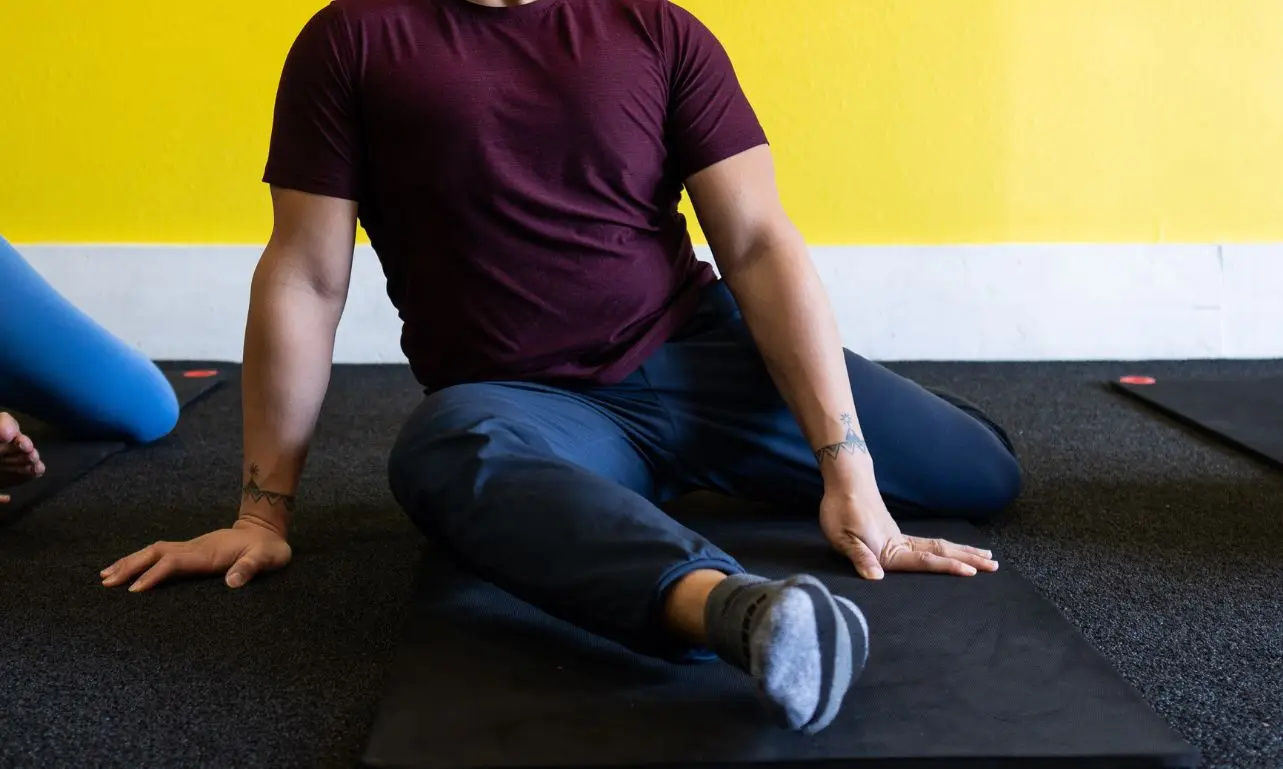
Sit on the edge of a table with your knees bent and let one foot swing inward, across toward the other leg. The foot travels in while the thigh bone turns outward in the socket. That’s hip external rotation. It’s the front leg in a 90/90 sit, the leg you pull up into a figure four, and a big part of what the hip does when you pivot on a planted foot.
External rotation gets less attention than internal rotation, and it’s easy to assume it’s fine. Sometimes it is. Sometimes one side has plenty and the other has very little, or the range is there when someone moves the leg for you and the hip can’t produce any force at the end of it. You find out by measuring, and the measurement makes the most sense next to its partner, hip internal rotation.
How it gets measured
We measure it in two positions, seated with the hip bent and face down with the hip straight. The capsule and the muscles around the hip sit differently in each, so the two numbers don’t always agree, and a hip that looks fine seated can come up short lying down.
Then come the comparisons. Left against right. Active against passive, where the working standard in Functional Range Conditioning is active range within about 85 percent of passive; everyone has some gap, and a big one is what we’re looking for. And external against internal rotation on the same hip. Together those two make up the hip’s total rotation arc, and two hips with the same total can split it very differently.
Most of the skill in testing rotation is catching the compensations. The pelvis rolls, the trunk leans, or the knee slides sideways so the shin looks like it’s rotating further than the thigh is. Any of those borrows range from somewhere else and makes the hip look better than it is.
What limits it
Bone shapes the arc. The angle of the femoral neck relative to the shaft (femoral version) tends to shift the whole rotation arc one way or the other. A femur with more anteversion usually has generous internal rotation and less external; a femur with less anteversion, or retroversion, tends toward the opposite. Training doesn’t move that structure, which is why the side-to-side and active-to-passive comparisons tell you more than any norm.
The capsule and ligaments come next. The front of the hip capsule and the ligaments that reinforce it tighten as the femur turns outward, so a hip that’s lost access to that position over the years can feel blocked at the front.
Then the muscles that resist the outward turn: the front fibers of the glute medius and minimus, the TFL, and depending on hip position, some of the adductors. They can limit range by being short or by staying guarded.
And control. The nervous system decides how much of the passive range you get to use, and it holds back in positions where you’ve never produced force. The active-against-passive gap is where that shows.
From the outside you usually can’t tell which of these is the limit, and imaging only gives clues. That’s why the measuring and retesting matter more than a guess about the cause. If the range opens with training, the limit wasn’t bone. If it doesn’t, the hip still gets stronger in the range it has.
Hips with too much
Some people have a lot of external rotation and very little internal rotation, often on the same hip. In that hip the internal rotation side of the arc is where the work goes. The measurement is what tells you which way the work should lean, which is why we never pick a direction without measuring both.
What training has to do
The structure is the same one we use for internal rotation, from Functional Range Conditioning. Daily CARs keep the joint moving through its whole circle and show where the outward turn gets jagged or the pelvis starts helping; the CARs guide covers them.
The end of the range gets loaded with isometrics: contracting the tissue that resists the outward turn while it’s lengthened, then working to turn further out with nothing helping. The programming guide for PAILs and RAILs covers how that’s dosed. The front leg of a 90/90 is the common position for it, though not everyone’s hips, knees, or low back can get into a good 90/90, and the position matters less than the hip being near the end of its turn and able to work there.
Then the hip has to produce force at the end of the range on its own. Those holds are small and hard, and they often cramp. The cramp is the hip being asked to work somewhere it hasn’t before, which is the reason for doing them; there’s more on that in isometric training at end range. Last, external rotation has to show up on one leg and under load, because that’s where the hip uses it.
Retesting
Retest every few weeks in the same positions, and test internal rotation at the same time so you can see the whole arc change. Watch the active number. It moves slower than the passive one, and it’s the one that tells you the hip can use what it has.
If you want the measuring done for you, that’s what the Motive Movement and Mobility Assessment is for. For guided rotation work at home, KINSTRETCH Online runs both directions through its classes.
Written by

Brian Murray, FRA, FRSC
Founder of Motive Training
Motive Training is a coaching studio in South Austin built around assessment, joint health, and strength you can use. Most clients start with the Movement & Mobility Assessment. From there, train with us in the studio, come to a stretching class, or work through the progressions in KINSTRETCH Online.