Most people who tell me their hip flexors are tight are probably right. Sitting for most of the day keeps the hip bent for hours at a time, and the front of the hip adapts to the position it spends its time in. Where it falls apart is the stretch. The hip flexors are hard to get into, and the kneeling lunge stretch most people learned is easy to set up in a way that puts the stretch almost anywhere but the hip.
That’s why people can do the same stretch for years and feel about the same. They feel a pull every time, so it seems to be working, and very little of it is happening at the joint they’re trying to change.
Why the hip flexors are hard to stretch
Hip extension is a small motion. It’s usually quoted somewhere around 10 to 20 degrees, which surprises people, and in a stiff hip it can be less than that. The lumbar spine, sitting right above it, can extend a lot further. So when you try to take the thigh behind you, the body has an easy alternative: tip the pelvis forward and arch the low back, and the leg ends up behind you without the hip extending much at all.
The anatomy makes that trade easier. The psoas attaches along the lumbar spine, so an arching low back gives it slack from the top end at the same time the stretch is trying to lengthen it from the bottom. The front of the hip capsule tightens as the hip extends, and a pelvis tipped forward takes that tension away too. You end up with a strong sensation somewhere in the front of the hip or the thigh, and the tissue you meant to lengthen sits in about the same position it was in when you sat down.
“Hip flexors” also covers several muscles, and they don’t all respond to the same setup. The iliacus and psoas cross only the hip. The rectus femoris crosses the hip and the knee, so it only gets put on length when the knee is bent as the hip extends. The tensor fasciae latae (TFL) on the outside front of the hip also pulls the thigh out to the side, so it shows up when the thigh is held in line. A stretch that suits one of them can miss the others entirely.
Where the setup goes wrong
The pelvis is the big one. It tips forward the moment the hip runs out of extension, and it does it quietly, so most people never notice. Once it tips, the front of the hip goes slack and the low back takes the load.
The ribs follow the pelvis. When they flare up and forward, the low back is arching, whatever the hips are doing.
The weight drifts into the front knee. Lunging further forward feels like going deeper, and past a point it mostly adds bend to the front knee and ankle while the back hip stays where it was.
The back leg turns out. Rotating the back thigh outward is an easy way to find a little more room, and it takes the stretch off the tissue in front.
Each of these is easy to fix with someone watching and hard to catch on your own, because every one of them still produces a stretch you can feel. If you want the longer version of the setup itself, why your hips are always tight walks through the half-kneeling position. If kneeling bothers your knee, the bench version of the couch stretch puts the hip in the same place.
Knowing which one you’re stretching
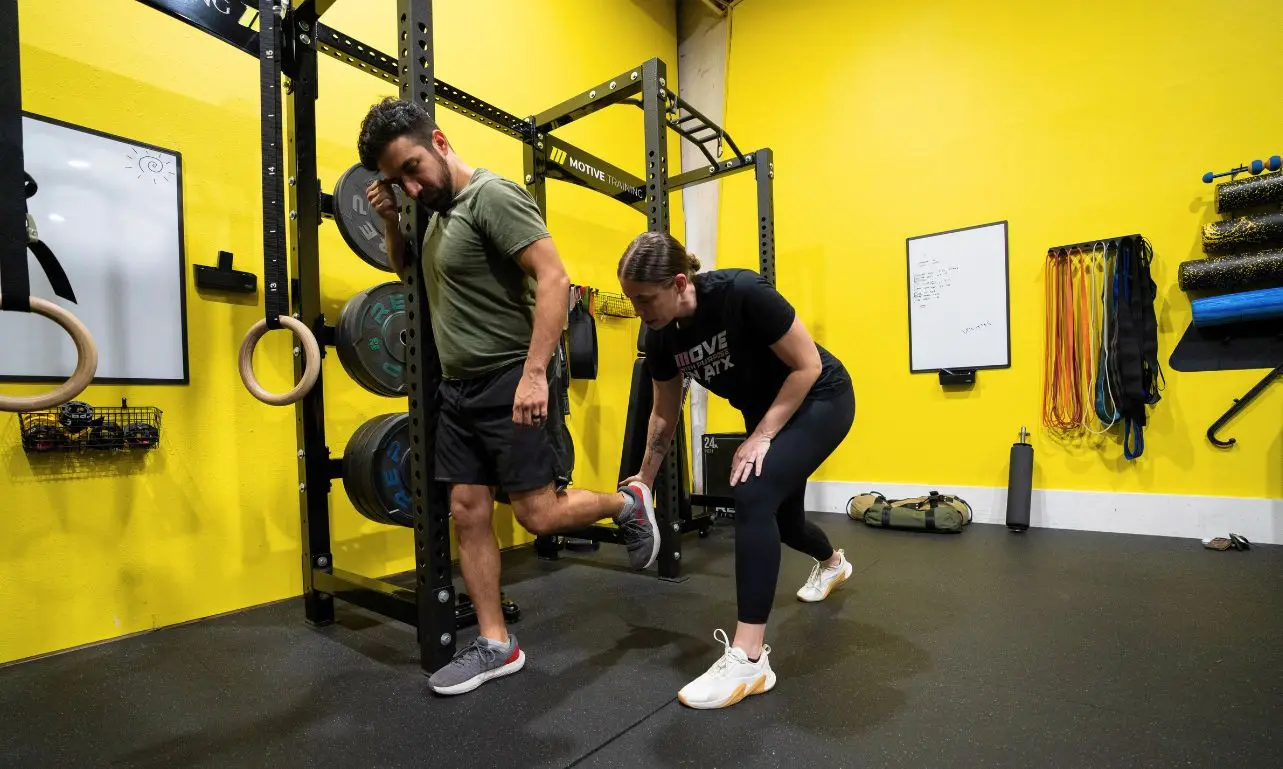
We test hip extension with a version of the Thomas test, where the low back is held flat so it can’t arch and fake extra hip range while one leg hangs free. If the thigh stays up with the knee relaxed and bent, the iliopsoas or the capsule is the likely limit. If the knee kicks straight as the thigh drops, the rectus femoris is running out of length and borrowing slack from the knee. If the thigh swings out to the side, the TFL is usually part of it. Most people show some mix, and the two sides rarely match, so the stretch that fits your left hip may not be the one your right hip needs.
Why even a good stretch fades
A held stretch mostly raises how much stretch you’ll tolerate. That fades once you stand up and walk around, because nothing in the stretch gave the nervous system a reason to keep allowing the range.
There’s always a gap between the range someone can push you into and the range you can produce yourself; that’s how the nervous system works. The working standard in Functional Range Conditioning is active range within about 85 percent of passive, and hip extension makes the gap easy to see, because the low back takes over the moment the hip runs out. A hip that can be pushed into extension but can’t get there on its own tends to stay guarded at the end of its range, and guarding feels a lot like tightness. I made the longer case in the post on psoas muscle pain.
So the stretch is where the work starts. Once the position is set up so it reaches the hip, the tissue being lengthened gets asked to contract there, and then to pull the hip further into extension with nothing helping. Those are PAILs and RAILs, explained in the PAILs and RAILs post, and they’re how a range you can be pushed into becomes one you can use.
This is also the part that’s hard to learn from a page. Setting up the hip flexors well is something we coach in person, and it’s a regular part of KINSTRETCH Online classes if you’d rather work at home.
Written by

Brian Murray, FRA, FRSC
Founder of Motive Training
Motive Training is a coaching studio in South Austin built around assessment, joint health, and strength you can use. Most clients start with the Movement & Mobility Assessment. From there, train with us in the studio, come to a stretching class, or work through the progressions in KINSTRETCH Online.