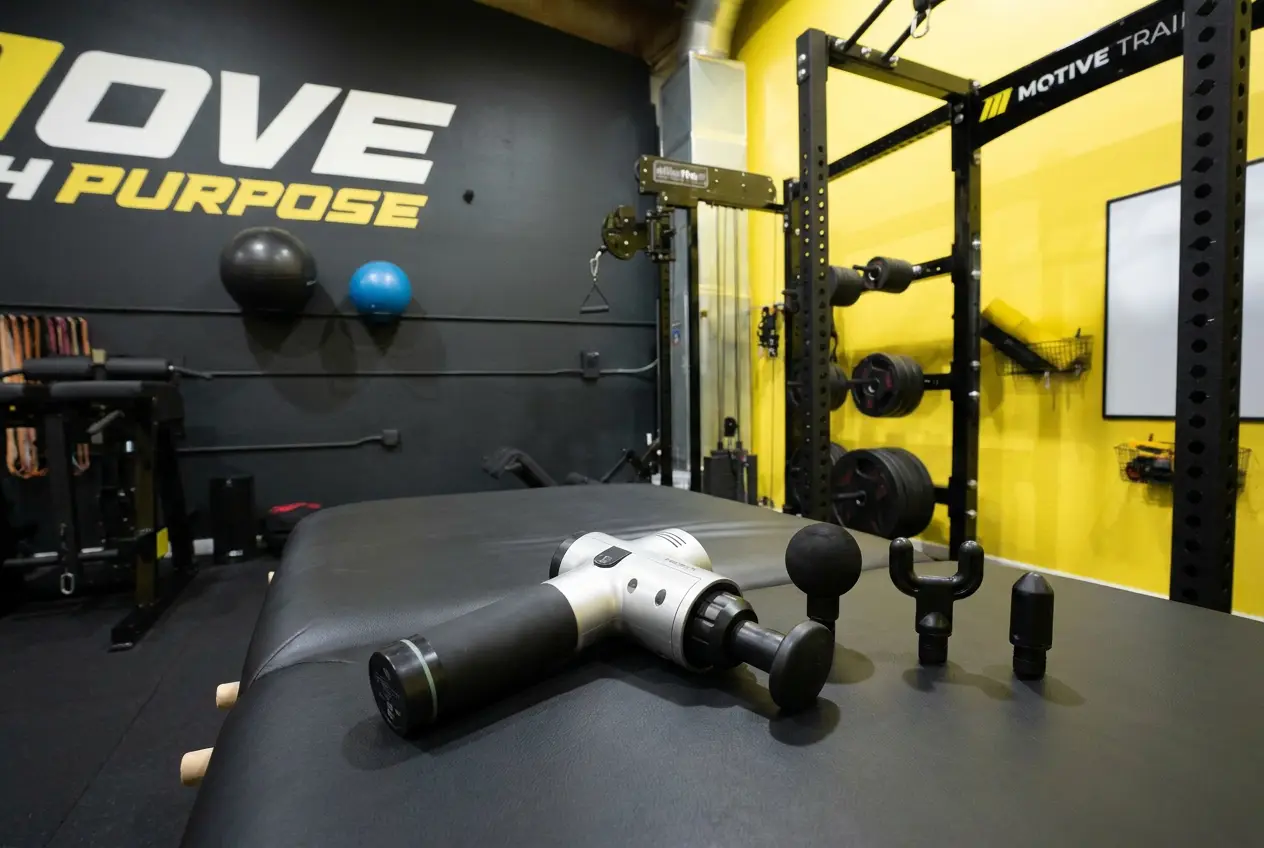
There’s a massage gun sitting on the treatment table at Motive right now. Clients ask for it. Coaches reach for it between sets. It does something, which is more than most recovery gear earns before it ends up in a drawer somewhere. The question worth asking isn’t if it works. It’s what it changes, how long that change sticks around, and where the whole approach hits a wall. That last part is where most of the marketing stops, and it’s the part that matters most.
What the device is changing
A percussion gun fires rapid, repeated strikes into a muscle at a set frequency, somewhere between 20 and 50 hertz depending on the setting. That pattern doesn’t shift based on what it meets. It can’t. The device has no way to register if the tissue underneath is guarded, inflamed, restricted by a joint above or below it, or just sore from Tuesday’s squats. Pressure and rhythm stay fixed no matter what’s under the head of the device. What changes is the person holding it.
A 2023 study using a Theragun Pro on the hamstrings found a measurable effect after two minutes of use. Range of motion rose 11.4 percent. Tissue stiffness dropped by roughly 6 percent (1). Neither number is small. But the same study found no change in tissue elasticity, meaning the muscle wasn’t lengthening or becoming more pliable at a structural level. What moved was tone, and how the tissue registered on a stiffness sensor immediately after treatment, which points toward a nervous system response more than a mechanical one. That distinction decides how long the change lasts and what’s driving it while it does.
A separate trial compared a percussion device directly against static stretching for hamstring extensibility and found no meaningful difference between the two (2). Same category of result, produced by two tools built around entirely different premises. A device that costs several hundred dollars producing roughly the same acute change as thirty seconds spent holding a stretch puts both in the same bucket, and the stretching bucket has a well documented ceiling of its own. The gun just gets there with better marketing behind it.
What the cervical disc trial showed
The one place a percussion device has shown up inside a real clinical protocol, not a warm-up routine, is a 2024 trial on patients with cervical disc herniation. Researchers added vibration therapy through a percussion gun on top of standard physical therapy, heat, TENS, and supervised range of motion work, then compared that combination against the standard therapy alone (3). The vibration group came out ahead on pain during activity, a result worth taking seriously. The standard therapy group did better on one specific measure though: joint position sense, the body’s ability to know where a joint sits in space without looking at it. That’s not a small thing to lose ground on. Joint position sense is part of how a neck or a shoulder avoids getting hurt again once it’s back under real load.
Even in the setting where the device performed best, it was riding inside a program a clinician built and adjusted week to week. It wasn’t running the show. That’s a fair description of where a percussion gun belongs in general: an add-on inside something someone is actively managing, not a standalone plan. A short drop in tone before a session, a faster warm-up, a change in how a tight spot feels before loading it. All real uses. What the gun isn’t doing is finding anything, deciding anything, or shifting its approach based on what it runs into. It fires the same pattern into a hip flexor that’s been guarded for three years of desk sitting as it does into a calf that’s just tired from a long run, and it treats a mildly stiff shoulder the same way it treats one that’s badly locked up. That gap is worth sitting with before the device becomes the whole plan, and it’s the same gap that shows up with foam rolling, a legitimate pre-session tool that keeps getting asked to do a job nobody built it for.
The honest problem with finding things by feel
Before getting into what a trained hand can do that a device can’t, it’s worth being straight about where manual assessment struggles. A 2018 systematic review pooled six studies on how consistently different examiners agree on the exact location of a myofascial trigger point by palpation alone, and the agreement across examiners came back weak (4). Two skilled clinicians, same patient, same muscle, and they don’t reliably land on the same spot. A separate study on shoulder end-feel, the quality of resistance a joint gives right at the limit of its passive range, found something similar. Ratings from the same therapist across two different days held up reasonably well, with intraclass correlation coefficients between .58 and .89. Agreement between two different therapists examining the same patient was noticeably weaker (5).
That’s a real limitation, not a footnote to wave off. If the claim was that two practitioners can independently locate the exact same anatomical point on a stranger and land on the same conclusion, the research doesn’t support that, and nobody serious should build a service on pretending it does. But that isn’t the claim being made here, and it isn’t what happens in a treatment room. What happens in a treatment room is one practitioner, working with one client, tracking how the tissue under their own hand changes from the first minute of a session to the fifteenth, and from one visit to the next month later. That’s a different question than two strangers pointing at the same spot on a diagram. The reliability of a single trained hand tracking change in one person over time sits apart from the reliability of trigger point mapping across different examiners, and the end-feel research backs up that exact split. Same therapist, consistent results. Different therapists, weaker agreement.
What touch is reading that a fixed pattern can’t
Skin and the fascia beneath it carry a dense population of sensory receptors, and different receptor types respond to different kinds of input. Pacinian corpuscles fire off fast, rhythmic pressure and vibration. Ruffini endings respond to slow, sustained stretch and steady pressure, and their activation has been linked in fascia research to a drop in sympathetic nervous system tone (6). A percussion device, locked into one frequency, is built almost entirely to hit the Pacinian end of that range. It can’t slow down, hold, and shift into the kind of sustained pressure Ruffini receptors respond to, because slowing down isn’t a setting on the dial. A hand can move between both inside the same five minutes, based on what the tissue underneath it is doing.
That connects to a broader mechanism behind why non-painful touch changes pain perception at all. Gate control theory, first described by Melzack and Wall, holds that non-threatening sensory input carried by large, fast nerve fibers can inhibit painful signals carried by smaller, slower ones at the level of the spinal cord (7). Manual pressure, applied with intent and adjusted to what a practitioner is feeling for, is a direct way to trigger that gating mechanism. A fixed vibration pattern can trigger some version of it too, to be fair to the device. What it can’t do is shift toward whichever receptor population and whichever gating response the moment calls for, because it has no read on the moment at all.
What manual pressure changes, and what it doesn’t
It would be easy to write the rest of this as hands good, machine bad, and call it finished. That isn’t honest, and it isn’t what the research on manual work says either. A hand pressing into a muscle for ten minutes isn’t lengthening that muscle. Between skin and the fascia underneath sits a frictionless layer that lets skin slide over what’s beneath it, which is why a forearm can be rubbed without dragging the muscle around underneath it. Force applied across that surface mostly dissipates before it reaches anything structural. A hand can’t shear a hamstring into a new resting length any more than a percussion gun can, and claiming otherwise is the same overreach in a gentler package.
What manual work does appear to change is smaller and more specific than most of the marketing around it suggests. A small 2012 study in Science Translational Medicine took muscle biopsies from a group of men after exercise-induced muscle damage, massaging one leg and leaving the other untouched as a control. The massaged leg showed lower levels of inflammatory markers, activated cellular repair signaling, and a reduced stress response inside the muscle fiber (8). Eleven participants, one study, and it deserves the same caution any single study deserves before anyone builds a whole philosophy around it. But it’s a measured, cellular-level signal, not a feeling someone reported after the fact. That kind of finding doesn’t come from a fixed vibration pattern, because the tissue response appears to depend on the specific pressure, direction, and duration a hand applies and adjusts in real time. A device running the same pattern for everyone can’t reproduce variables it has no way to sense in the first place.
Reading the response in real time
Hands read tissue before deciding what to do with it, and that’s the real separation between the two tools. It has nothing to do with which one feels better in the moment. A trained hand moving across a muscle can tell guarding from actual restriction, a spot that needs held pressure from one that needs the joint moved through range under load, tissue that’s responding from tissue that’s protecting something further up the chain. Inside a session, a practitioner is watching for softening under the hand, a shift in temperature, spontaneous movement or release in the area being worked, and adjusting pressure and technique based on what shows up. None of that lives on a frequency dial. It’s a judgment call made and remade every few seconds, built on feedback a device doesn’t have access to.
That feedback loop is also where the safety margin lives. A 2021 case report in Physical Therapy documented a young woman who developed rhabdomyolysis, a serious breakdown of muscle tissue, after her coach ran a percussion gun over her thighs for what was supposed to be simple recovery work (9). She had undiagnosed anemia at the time, which nobody was checking for, because nothing in the process was built to check for it. A fixed pattern applied without a read on what’s underneath doesn’t know when to back off. A hand, guided by someone paying attention to how the tissue is responding, does.
Where Functional Release fits
Motive’s manual therapy work runs on exactly this premise. Functional Release is built to read tissue and adjust session to session, instead of running a fixed protocol on a timer. It’s designed to reduce tension where it shows up, rather than wherever a device happened to land, working from an assessment of what a specific joint or muscle needs that day instead of a routine applied the same way to everyone who lies down on the table. It sits inside the same assessment-first approach that shapes every program at Motive, training and manual work as two halves of one system rather than two offerings competing for the same hour. What a session looks like is laid out here, including why the tissue change has to be followed by active loading or the body doesn’t keep it.
The device isn’t the problem, and it never was. It stays on the table because it does something real, in a narrow lane, for a short window of time. The problem is asking it to do a job that requires a hand paying attention to what it finds and changing course because of it. No amount of frequency or amplitude closes that gap. Only attention does.
References
- The Acute Effects of Theragun Percussive Therapy on Viscoelastic Tissue Dynamics and Hamstring Group Range of Motion, PubMed, 2023
- The Comparison of Mechanical Percussion Therapy and Manual Stretching on Hamstring Length, International Journal of Sports Physical Therapy
- Effect of Local Vibration Therapy on Pain, Joint Position Sense, Kinesiophobia, and Disability in Cervical Disc Herniation: A Randomized Controlled Trial, MDPI Journal of Clinical Medicine, 2024
- Interrater Agreement of Manual Palpation for Identification of Myofascial Trigger Points: A Systematic Review and Meta-Analysis, PubMed
- Movement Diagram and End-Feel Reliability When Measuring Passive Lateral Rotation of the Shoulder in Patients With Shoulder Pathology, Physical Therapy, Oxford Academic
- Fascial Plasticity: A New Neurobiological Explanation, Part 1, Journal of Bodywork and Movement Therapies, 2003
- The Role of Descending Modulation in Manual Therapy and Its Analgesic Implications: A Narrative Review
- Massage Therapy Attenuates Inflammatory Signaling After Exercise-Induced Muscle Damage, Science Translational Medicine, 2012
- Rhabdomyolysis After the Use of Percussion Massage Gun: A Case Report, Physical Therapy, 2021
Written by

Brian Murray, FRA, FRSC
Founder of Motive Training
Motive Training is a coaching studio in South Austin built around assessment, joint health, and strength you can use. Train with us in the studio, come to a KINSTRETCH class, or work through the progressions in KINSTRETCH Online.