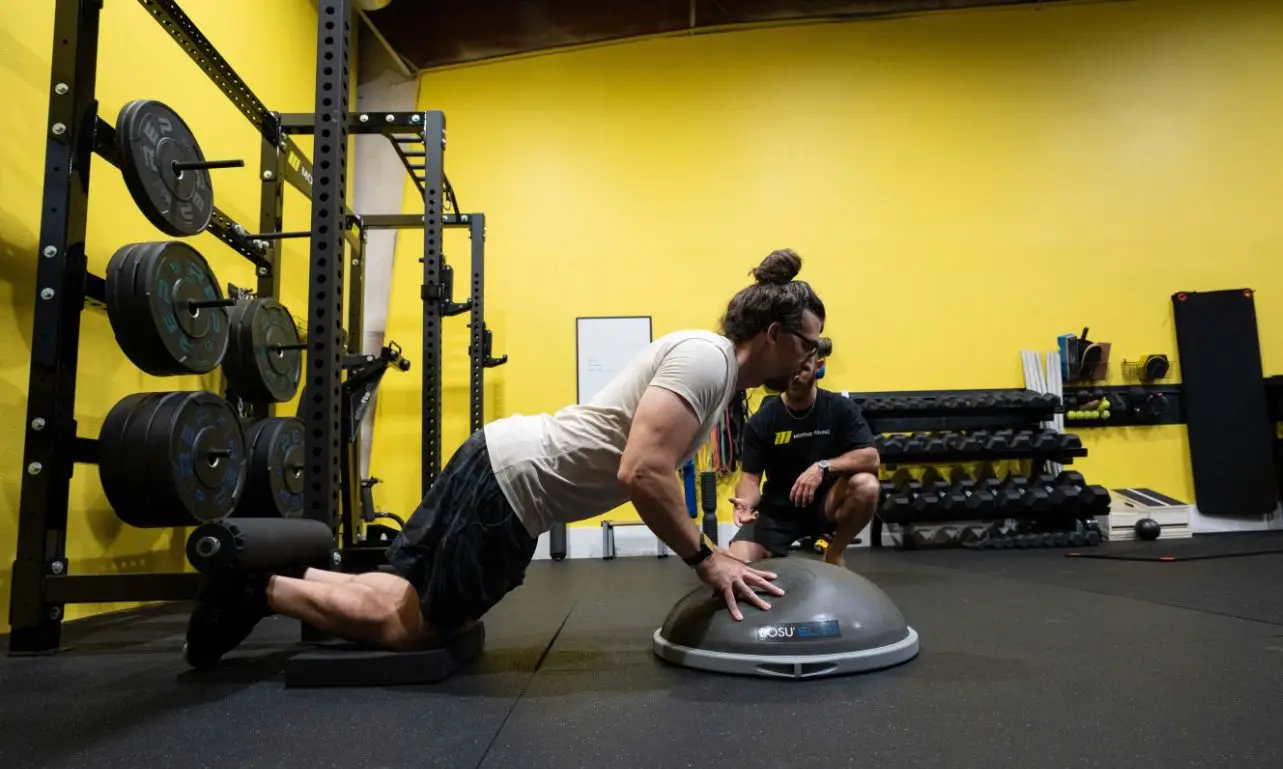
Golfers, pickleball players, cyclists, and runners rarely walk into Motive describing the same problem. One’s dealing with a hip that won’t clear on the downswing, another with a shoulder that aches after doubles, another with a stiff lower back on long rides, another with an IT band that flares up past mile six. Different sport, different complaint, same root cause almost every time: the range their sport demands and the range they’ve actually trained don’t match.
That gap is the reason sport-specific mobility work exists as its own category instead of just being “more stretching.” Every sport asks something particular of your joints, usually asymmetrically, usually at end ranges the sport itself never deliberately trains. Golf demands thoracic and hip rotation loaded through one side of the body thousands of times a season. Pickleball demands quick hip and ankle direction changes plus overhead shoulder control. Cycling locks the hips into a flexion-dominant position for hours and rounds the thoracic spine forward. Running asks the hips and ankles to absorb repetitive, asymmetric impact mile after mile. Playing the sport builds skill and conditioning fast. It doesn’t automatically build the joint’s ability to control the exact range that sport is asking for, and that’s the piece most training programs skip entirely.
The pattern underneath every sport
Whatever the sport, the mechanism is the same. A joint gets loaded into a big range by the demands of competition or practice, but nothing about that loading is deliberate strength training at the outer edge of that range. The nervous system treats a range it was pulled into differently than a range it has actual strength in. The first kind gets guarded, avoided under fatigue, or routed around through compensation somewhere else in the body. The second stays available even when you’re tired, under load, or moving fast. This isn’t a pattern specific to one sport. Climbers show a measurably lower external-to-internal shoulder rotation ratio than nonclimbers, built entirely by the sport’s own demand pattern (1). Tennis players with a history of shoulder pain show significantly more of the same kind of rotation asymmetry than pain-free players (2). Different sports, same shape of problem, because the mechanism doesn’t care what game produced the imbalance.
This is why generic warm-ups and stretching routines rarely solve sport-specific problems. A pre-round stretch or a few dynamic lunges before a ride raise tissue temperature and rehearse a pattern. They don’t teach a hip or shoulder that it can be trusted at the exact end range your sport requires, because nothing about a warm-up asks that joint to produce strength there in isolation. That’s a question worth sitting with on its own: our piece on how often mobility actually needs to be trained gets into why a warm-up and a real mobility practice aren’t the same category of work, even when they look similar from the outside.
Find the specifics for your sport
We’ve written sport-by-sport breakdowns because the details differ even though the underlying principle doesn’t. If golf is your game, our guide on golf mobility training in Austin covers the thoracic and hip rotation demands of the swing specifically. Pickleball players can go straight to mobility for pickleball players in Austin for the shoulder and lower-body patterns that sport creates. Cyclists dealing with the flexion-dominant posture that hours in the saddle builds should start with mobility training for Austin cyclists. And runners working through hip, ankle, or IT band issues will find the specifics in mobility for runners.
More sport guides are in progress as we work through the rest of Austin’s active population, since the principle holds for every activity even when the specifics change.
Where to start if you’re not sure what’s actually limiting you
Reading about your sport’s general patterns is a starting point, not a diagnosis. The hip that’s tight for a golfer and the hip that’s tight for a cyclist might be limited in completely different directions, and training the wrong one wastes months. A Functional Range Assessment evaluates exactly where your joints are limited, so the sport-specific work you do afterward is built around your actual restrictions instead of a general pattern that happens to apply to most people who play your sport.
References
- Wong EK, Ng GY. Strength profiles of shoulder rotators in healthy sport climbers and nonclimbers. Journal of Athletic Training, 2009
- Moreno-Pérez V, Moreside J, Barbado D, Vera-Garcia FJ. Comparison of shoulder rotation range of motion in professional tennis players with and without history of shoulder pain. Manual Therapy, 2015
Written by

Brian Murray, FRA, FRSC
Founder of Motive Training
Motive Training is a coaching studio in South Austin built around assessment, joint health, and strength you can use. Train with us in the studio, come to a KINSTRETCH class, or work through the progressions in KINSTRETCH Online.